Feeding Baby While Traveling: Real Tips + What You Actually Need
The idea of feeding a baby while traveling can feel really intimidating.
At home, you’ve figured out your flow, you have your routine, you’ve developed a rhythm. On the road, everything feels less predictable, especially when it comes to keeping a tiny human fed.
We’ve traveled with exclusively breastfed babies, combo fed, formula fed, and even NG tube fed. I’ve nursed on 14-hour international flights, flown with a 2.5-month-old, boiled bottles in apartment kitchens abroad, and baby-led weaned all three of our kids while traveling.
Here’s what I’ve learned. Babies exist everywhere. They all eat. Feeding baby while traveling is usually much simpler than we imagine.
You don’t need a suitcase full of gear. You need a simple plan, flexibility, and a few items that can make things easier.
Jump to: Nursing, Breastfeeding and bottles, Formula and milk, Feeding on an airplane, Feeding flexibility, Baby travel gear for feeding, Rentals, Not perfection, FAQs
Affiliate Disclosure: Familee Travel contains affiliate links and is a member of the Amazon Associates Program, we may earn commissions from qualifying purchases at no additional cost to you.
In a rush? Pin this or email it to yourself to read later! (Psst! Use the buttons at the very top or bottom of this post for ease.)
”, “BABY TRAVEL TIPS”, “FEEDING BABY WHILE TRAVELING”, and “HOW TO FEED YOUR BABY ON A TRIP”.](https://www.famileetravel.com/wp-content/uploads/2018/05/Pinterest-pin-Baby-feeding-while-traveling-hand-broccoli.webp)
Exclusively Nursing While Traveling
If your baby is exclusively nursing, feeding while traveling doesn’t get much easier. And this is one of the reasons some parents find traveling with younger babies easiest.
When we flew with our first baby at 2.5 months old, he was exclusively nursing. I’ve done 13 to 14 hour international flights that way to Istanbul, Tokyo, and Singapore without bringing a single bottle.
Logistically, nothing really changes. No need to pack food. No need to wash bottles. You just feed your baby wherever you go.

On airplanes, I nurse during takeoff and landing to help with ear pressure. Beyond that, I feed on demand. Travel days are already overstimulating, so I don’t try to control feeding more than usual.
The biggest shift tends to come during the distracted nursing stage, usually around 4 to 8 months. Suddenly, everything is more interesting than eating.
That’s when I make sure to have a nursing cover.
Not out of obligation, but because it creates a visual boundary. It can help baby focus long enough to get a full feed instead of constantly unlatching.
Nursing also felt more normal around the world than I expected. Even in places often described as more modest, like Egypt or Japan, I felt less self-conscious than I sometimes did in parts of the U.S.

That said, it’s still worth being aware of local norms and expectations.
While you can breastfeed in most places, some destinations are more modest culturally, and covering up or finding a more private space is more typical. In Japan, for example, breastfeeding is widely accepted, but it’s common to use baby care rooms in train stations, malls, and public spaces rather than nurse openly.
It’s less about restriction and more about respecting the local culture. Having a nursing cover or knowing where to find these spaces gives you flexibility to adapt as needed.
In many larger or more modern airports, you can also find dedicated nursing and pumping rooms, or private pods like Mamava, which give you a quiet space if you prefer not to feed in the open.
If you’re exclusively nursing, you may find travel simplifies feeding rather than complicates it.


Breastfeeding and Bottles While Traveling
Sometimes feeding while traveling is a mix of nursing, pumping, and bottles.
We’ve traveled that way too.
I’ve pumped while traveling, brought expressed milk, used coolers in transit, and relied on hotel fridges once we arrived. It adds logistics, but it’s manageable with a simple system.
If you’re pumping while traveling, here’s what matters most:
- Have a plan for storage in transit. A small insulated cooler with ice packs works well for flights and long travel days.
- Confirm your accommodations have a fridge. I always check this ahead of time.
- Keep pumping gear minimal. I don’t bring every accessory, just what I know I’ll use.
- Build in time. Travel days stretch routines. Give yourself margin to pump without feeling rushed.
If you’re traveling with expressed breast milk, TSA allows it in reasonable quantities, even beyond standard liquid limits. I keep milk separate in my carry-on so screening is straightforward.
One of the biggest advantages of combining nursing and bottles while traveling is flexibility. You can nurse when it’s convenient and use bottles when you need more predictability.
It does require more planning than exclusively nursing, but it’s still doable. A cooler, access to refrigeration, and a realistic schedule go a long way.

Formula, Milk, and Bottles While Traveling
Formula feeding while traveling adds another layer, but it doesn’t have to add stress.
When we used formula, it was for domestic travel in the U.S., and we planned to buy more at our destination rather than packing weeks’ worth. For longer international trips, I’ve seen this debated often. Bring enough from home or buy locally?
The honest answer is it depends on your baby.
If your baby has sensitivities or reacts poorly to changes, bringing enough of your exact formula for the entire trip may give you peace of mind. If your baby tolerates change well and you’re traveling somewhere with reliable grocery access, buying at your destination can make packing much easier.

This is also where age and stage matter more than most people think about ahead of time. Feeding looks very different at 3 months versus 12 months when you’re traveling.
When we traveled with formula or milk and bottles, here’s what actually mattered:
- Access to safe water. We boiled water rather than traveling with a sterilizer.
- A reliable place to wash bottles. This is why I prefer apartment-style stays when bottles are involved.
- Keeping transit simple. Pre-filled bottles of water and adding formula when ready to feed, or ready-to-feed bottles for travel days.
- Not overcomplicating storage. No elaborate systems, just clean bottles and a predictable routine.
Some parents prefer to use ready-to-feed bottles just for travel days. Not necessarily for the whole trip, but for flights and the first day or so after arrival. It simplifies things since you can feed and toss without worrying about measuring, mixing, or cleaning bottles in transit.
For flights, formula, breast milk, and baby food are considered medically necessary liquids in the U.S. and allowed in reasonable quantities through TSA. I keep them separate in my bag so screening is easier. If you need more details on navigating security and the airport, read my guide on traveling with baby bottles. For slightly older babies, flying with milk for a toddler can help.
The biggest thing is realizing you don’t need to plan for every possible scenario. You can simplify and still figure it out.

Feeding Baby on Airplanes
Airplanes are where feeding can feel the most stressful, but they’re also where feeding can help the most.
When our babies were younger, I always tried to nurse during takeoff and landing to help with ear pressure. Swallowing milk helps them acclimate to the pressure change. If they weren’t nursing, I offered a pacifier. As they got older, water or a small snack worked just as well.
On flights, I fed on demand, which was sometimes more often than usual. But travel days and airplanes are not usual scenarios.
I also nursed to sleep often. If takeoff was approaching and I knew sleep would help, I sometimes waited a few minutes so that feed could double as a calming, sleep-inducing moment. Like feeding, baby sleep while traveling may also look a little different than at home.

For babies eating solids, airplanes are not the time for full baby-led weaning meals. Tray tables are small. Turbulence happens. It gets messy fast.
This is where pouches help. We brought pouches specifically for flights because they’re contained, easy, and require minimal cleanup.
Maybe a few small bites of soft food can work, but not a full BLW spread where you let baby dive in to everything themself like you might at home. You can pack your own food to carry on, buy at the airport, or share your airplane meal with your baby.
On some long haul flights, certain airlines provided us with baby food pouches or baby food jars.

Silicone bibs are worth packing in your carry-on. It’s much easier to wipe down a bib than change an outfit mid-flight. Though, packing plenty of wipes and at least a couple of extra outfits is still a good call.
What I focus on during flights:
- Feed during pressure changes
- Keep solids simple
- Pack at least two extra outfits (depending on baby’s age and flight length)
- Expect routines to shift slightly
Flights are temporary. You can reset once you land.
If you’re planning a longer international flight, I go much deeper into routines, sleep, and logistics in my full guide to long haul flights with a baby.
How Feeding Flexes When You Travel
This is one of the biggest shifts when it comes to feeding baby while traveling.
At home, it’s easy to build a rhythm. Meals happen in the same chair, at the same times, in a familiar environment. Travel changes all of that.
For younger babies, this often matters less than you think.
Most babies rely primarily on breast milk or formula for nutrition until around one year old. If your baby is early in their solids journey, you may be able to simplify things for a short trip. For something like a one-week trip, it can be completely fine to scale back solids and lean more on milk feeds.
For older babies who are further along with solids, skipping them altogether probably won’t go over well. That’s where flexibility and baby-led weaning help.

Instead of preparing separate meals, your baby can eat modified versions of what you’re already eating. Many restaurants are happy to accommodate simple requests like plain eggs, avocado, fruit, plain meat or fish, or steamed vegetables if you ask.
The same goes for where and how your baby eats.
At home, your baby might always sit in the same high chair. While traveling, that setup will look different. Some restaurants have standard high chairs. Others have basic ones. Some have none at all.
We’ve been offered everything from sturdy wooden chairs to classic IKEA ones to homemade setups. Sometimes we just hold baby on our lap or keep them in the stroller next to the table.
That variability is part of travel.
Sometimes feeding doesn’t even look like a full sit-down meal. It might be fruit on a stroller snack tray while you’re out exploring, a pouch in the carrier, or a quick snack from a local stand along the way.

Feeding schedules can shift, too. You might aim to keep your routine, and sometimes that works. Other times, it doesn’t.
Between different environments, new stimulation, changing sleep, and time zone shifts, babies don’t always respond the same way they do at home. Trying to hold everything exactly the same can make things harder than they need to be.
In most cases, it’s easier to loosen your expectations and adjust in the moment.
Babies are more adaptable than we give them credit for. When you give yourself permission to be flexible, feeding while traveling becomes much more manageable.

Flying Long-Haul With a Baby?
If your baby is under one and you’re preparing for an international flight, start here.
Download the Calm Long-Haul Baby Guide — a practical carry-on checklist and sleep strategy framework built for the 0–12 month stage.
Plus, I’ll send one calm, useful email per month with real-world travel guidance.
You don’t have to figure this out alone.
The Baby Travel Feeding Gear We Actually Pack
You don’t need a suitcase full of feeding gear.
We switch what we bring depending on the trip, where we’re staying, and how old the baby is. These are the items that consistently earn space in our luggage.
Distraction and Privacy Support
Nursing Cover
I don’t always use a nursing cover at home, but I almost always travel with one.
Not because I feel pressure to cover, but because distracted nursing is real. Around 4 to 8 months, babies notice everything.
A lightweight nursing cover helps create a visual boundary so the baby can focus long enough to eat.
Depending on your destination, it can also provide modesty if that feels appropriate. It’s small, flexible, and solves a very specific problem.
Setup – Where Baby Sits
Portable Clamp High Chair
For longer stays, especially in a vacation rental or with family, we bring a clamp-style high chair like the Inglesina Fast Table Chair.
Not every destination has reliable high chairs, and not all are supportive for younger babies. This gives you a consistent setup.
It’s far from the most compact item, so we skip it for multi-stop trips. But for easy one-stop trips, longer stays, and places where we’ll regularly be eating in, it’s worth it.

Fabric Chair Cover – Portable High Chair
For other trips, a fabric chair cover is much more compact. It helps secure baby to a regular chair.
It doesn’t elevate baby, so it works better for containment than full self-feeding, but it keeps your baby secure at the table and saves you from holding them through an entire meal.
Mess Control – The Items That Save You
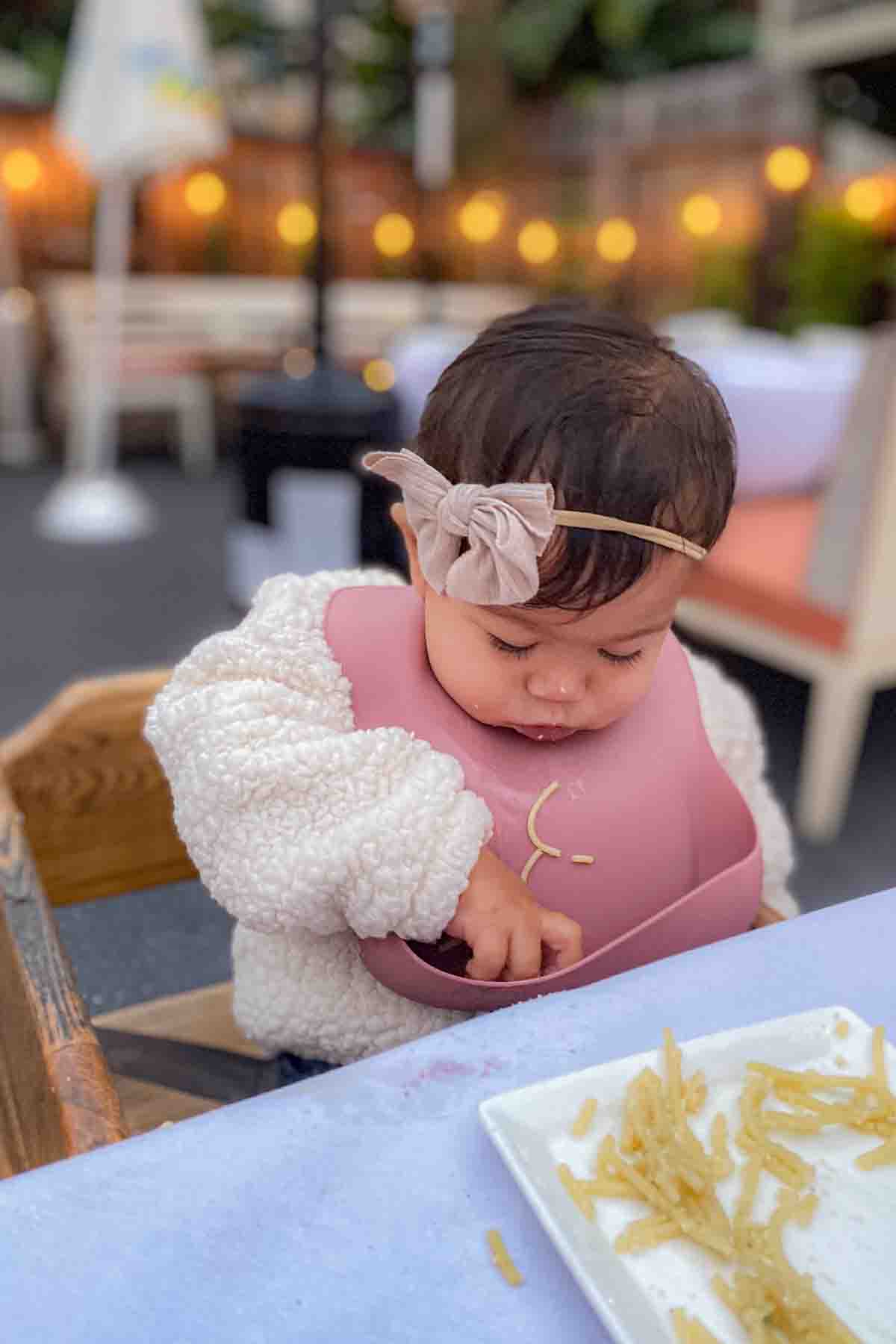
Silicone Bibs
Silicone bibs are a winner for us.
They wipe clean, dry quickly, and catch food. They minimize outfit changes and reduce laundry.
We tried out disposable bibs for a bit, but they didn’t work as well as I would have liked them to.
Disposable Placemats
During the younger self-feeding phase, where everything gets swiped off the table, and plates just won’t work, these are helpful.
They stick to surfaces, create a clean eating space, and make cleanup easy. Not always necessary, but useful in certain stages.

Baby Bottle and Pacifier Wipes
This is one of those small things that’s really helpful in specific moments.
When you don’t have access to a sink, like on an airplane or in transit, baby bottle and pacifier wipes can help clean bottles, pacifiers, pump parts, teethers, plates, and utensils quickly.
I don’t rely on them as a full cleaning solution every day of a trip, but they’re useful for temporary situations when proper washing isn’t possible. Especially on flights where the water isn’t something you want to use for cleaning feeding items.
They’re lightweight, easy to pack, and give you a simple backup option when you need it.
Containment and Self-Feeding Tools
Soft Silicone Utensils
If you’re doing baby-led weaning, bring your own infant utensils.
Most restaurants only have large metal ones, which don’t work well for early self-feeding. A small silicone set is lightweight and much easier for babies to use.
Suction Mat Plate
We used the Mini Mat once our babies stopped flipping plates.
It works well on some surfaces, not all, but surprisingly well on airplane tray tables. It’s easy to clean and compact enough for travel.

Pumping Support
Pump Options
If you need to pump occasionally on a trip, the Harmony works great if you can successfully pump with a manual hand pump.
If you are at the tail-end of your breastfeeding journey and not pumping much at all, you may be able to get by with only the Haakaa.
These are lightweight, easy to clean, and don’t require power. Not a full replacement for regular pumping, but useful for travel.
If you are exclusively pumping or pumping multiple times a day, you probably want to bring a full double electric pump for consistency and efficiency.
What We Don’t Pack
We don’t travel with sterilizers.
We don’t pack weeks of baby food.
We don’t bring elaborate systems.
We bring what makes feeding predictable and rely on simple routines and local stores for the rest.
Renting Baby Feeding Gear Instead of Packing It
If you don’t want to pack certain items, renting can be a great option.
Depending on your destination, you may be able to rent baby gear locally through services like BabyQuip. Availability varies by location, but in many places you can find things like high chairs, bottle sterilizers, bottle warmers, drying racks, and even pumps.
This can be especially helpful for longer stays or trips where you want a more complete setup without checking extra luggage.
It’s also worth checking with your hotel or vacation rental. Some family-friendly properties offer baby gear to borrow or rent directly, which can be the easiest option since it’s already on-site.
That said, I still keep our approach simple. I don’t rely on rentals for everything, and I always make sure we have what we need for the first day or two. But if you’re trying to avoid overpacking, it’s a helpful option to look into.
Feeding Doesn’t Have to Be Perfect While Traveling
Feeding doesn’t have to look exactly the same on vacation as it does at home.
Maybe feeds are closer together. Maybe solids are simpler. Maybe you rely on pouches more than usual.
That’s okay.
Travel days are temporary. You can get back to your routine at home.
I’ve nursed more often on flights. I’ve skipped full baby-led weaning meals in tight spaces. I’ve chosen convenience when it made the day smoother.
Babies are adaptable.
What matters most is keeping everyone fed, however possible, and regulated enough to move through the day.

Frequently Asked Questions About Feeding a Baby While Traveling
Can you bring baby food on a plane?
Yes. Baby food, breast milk, formula, baby pouches, and milk for toddlers are considered medically necessary liquids in the U.S. and are allowed through TSA in reasonable quantities.
You do not have to fit them into the standard 3.4 oz liquid rule. Keep them separate in your carry-on so screening is straightforward. Policies may vary internationally, so it’s always wise to review local airport guidelines before flying home.
Can you bring formula or breast milk through TSA?
Yes. Formula and breast milk are permitted in quantities greater than 3.4 ounces.
I keep bottles and milk together in a clear section of my bag so I can remove them easily if asked. In our experience, screening has been straightforward and uneventful.
How do you sterilize bottles while traveling?
You don’t need to travel with a sterilizer.
We’ve boiled bottles in apartment kitchens or used very hot, soapy water when boiling wasn’t practical. Access to a kettle or stovetop makes it simple. This is one reason I prefer apartment-style accommodations when traveling with bottles.
Keep your system basic and repeatable.
Is it safe to use tap water for formula abroad?
This depends entirely on your destination.
In places with safe, drinkable tap water, many parents feel comfortable using boiled tap water. In destinations where tap water isn’t considered potable, bottled water is typically the safer choice, and you can still boil it if you prefer extra caution.
If your baby has sensitivities or you’re unsure about local water quality, research your destination ahead of time and consult your pediatrician for guidance specific to your trip.
The key is planning ahead rather than deciding on arrival.
What food should I bring for a 1-year-old on a plane?
Keep it simple and low-mess.
Pouches, soft snacks, yogurt melts, small pieces of fruit, or crackers travel well. Airplanes are not ideal for full baby-led weaning spreads. I focus on contained foods that are easy to clean up and won’t roll under seats.
Do I need a travel high chair?
Not always.
If you’re staying in one location for a week or more, a portable high chair can create helpful predictability. For short trips or city-hopping, you can often manage with restaurant high chairs or a compact chair cover instead.
It depends on your trip length and how much stability your baby needs during meals.
Is baby food easy to find internationally?
In most destinations, yes. Grocery stores and convenience stores in many countries carry baby food, snacks, and simple staples like yogurt and fruit.
We’ve found baby pouches, snacks, and easy foods everywhere from Brasov, Romania to Seoul, Korea, Venice, Italy, and Panama City, Panama. Babies are everywhere, and stores stock food for them.
I usually pack just a few pouches for transit days and rely on local stores once we arrive.
Japan, in particular, made this incredibly easy. Convenience stores and grocery stores had simple, baby-friendly options everywhere.


Babies Eat Everywhere – Keep It Simple
Babies eat everywhere.
In Tokyo. In Cairo. In Mexico. In Italy. In Peru. In small towns and big cities. They nurse, take bottles, and eat simple foods. Their parents figure it out.
You will too.
Feeding baby while traveling doesn’t require a completely new system. It’s the same basics, adapted slightly.
You don’t need every gadget.
You don’t need to pack everything.
You don’t need to get it perfect.
You need a simple plan, realistic expectations, and the ability to adjust.
Keep it simple. Let it flex. Then go enjoy your trip.
More Tips for Traveling with a Baby
If you’re planning a trip with a baby, these guides can help you feel more prepared: