Long Haul Flight With a Toddler: Sleep, Snacks, and Survival Strategies
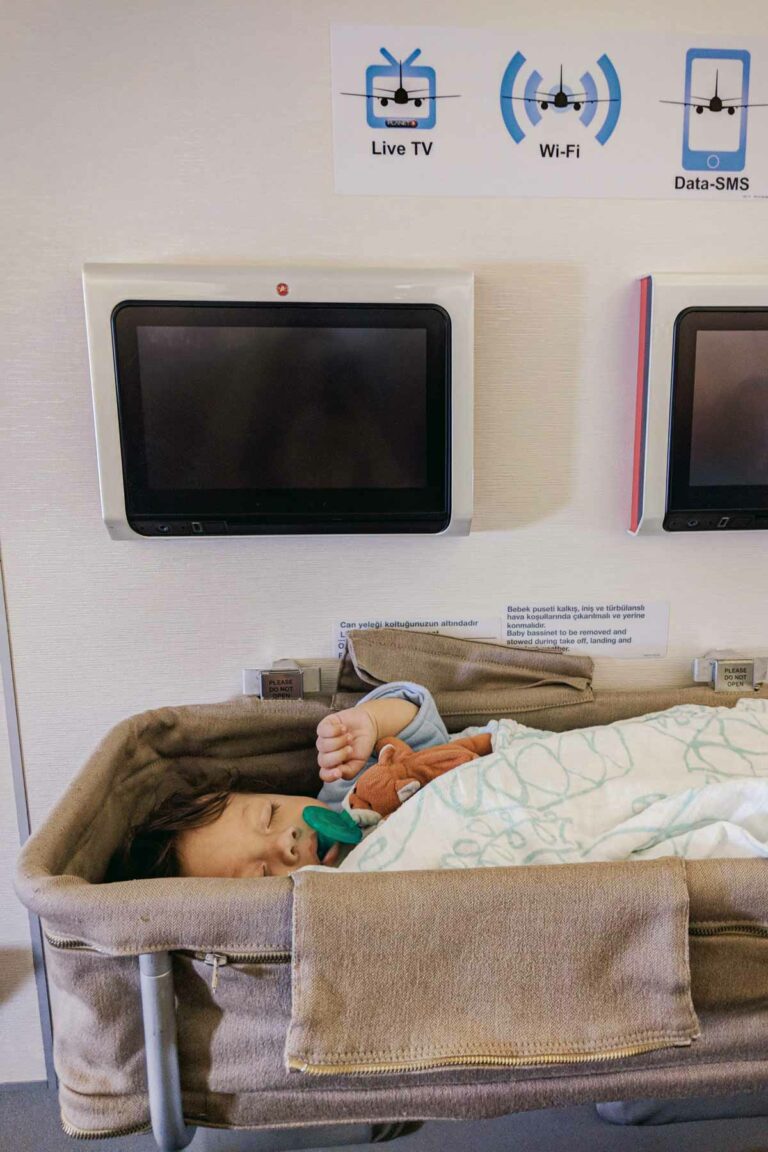
At hour 12 of a 17-hour flight from Dubai to Texas, my 15-month-old was still wide awake. Not crying. Not upset. Just bouncing. We built a blanket fort around our seats to block out the cabin lights and meal carts, and he finally fell asleep somewhere around hour 15.
If you’re planning a long haul flight with a toddler, I won’t pretend it’s easy. Ages 1 to 4 are the toughest years to fly long distance. But it is absolutely doable with the right expectations, structure, and strategy.
After flying several ultra long-haul routes with three kids through the toddler and preschooler years, here’s exactly how I prepare, what actually works on the plane, and what I no longer bother trying.
Jump to: Seat Selection, Seat Location, Prep, Travel Day, Survival Tips, Entertainment, Food, Tantrums, Sleep, Potty Training, Packing List, FAQs
Affiliate Disclosure: Familee Travel contains affiliate links and is a member of the Amazon Associates Program, we may earn commissions from qualifying purchases at no additional cost to you.
In a rush? Pin this or email it to yourself to read later! (Psst! Use the buttons at the very top or bottom of this post for ease.)
What Counts as a Long Haul Flight
Definitions vary slightly by airline, but generally a long haul flight is anything over 6 hours. Once you hit 10 hours, it feels different. Once you hit 12 to 15 hours, you are in a completely different category of planning.
A three-hour flight with a toddler is something you power through. A long haul flight with a toddler requires strategy. You are not just passing time. You are managing sleep, hunger, boredom, and movement in a very small space for an entire day or overnight.
And that’s what makes it feel so intimidating.
Why a Long Haul Flight With a Toddler Feels So Hard
Flying long distance with a toddler is not hard because you are doing something wrong. It is hard because toddlers are built to move. If you have a baby and a toddler, managing a baby on a long haul flight is actually easier.
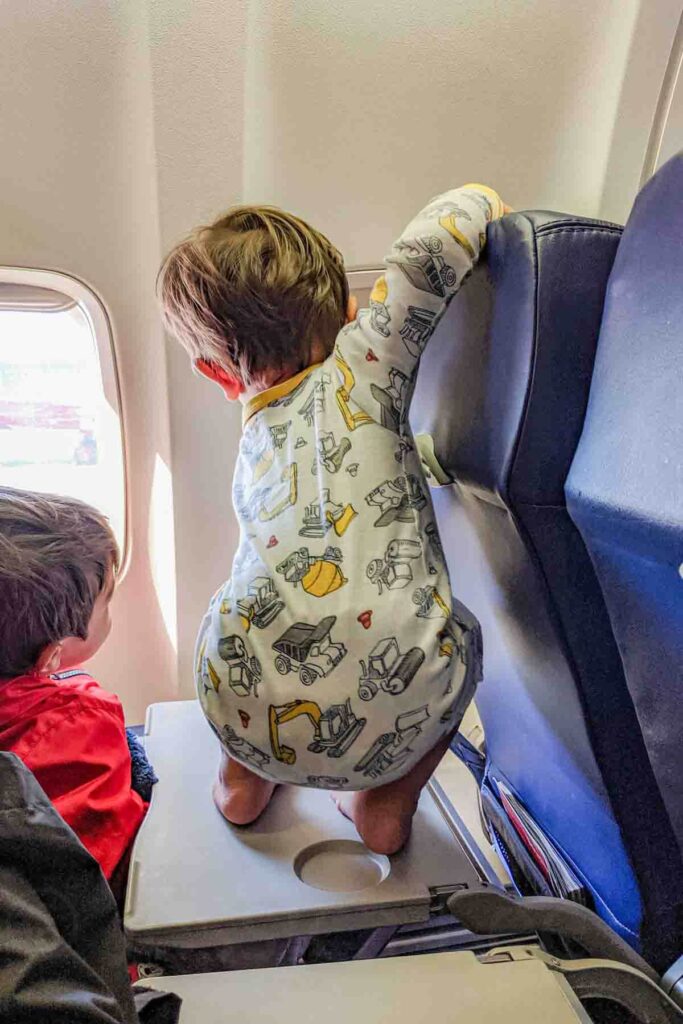
Between ages 1 and 2, they are newly mobile and have almost no impulse control. Sitting still is not developmentally natural. Add a tight airplane seat, unfamiliar environment, cabin noise, and disrupted routine, and you have a lot working against you.
Around ages 3 to 4, many toddlers, or preschoolers at that point, can reason a bit more. They understand “later.” They can follow simple timelines. They can focus on a movie longer. It is still work, but it usually feels more manageable.
No matter the age, the key is this. Check your expectations and adjust accordingly. I’ll say it again. Adjust your expectations. A long haul flight is not a normal day. You are not aiming for perfect behavior. You are aiming for safe, fed, somewhat rested, and arriving intact.
Should You Buy Your Toddler Their Own Seat
This is one of the biggest decisions you’ll make when planning a long haul flight with a toddler.
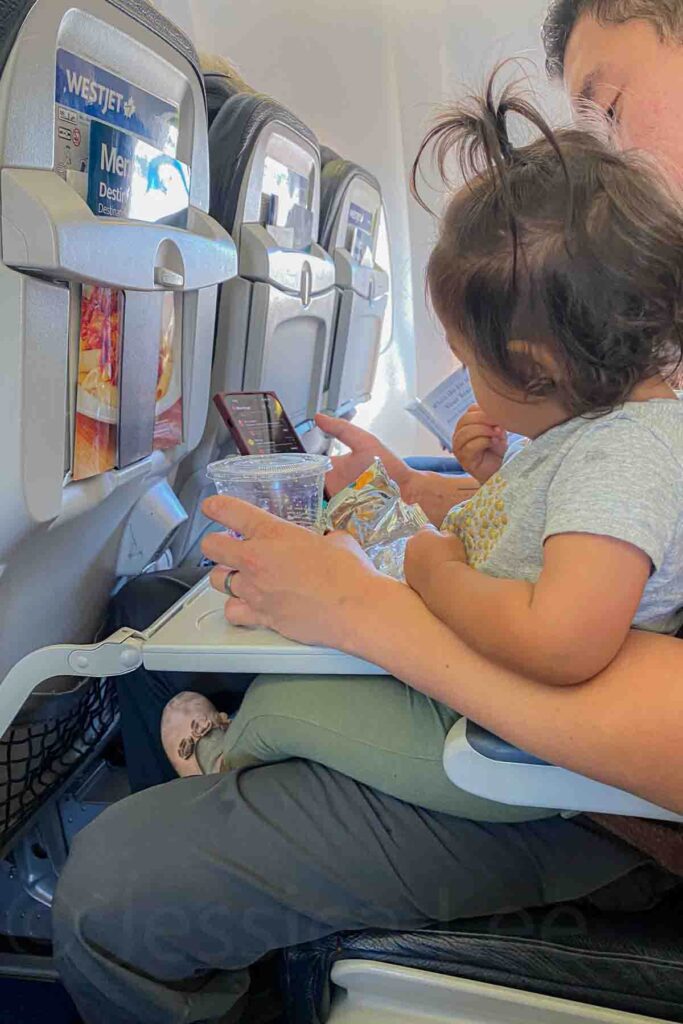
If your child is under 2 years old, they are legally allowed to fly as a lap child. Once they turn 2, they must have their own seat. But just because you can keep them on your lap does not mean it will be easy.
Lap child vs own seat
When our kids were younger, we often booked them as lap toddlers and crossed our fingers for an empty seat next to us. On a few flights, we lucked out and had extra space. That made a huge difference.
That is far less common now. Flights are fuller, especially on popular long haul routes.
Holding a 20 to 30-pound toddler on your lap for 10 to 15 hours is physically exhausting. Even if they are calm, it is still a long time to share one small seat.
Around 18 months with our second child, we started buying a separate seat when possible. The extra space alone reduced stress significantly.
When a separate seat is worth it
Buying a seat for your toddler can be worth it if:
- You are flying overnight and hoping they will sleep
- Your toddler resists being physically confined on your lap
- You want the option to use a car seat
- You simply want more physical space for everyone
It does not guarantee an easy flight. But it does give you more space and flexibility.
Other seat options parents consider on long haul flights
Some families choose to upgrade instead of purchasing another standard economy seat.
Business class or lie-flat seats
Some parents book lie-flat seats so they can co-sleep more comfortably with a toddler. The added width and ability to recline fully can make overnight flights feel much more manageable.
That said, policies vary by airline. Not all business seats are designed for two people to share safely, and some have dividers between seats. If you are considering this option, it is worth reviewing the exact seat configuration before booking.
Purchasing an entire row
A few airlines now offer the option to book a full row of economy seats and convert it into a flat surface using a special pad or attachment.
For example:
- Air New Zealand offers the SkyCouch, which turns a row into a wider, couch-like space.
- All Nippon Airways offers a similar option called Couchii.
- Lufthansa has a Sleeper Row product on select routes.
These options can allow an adult to lie sideways next to a toddler more comfortably than in upright seats. Availability is limited and pricing varies by route.
We have not personally used these products, but they can be worth researching if sleep space is your highest priority on an overnight long haul flight with a toddler.
If you do buy a seat
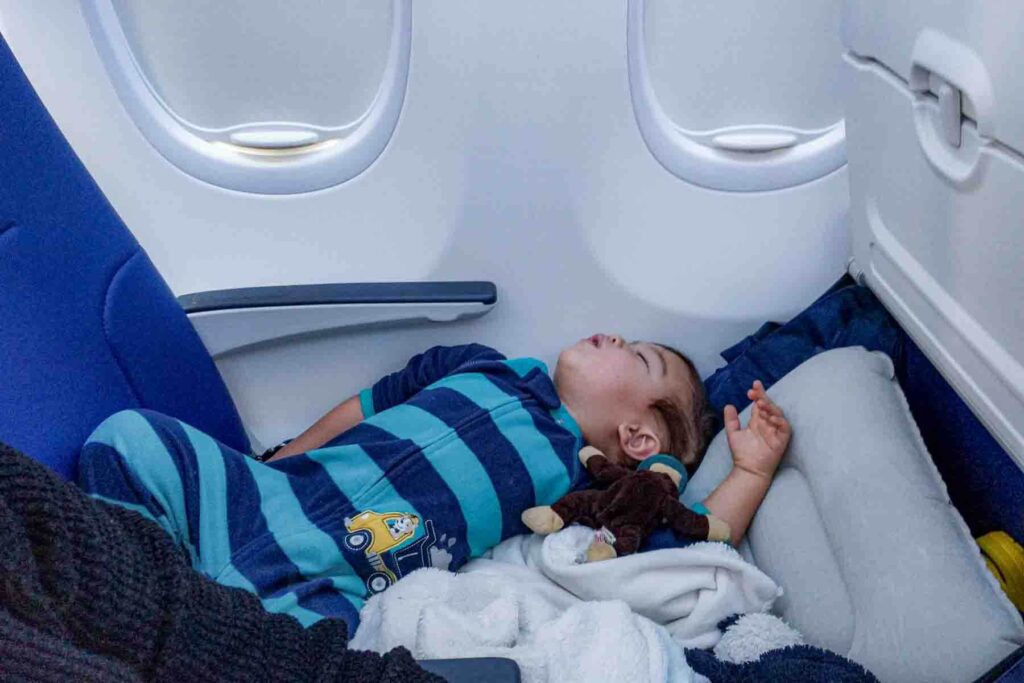
If your toddler has their own seat, you have more sleep options.
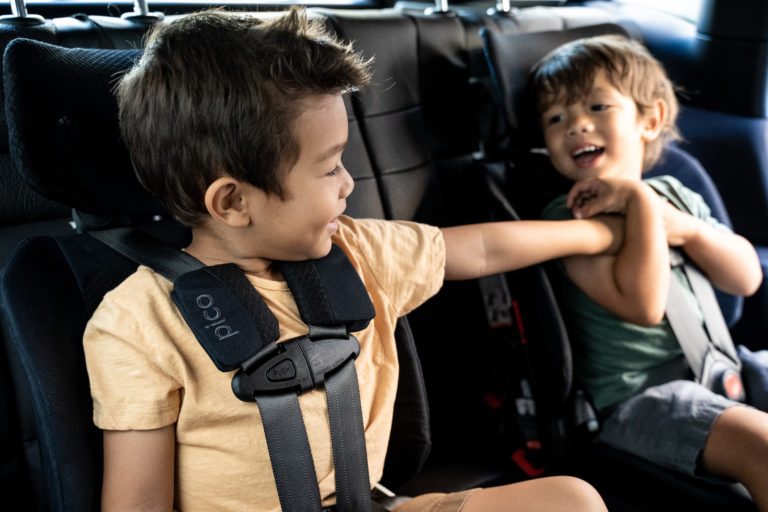
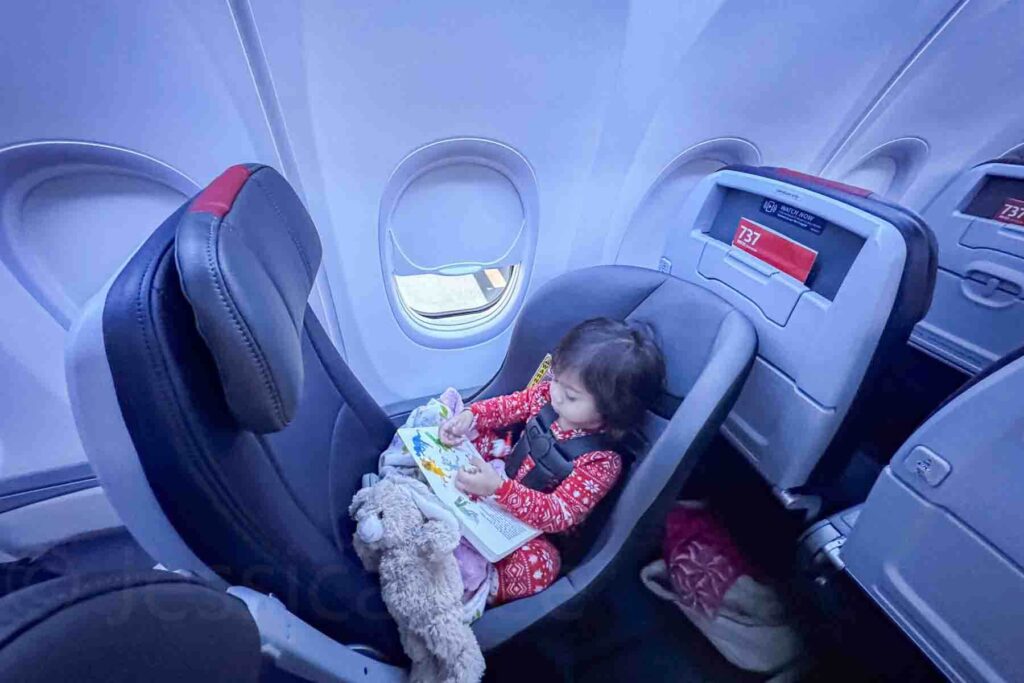
A car seat can work very well for some toddlers, especially closer to age 1 to 2. It did not work well for our first two kids. They felt constrained and wanted out. It worked beautifully for our youngest. Every child is different.
Another option, especially around ages 2 to 3, is an inflatable footrest pillow that fills the floor gap and extends the seat surface. With a blanket over the whole area, it creates a larger, flatter space. This setup worked extremely well for us in the 2 to 3-year-old stage.
Just know that some airlines do not allow inflatables. Always be prepared to pivot.
Best Seat Location for a Long Haul Flight With a Toddler
Once you’ve decided whether your toddler will have their own seat, the next question is where you should sit.
Seat location will not make or break the flight. But the right setup can make things noticeably easier.
Window vs aisle with a toddler
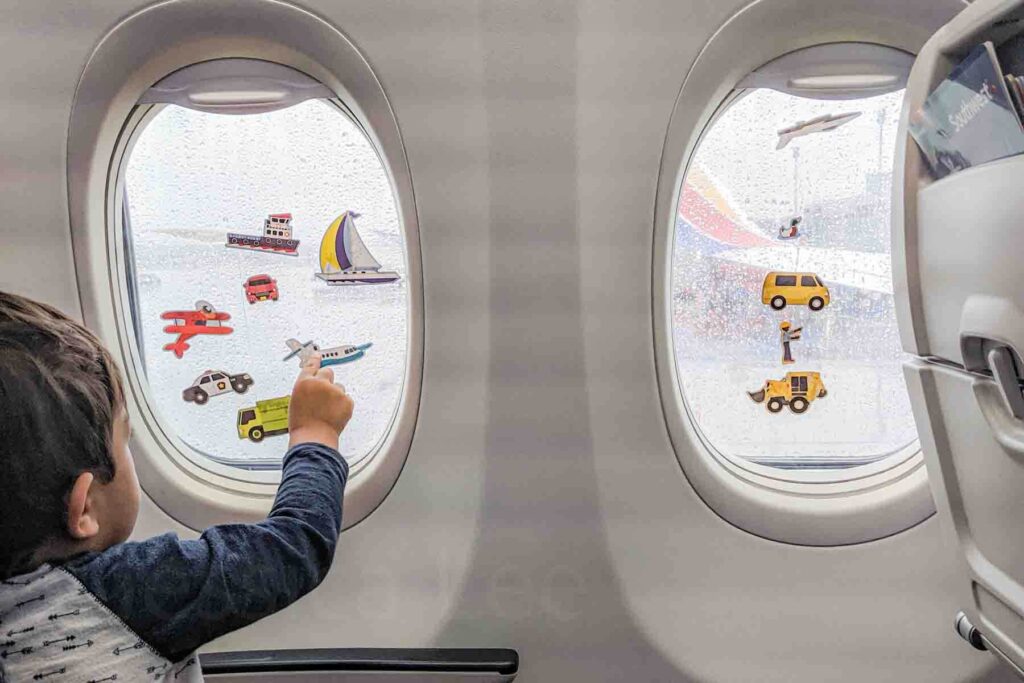
For toddlers between 1 and 4, I usually prefer a window seat for them when possible.
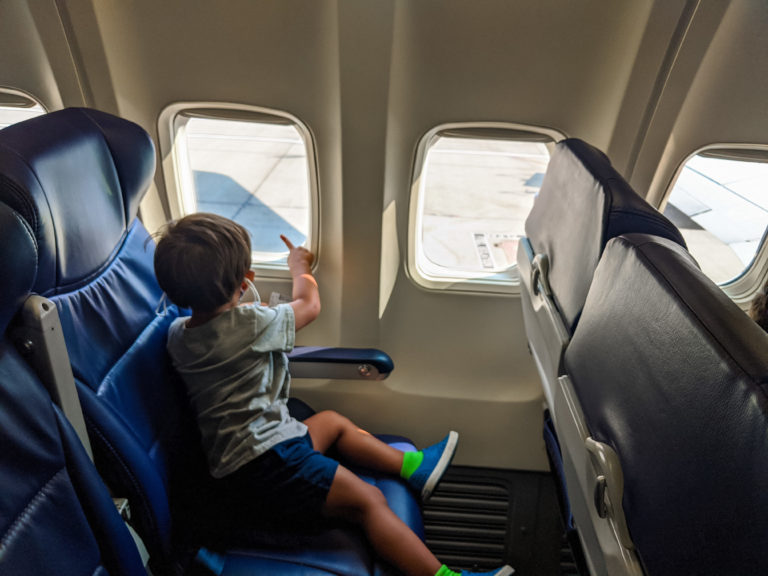
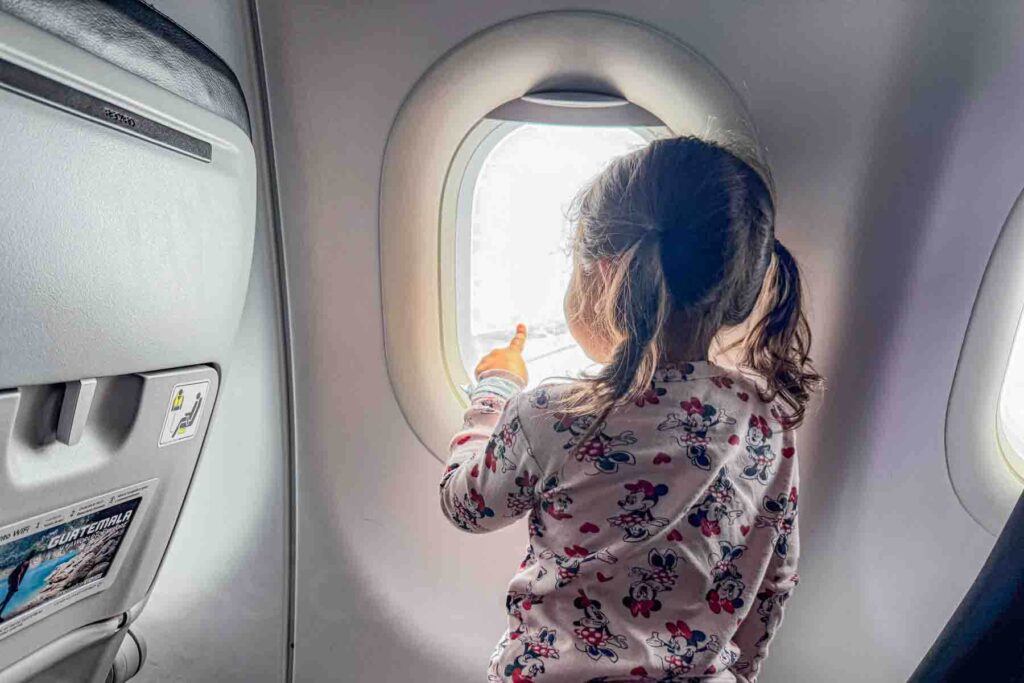
The window creates a physical boundary. There is only one direction they can attempt to escape. It also gives them something to look at during takeoff and landing, which can help with distraction.
An aisle seat, on the other hand, gives you easier access for bathroom breaks and walking resets. If your toddler is recently potty trained, or you know you will be up frequently, aisle access is convenient.
If you’re traveling with two adults, a common setup is:
- Toddler at the window
- One adult in the middle
- One adult on the aisle
That gives containment and flexibility.
Bulkhead seats
Bulkhead seats can feel appealing because of the extra legroom.
Pros:
- More floor space for stretching legs
- Easier to stand up without climbing over someone
Cons:
- Armrests are often fixed
- Screens and tray tables may fold out of the armrest
- You cannot store bags under the seat in front of you
For toddlers, fixed armrests can make it harder to share seat space or create a little “nest” with blankets. We personally prefer regular rows for that reason, but it depends on the aircraft.
Avoid high-traffic areas if possible
Seats near bathrooms and galleys can be noisy. There is more foot traffic, more light, and more conversation.
For some toddlers, that stimulation makes sleep harder. For others, it does not matter at all. If your child is a light sleeper, consider choosing seats farther from those areas.
Daytime vs overnight flights
This is not technically a seat location decision, but it ties into booking strategy.
If you’re flying long haul with a 1 or 2-year-old, overnight flights can be unpredictable. Some toddlers sleep beautifully. Others treat it like a party.
By ages 3 to 4, many toddlers or preschoolers handle red-eye flights better because they understand bedtime cues and can focus on a movie before sleep.
There is no perfect answer. The “best” flight time depends heavily on your child’s temperament and sleep style. And even with the perfect plan, things go array in travel. Delays happen, so you have to be ready for anything.
Prep That Actually Helps Before Travel Day
If you’re reading this weeks or even months before your flight, you’re already doing the right thing.
Preparing for a long haul flight with a toddler starts well before you step onto the plane.
Talk about the flight in advance
Toddlers understand more than we give them credit for.
Even if your child is not fully verbal yet, they can process routine and expectation. Start talking about the flight ahead of time.
- We’re going to the airport.
- We’ll go through security.
- We’ll sit on a big plane.
- It’s a sleeping plane.
I repeat that last one a lot before overnight flights. I explain that we will eat dinner on the plane, change into pajamas, and sleep there. I do not want bedtime to feel like a surprise.
For younger toddlers around 1 to 2, simple repetition is enough. For older toddlers and preschoolers 3 to 4, you can explain more details and timelines.
Use books to make it familiar
Library books about airports and airplanes are incredibly helpful.
They introduce vocabulary. They show security lines, boarding gates, seatbelts, and cabin crew. The more visually familiar it feels, the less shocking it is on travel day.
I love the toddler prep book series to help younger kids get ready for new experiences, and here are some others my kids enjoyed.
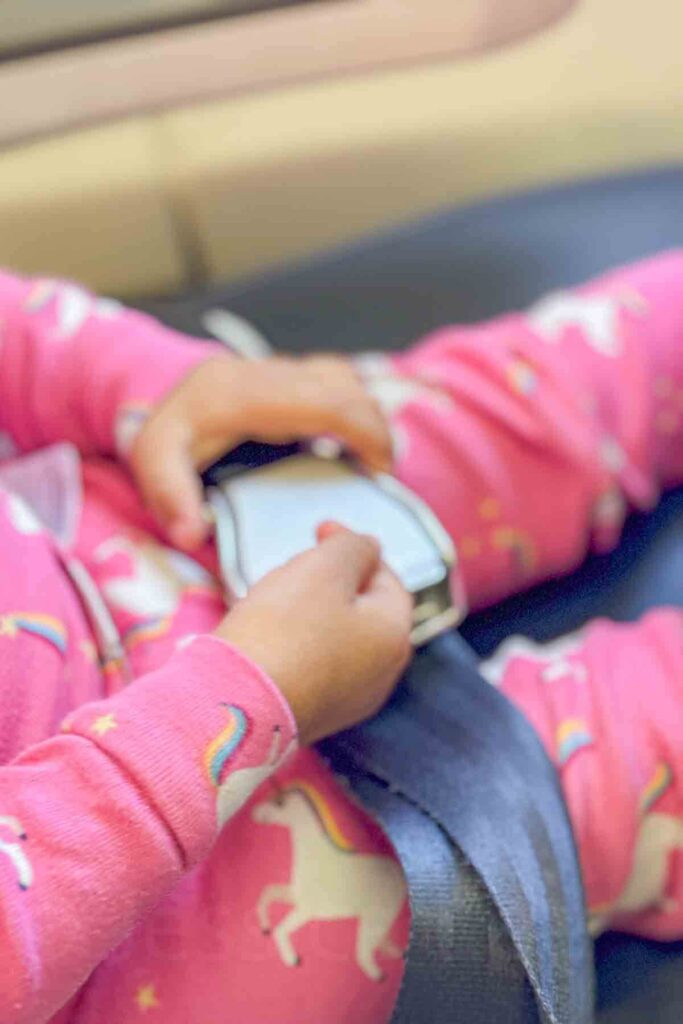
Then, on the actual day, bring them into the routine. Let them help where possible. Toddlers love to help. Show them how to buckle their seat belt.
If this is your toddler’s first flight, this step matters even more.
If you can, don’t make a long-haul their very first flight
If possible, try a shorter flight before committing to a 10 to 15-hour journey.
A three-hour domestic flight gives you valuable information:
- How do they handle takeoff?
- Do they tolerate headphones?
- Do they nap at all in a seat?
If you do not have that option, it is still completely doable. It just means you should prepare more with books ahead, build in more structure on your travel day, and lower your expectations.
Aim for decent sleep before the flight
This sounds obvious, but it makes a difference.
Try to prioritize good sleep for the one or two nights before your departure. A well-rested toddler has more resilience. An overtired toddler often does not “crash” the way parents hope.
The same goes for you. Long haul flights are physically and emotionally draining. Going into it already exhausted makes everything harder.
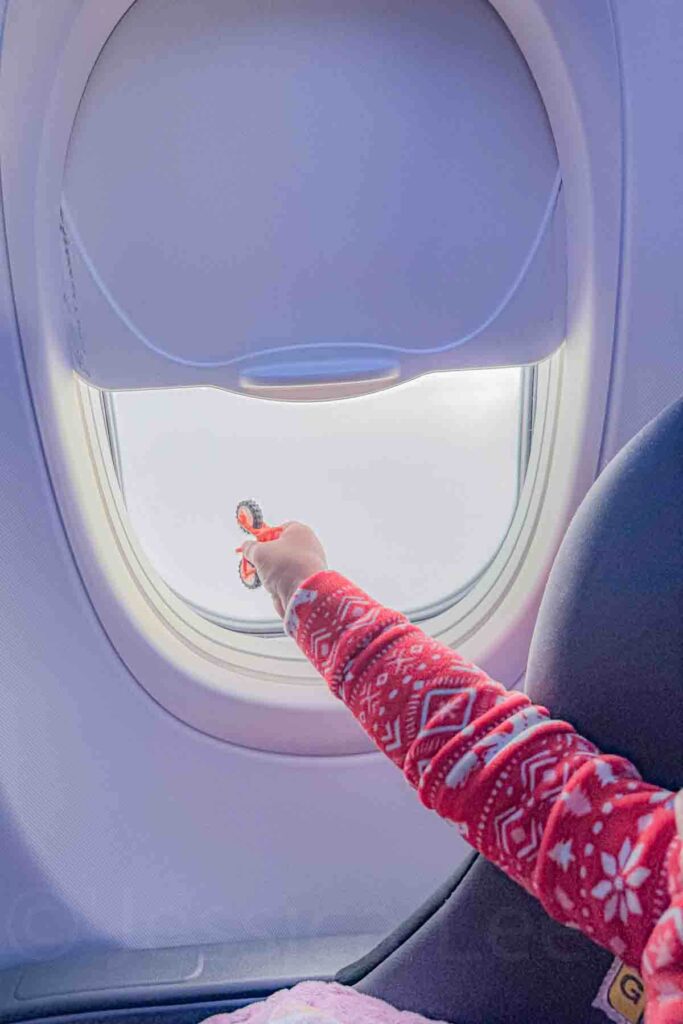
Adjust your own expectations
This is the most important prep of all.
A long haul flight with a toddler is not a normal day. It is a high-stimulation, low-movement environment for many hours.
Your goal is not perfect behavior.
Your goal is:
- Safe
- Fed
- Somewhat rested
- Arriving intact
That mindset shift changes how you handle every small hiccup on the plane.
Travel Day Strategy Before You Board
What you do in the 6 to 8 hours before takeoff matters more than most parents realize.
By the time you sit down on a long haul flight with a toddler, you want to feel prepared, not already depleted.
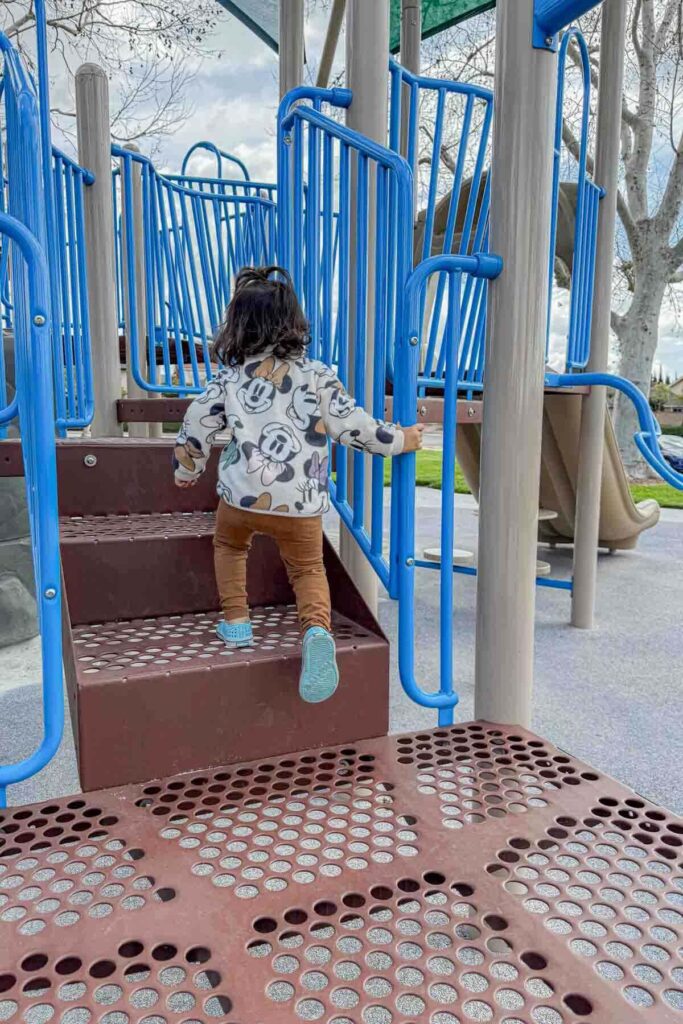
Get energy out on purpose
Toddlers are wired to move. A long flight removes that outlet almost entirely.
If you can, prioritize movement before you head to the airport.
- Playground time
- A long walk
- Running outside
- Anything physical
You are not trying to exhaust them. You are trying to meet their movement needs so they do not board already desperate to climb the walls.
If you are staying at an airport hotel, even 20 minutes of running around outside can make a noticeable difference.
Time your airport arrival wisely
Arriving extremely early can backfire with toddlers.
Yes, you need time for check-in and security. You do not want to be running through the airport last minute. But sitting at the gate for an excessive time with nothing to do drains everyone’s patience before the flight even begins.
Build in buffer, but do not build in unnecessary waiting.
The boarding strategy that can help with toddlers
This is one of my favorite practical tips.
If you are traveling with another adult:
- One adult boards with the bags during regular boarding.
- The other stays out at the gate with the toddler until the last possible minute.
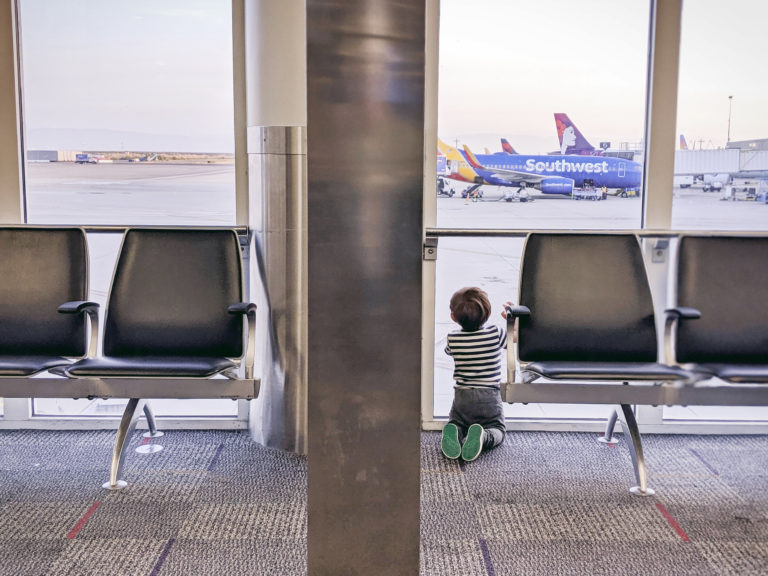
That way your toddler gets more time to move and explore before being confined to their seat for the next 10 to 15 hours.
When pre-boarding is offered for families, you do not have to use it if it means sitting on the plane longer than necessary.
Feed them before you board
Even though long haul flights include meal service, timing is unpredictable.
A toddler who boards hungry is much harder to manage during taxi and takeoff, when everyone must remain seated.
A solid snack or small meal before boarding gives you a calmer start.
Change into “Flight Mode” before takeoff
For overnight flights especially, start transitioning before you leave the ground.
- Change into comfortable clothes if needed.
- Explain again that this is a sleeping plane.
- Set expectations clearly but calmly.
Once you are in the air, things feel less chaotic if everyone already understands the plan.
Create a Schedule to Suvive the Long Flight
A long haul flight with a toddler is not something you “get through.” It is something you structure.
On a three-hour flight, you can power through. On a 10 to 15-hour flight, you need rhythm.
Without structure, it feels endless. With structure, it feels like manageable chunks.
Why structure matters on a long flight
Toddlers and preschoolers thrive on schedules and transitions.
They may not tell time, but they understand what comes next. If you simply sit and hope they stay entertained, boredom builds quickly. When boredom builds, so does frustration.
A loose plan gives everyone a sense of progress.
You are not counting hours.
You are moving through phases.
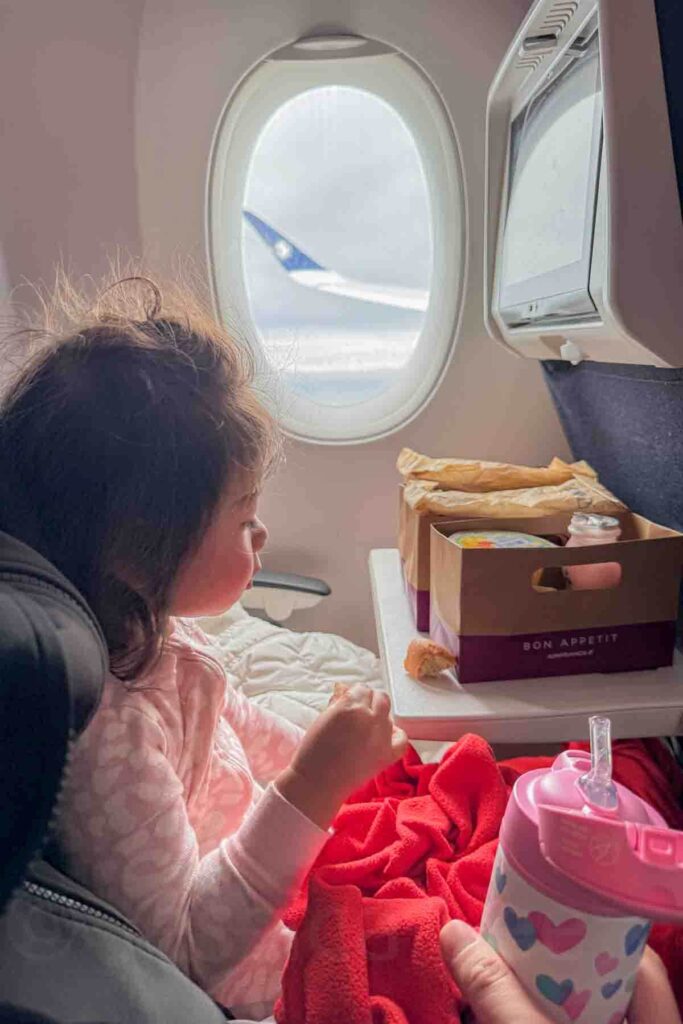
A simple long flight schedule you can copy
This does not need to mirror your exact home routine. It just needs flow.
For example:
- Snack plus short show
- Quiet activity
- Walk or bathroom reset
- Meal service
- Independent play
- Pajamas
- Sleep attempt
- Repeat in smaller cycles after wake-ups
Breaking the flight into blocks prevents it from feeling like one neverending stretch of time.
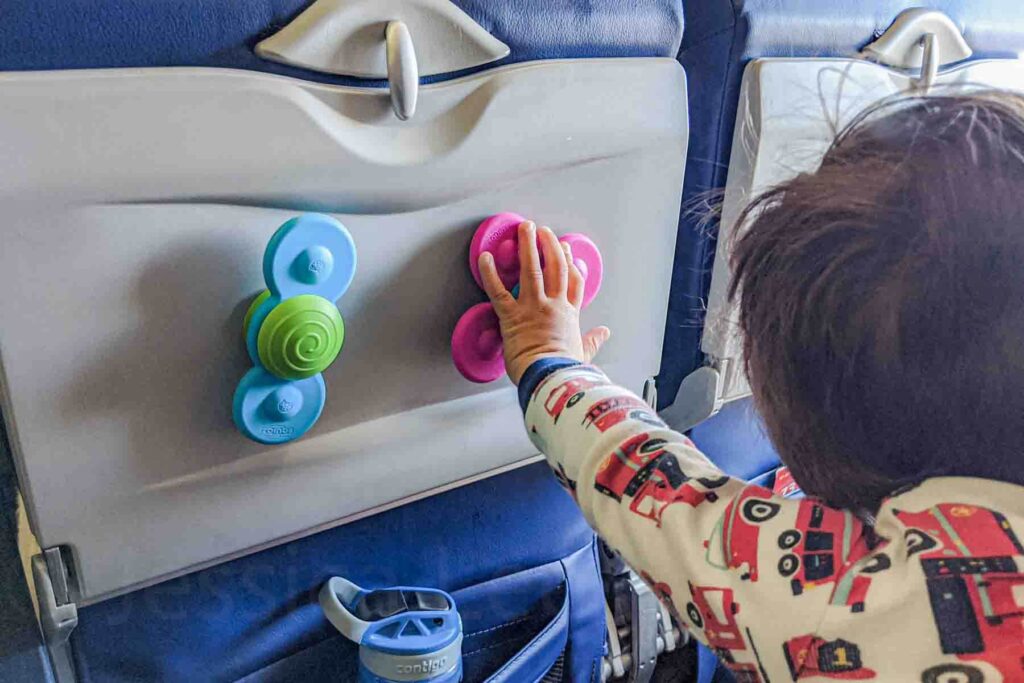
Control the toys one at a time
This is where a lot of parents accidentally burn through their resources too quickly.
Do not let your toddler dump the entire backpack at once.
Instead, let them take one activity out and play until their interest fades. Then put it away before bringing out the next.
Later, you can recycle earlier toys. What was boring three hours ago might feel new again.
Novelty is powerful at this age. Use it strategically.
Rethink the snack strategy
You may have seen those “snackle box” ideas online. They look adorable.
For toddlers, I personally prefer not to reveal every snack at once.
Why?
- Once they see everything, the novelty fades faster.
- Spills happen easily in tight airplane seats.
- If everything is out at once, you lose your pacing tool.
Instead, pack snacks in small portions and reveal them gradually.
Think of snacks as part of the schedule, not a free-for-all.
Save certain cards for later
There are a few tools that work best if you do not use them immediately:
- Screens
- Walking the aisle
- Special treats
For younger toddlers, I try to hold off on screens at the beginning of the flight. Around age 3 or 4, I am more flexible. But even then, I like having something strong in reserve.
The same goes for aisle walks. Once they realize walking is an option, they will want it frequently. Use it when you need a reset, not at the first sign of boredom.
The goal is not restriction.
The goal is pacing.
How to Entertain a Toddler on a Long Haul Flight
Entertaining a toddler on a long flight is not about bringing more stuff.
It is about bringing the right stuff and pacing it well.
Between ages 1 and 4, attention spans are short. That is normal. Your job is not to find one magical activity that lasts three hours. Your job is to rotate strategically.
Choose activities that match their age
A 14-month-old and a 4-year-old do not need the same type of entertainment.
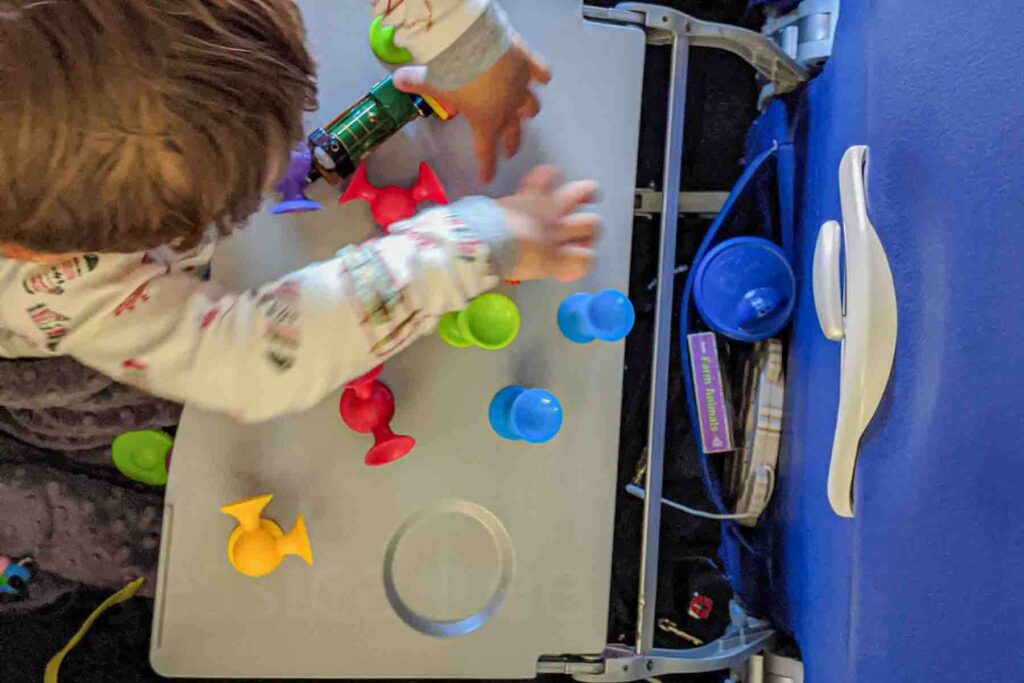
For younger toddlers around 1 to 2:
- Larger, easy-to-grip items
- Puffy or reusable stickers
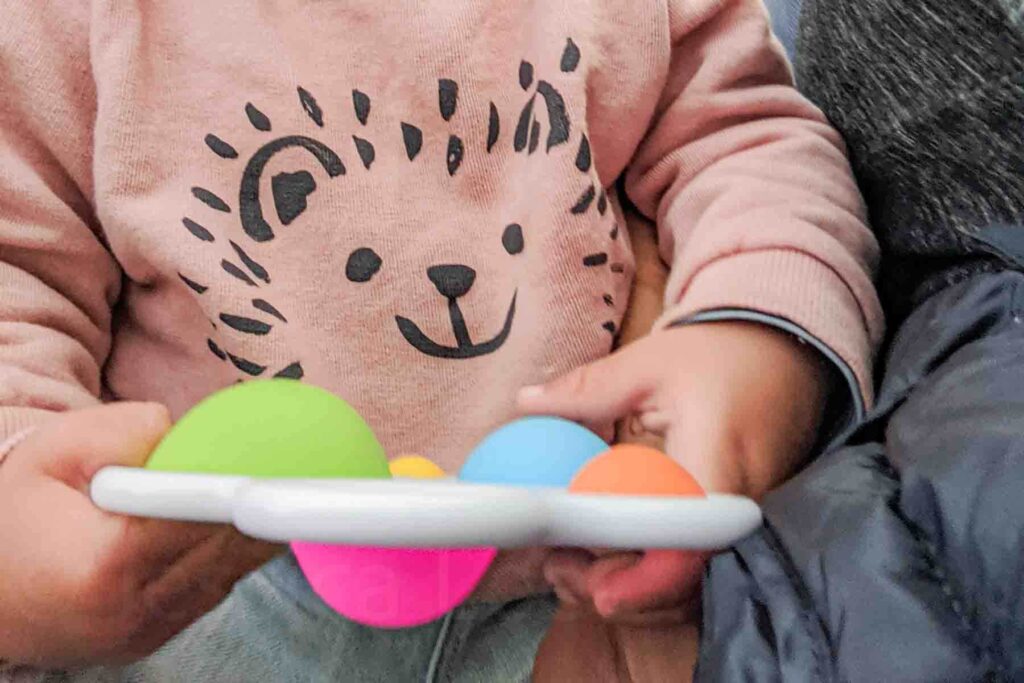
- Simple popper fidgets
- Buckle toys
- Chunky figurines or cars
Fine motor frustration on a plane is not what you want. If a toy is too complex, it will create more stress than relief.
For older toddlers and preschoolers around 3 to 4:
- Reusable sticker scenes
- Water-based coloring books
- Mess-free markers
- Small imaginative toys
- Simple activity books
The key is quiet, low-mess, and no tiny pieces that will disappear under the seat.
Bring a few new-to-them items
They do not need to be expensive.
A new sticker book.
A new coloring set.
A small toy they have not seen before.
Novelty buys you time. Even 20 focused minutes is a win on a long haul flight.
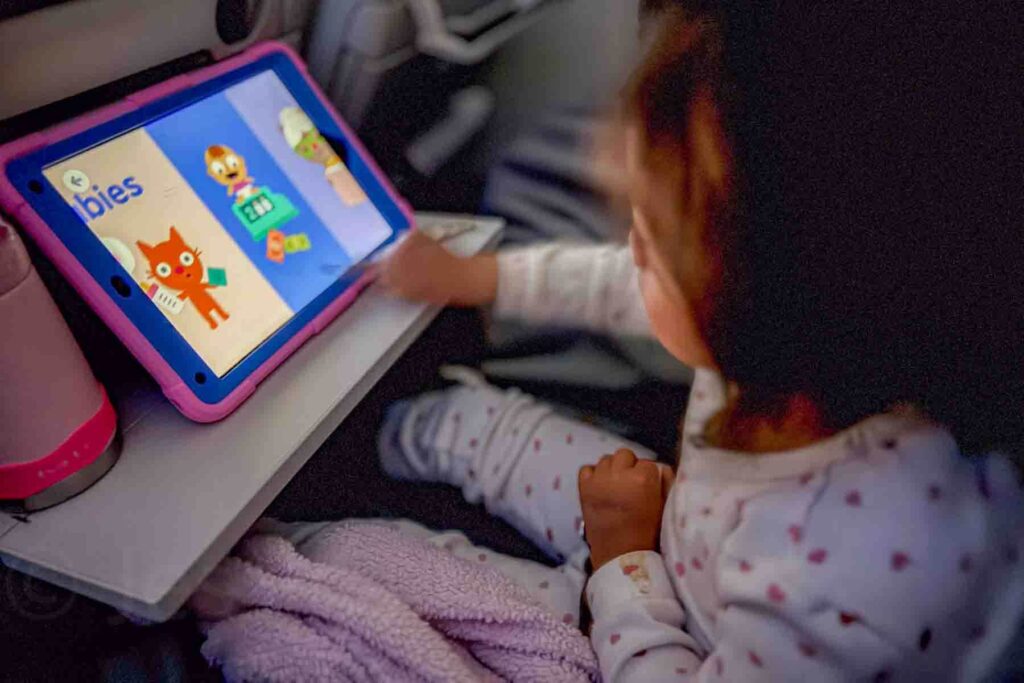
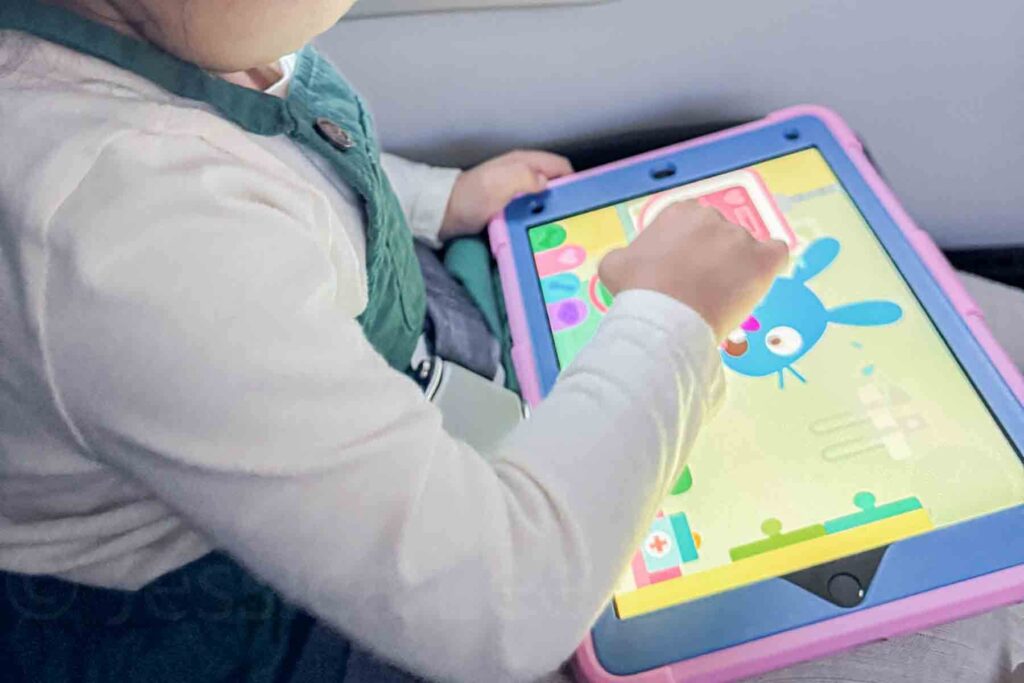
Screens are a tool, not a failure
For long distance flights, I use screens intentionally.
With younger toddlers, I try to hold off early in the flight so I have something powerful later. With older toddlers or preschoolers, I am more flexible.
Download shows ahead of time.
Test the tablet on airplane mode before you leave.
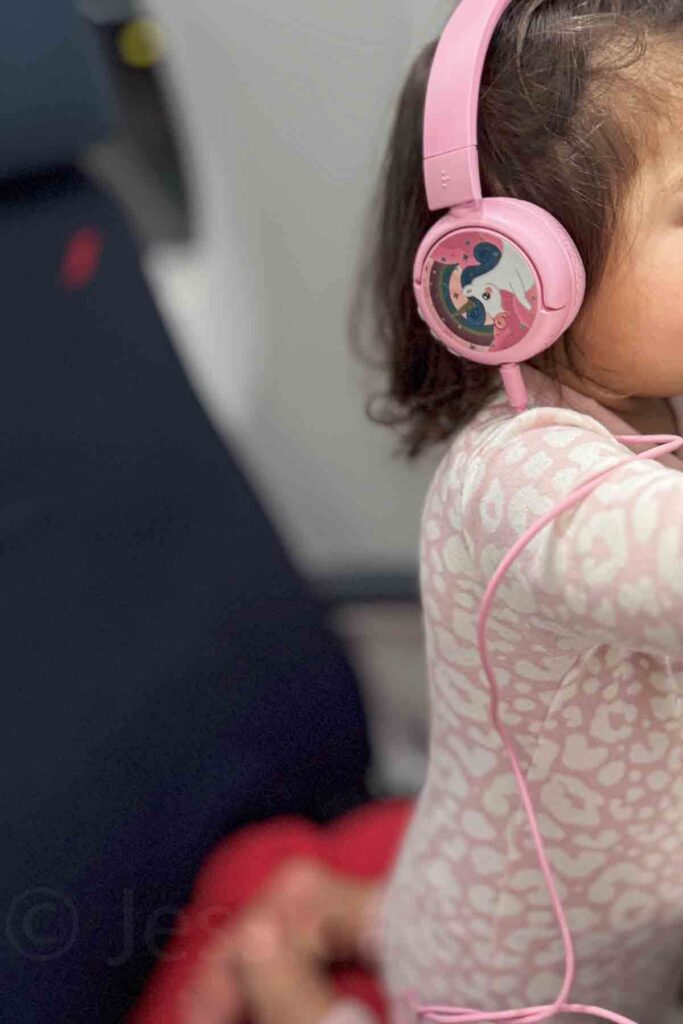
Bring child-sized headphones and make sure they actually fit.
We once brought headphones that kept sliding off. That was a mistake I will not repeat.
Once my kids were a little older around 3, we bought them more structured kids headphones. When they were younger toddlers, we used soft headphones.
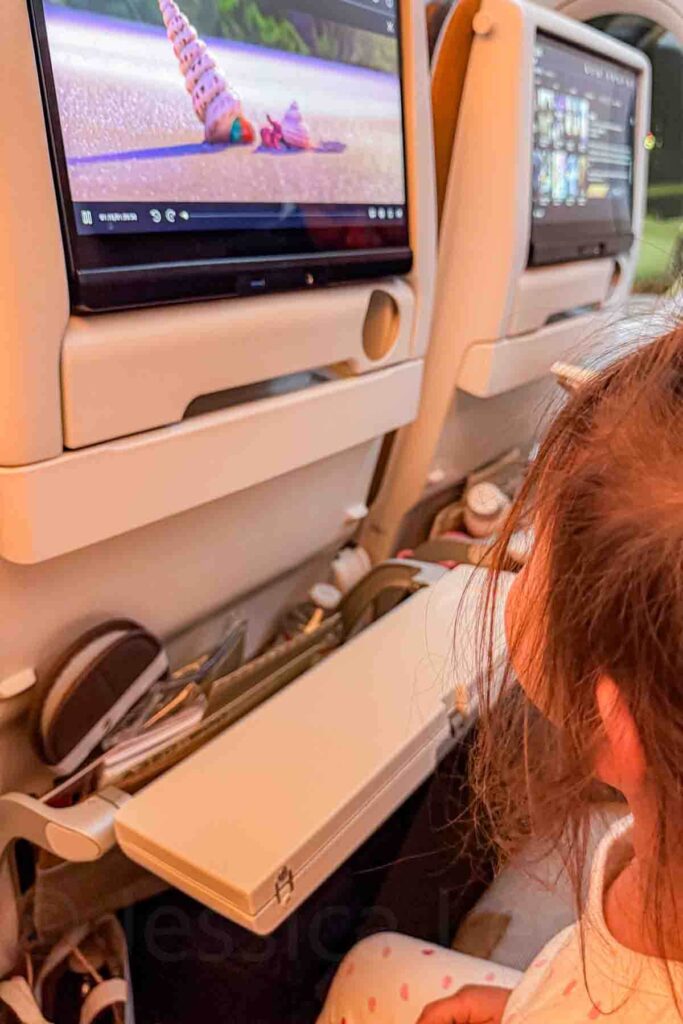
Seatback screens are great if your child can navigate them, but you will still need your own headphones. Airlines don’t always offer child-sized ones.
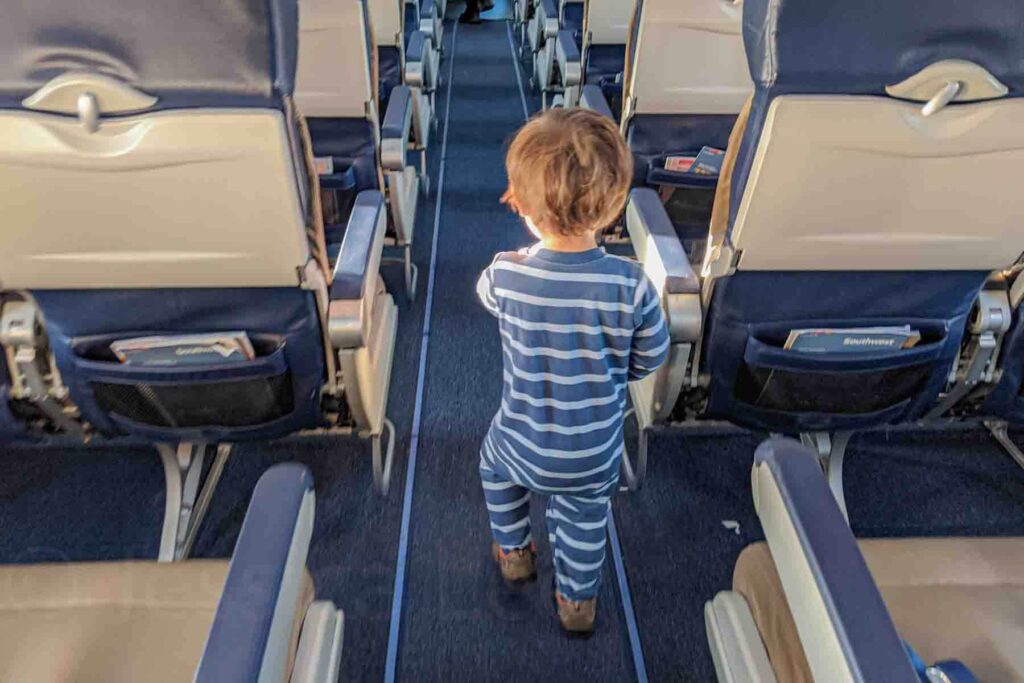
The walking reset
You are allowed to walk the aisles on a long haul flight.
Use it when you need a reset, not as your first move.
Once your toddler realizes walking is an option, they may want it repeatedly. Save it for when seated activities are truly not working.
Even a quick trip to the bathroom to wash hands and change scenery can shift the mood.
Let other people help
Long haul flights are full of other parents, grandparents, and travelers who remember this stage.
If someone smiles, plays peekaboo, or offers to help in a small way, accept it.
A few minutes of distraction from a friendly stranger can feel like a gift.
Keep expectations real
Your toddler will not sit perfectly for 12 hours.
There will be wiggling.
There may be whining.
There will likely be at least one moment where you think, this was a mistake.
That does not mean you are failing.
It means you are on a long haul flight with a toddler. And this is hard.
How to Manage Toddler Meltdowns on a Long Haul Flight
Let’s talk about the thing parents worry about most.
The meltdown. The tantrum.
A long haul flight does not create new parenting challenges. It simply magnifies the ones that already exist.
Your toddler is still your toddler.
The same principles apply. The stakes just feel higher because you are in a small space surrounded by strangers.
First, adjust your expectations
Before you even board, remind yourself:
- Sitting still for 10+ hours is not developmentally natural.
- Transitions are harder in unfamiliar environments.
- Sleep and hunger cues will not look normal.
If your expectations are age-appropriate, you will respond more calmly.
And calm is contagious.
Get beneath the surface
Most toddler meltdowns have a root cause.
On a long haul flight, it is usually one of five things:
- Hungry
- Overtired
- Overstimulated
- Bored
- Bathroom-related
Instead of reacting to the volume of the meltdown, ask:
What is actually happening here?
Do they need a real snack, not just crackers?
Do they need help settling, not just “go to sleep”?
Do they need a bathroom reset?
Do they need a change of activity?
Addressing the root cause solves more than trying to quiet the surface behavior.
Use resets strategically
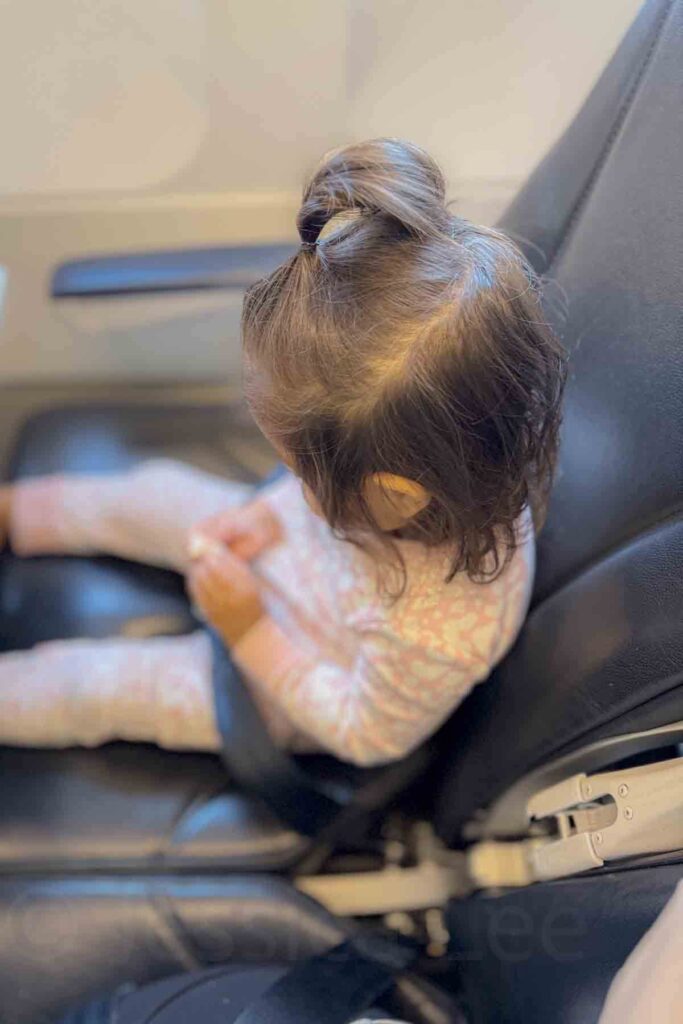
On a plane, resets look different, but they still work.
- Bathroom trip
- Quick aisle walk
- New activity
- Water break
- Quiet cuddle with a blanket
You are not fixing everything.
You are lowering the intensity enough to move forward.
Do not change your parenting style mid-flight
It is tempting to abandon boundaries because you feel watched.
Or to over-correct because you feel embarrassed.
You do not need to parent differently just because you are on a plane.
Stay consistent.
Stay calm.
Use the same tone and structure you use at home.
Toddlers feel your stress quickly. If you stay steady, they often settle faster.
And if it gets loud
Sometimes they cry. Sometimes they scream.
It is uncomfortable. It is human. It is temporary.
Most people on long haul flights have noise-canceling headphones on.
Many are parents themselves.
And the ones who are not? They will survive.
A toddler meltdown does not mean you should not travel.
It means you are traveling with a toddler.
How to Get a Toddler to Sleep on a Plane
Let’s start with the most important truth.
Sleep on a plane will not look like sleep at home.
If your toddler only sleeps in a dark room, in their crib or bed, with perfect white noise and zero interruption, you cannot expect that to transfer seamlessly to a long haul flight.
Your goal is not perfect sleep.
Your goal is enough sleep.
Reset expectations first
A long haul flight is loud, bright, and unfamiliar.
There are announcements.
There are meal carts.
There are seatbelt signs turning on and off.
If your expectations are unrealistic, you will feel frustrated before the flight is even halfway done. Adjusting your mindset ahead of time helps you respond calmly when sleep is broken or delayed.
Use bedtime cues even on a plane
Even though the environment is different, your toddler still responds to routine signals.
For overnight flights, we:
- Change into pajamas
- Brush teeth or wipe face and hands
- Lower our voices
- Repeat our usual bedtime phrases
I always explain again, this is a sleeping plane. We eat dinner, we change, we sleep.
For 1 to 2-year-olds, repetition helps.
For 3 to 4-year-olds, explaining the sequence gives them something predictable to hold onto.
Sleep Setups by Age
Different ages handle airplane sleep differently.
Ages 1 to 2
If your toddler has their own seat, you can consider bringing a car seat onboard.
This works beautifully for some kids.
It did not work well for our first two.
They felt confined and wanted out.
It worked very well for our youngest.
Every toddler responds differently to being strapped in for long stretches. If they already tolerate long car rides well, it may be worth trying.
If they are flying as a lap child, plan for more physical support. Leaning against you, curling up across your lap, and broken stretches of sleep are common.
It is rarely long, uninterrupted rest at this age.
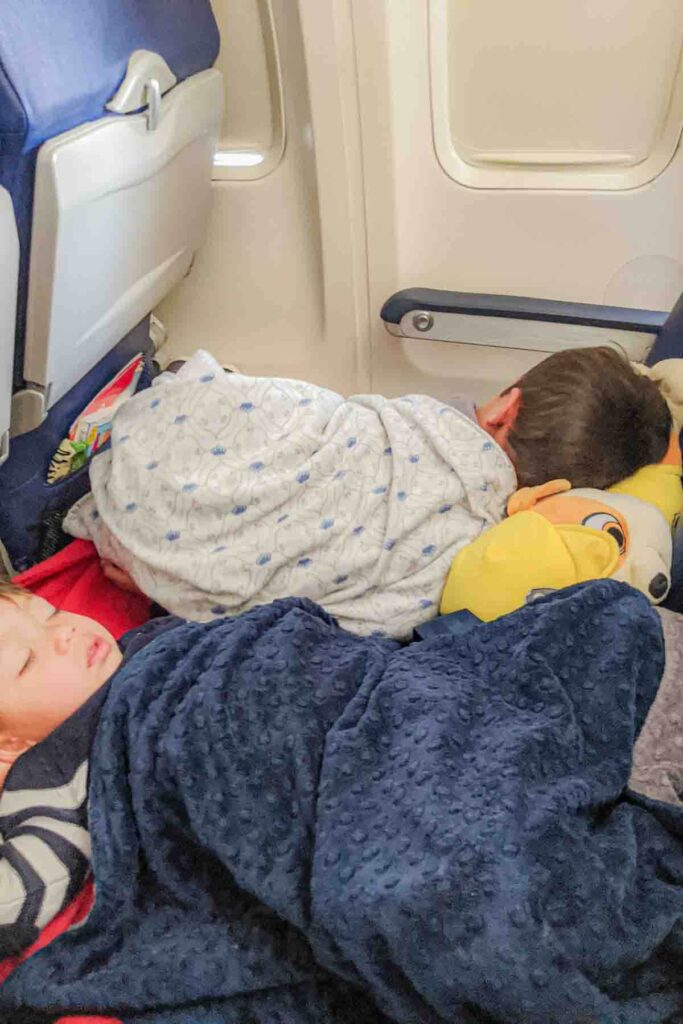
Ages 2 to 3
This was the sweet spot for us.
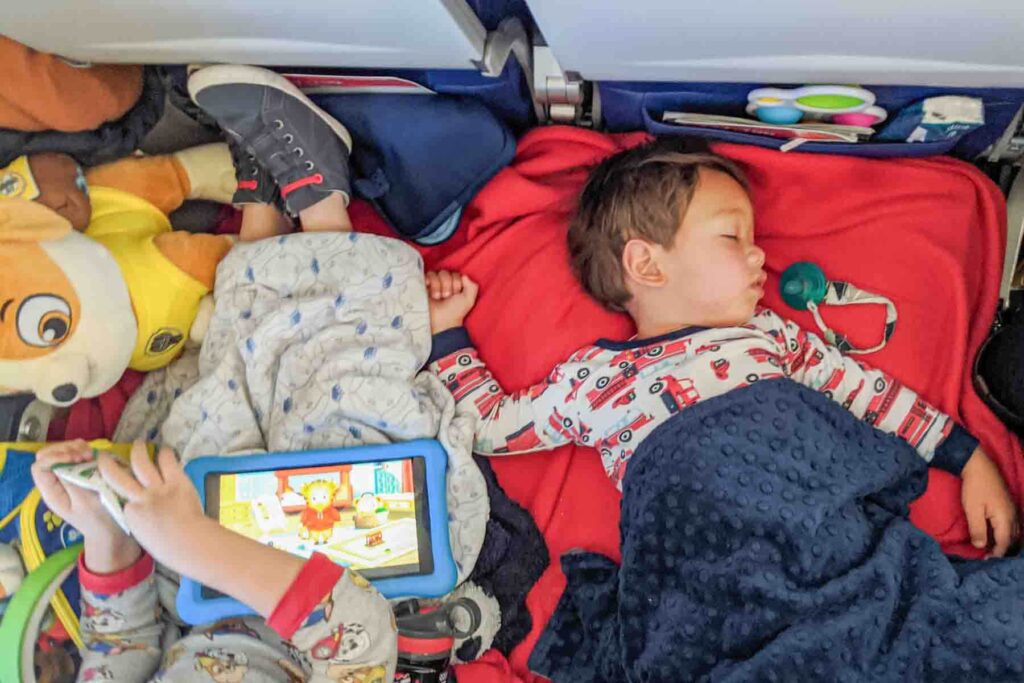
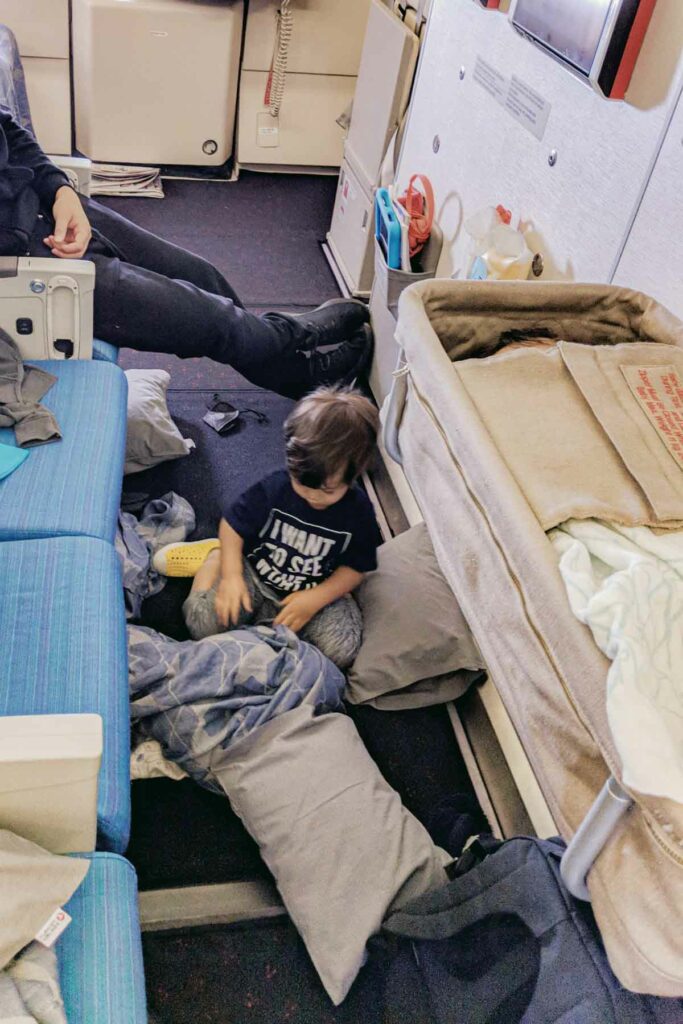
If they had their own seat, using an inflatable footrest pillow to fill the gap between seats made a big difference. With a blanket over the seat and footrest, it created a larger, flatter surface where they could curl up more comfortably.
All three of our kids slept well this way during the 2 to 3-year-old stage.
Important note:
Some airlines do not allow inflatable footrests. Always be prepared to switch up your strategy if asked to deflate it.
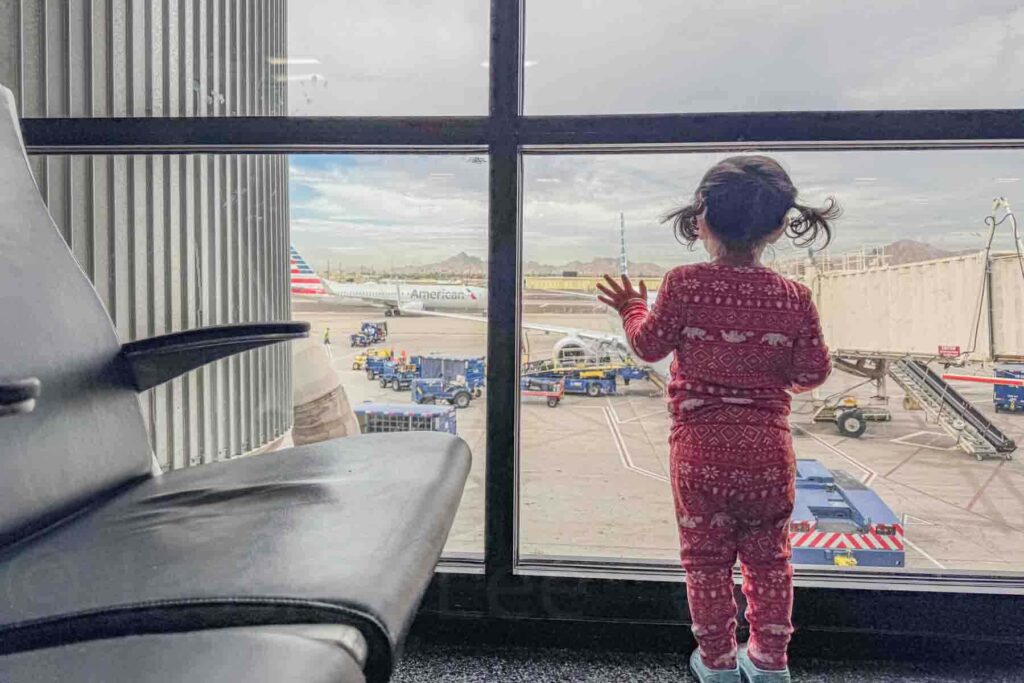
If inflatables are not allowed, you can still create a small nest with blankets and let them curl up in their seat. This is easier to do if they have a window seat.
Ages 3 to 4 – preschooler stage
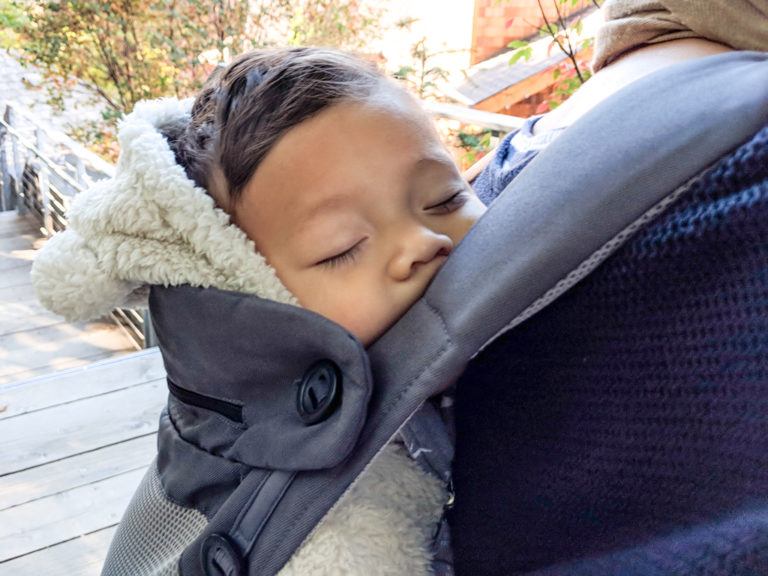
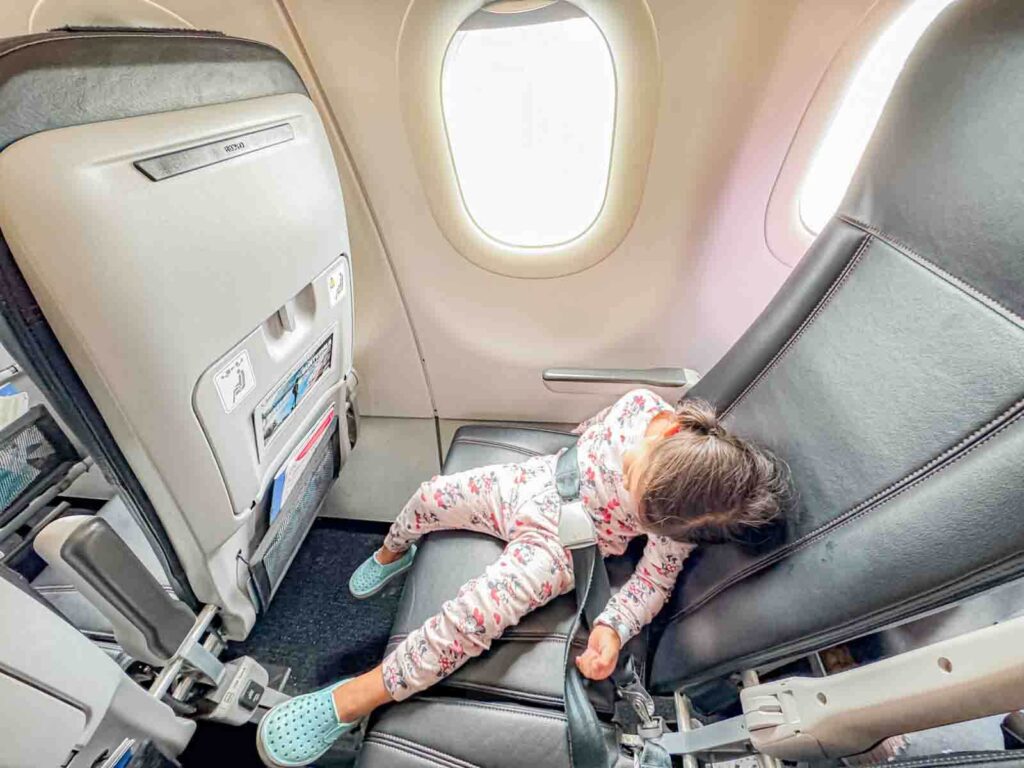
By this age, many kids can simply fall asleep sitting upright.
It may not look comfortable to you, but toddlers and preschoolers can sleep in positions that would ruin an adult’s back for a week.
Less gear is often needed at this stage. We use the airline provided pillow and blanket to prop up their heads a bit.
Managing noise and light
Planes naturally provide white noise from the engines, which can help.
The challenge is when cabin lights turn on for meal service or announcements break the quiet.
If your child is a light sleeper, a small portable noise machine can help smooth over sudden sound changes.
For light, draping a blanket over the seat area can reduce brightness. Just be mindful of airflow and not disturbing your flight neighbors’ seats.
What if they just will not sleep
Sometimes they will not.
We had a 17-hour flight where our toddler stayed awake for 15 hours. It was exhausting.
But it ended.
We arrived.
We recovered.
If your toddler skips sleep on the plane, focus on hydration, food, and calm energy. You can reset once you land.
A rough flight does not define the entire trip.
Snacks, Meals, and Drinks on a Long Haul Flight
If you remember nothing else from this post, remember this.
Do not rely solely on the airline to feed your toddler.
Even on a true long haul flight with two meal services, timing can feel random. The food may not be something your toddler likes. And hunger on a plane escalates quickly.
Bring snacks on snacks
This rule applies at the grocery store, in the car, and especially on a long haul flight with a toddler.
Pack more than you think you need.
For younger toddlers around 1 to 2:
- Easy-to-eat finger foods (practice pincer grasp with Cheerios)
- Familiar snacks they already love
- A mix of filling and fun
For older toddlers and preschoolers:
- Protein-heavy options to avoid sugar spikes
- A few novelty snacks for morale
- Something that takes time to eat (like peeling a clementine themselves)
Snacks are not just food.
They are part of your pacing strategy.
Do not show them everything at once
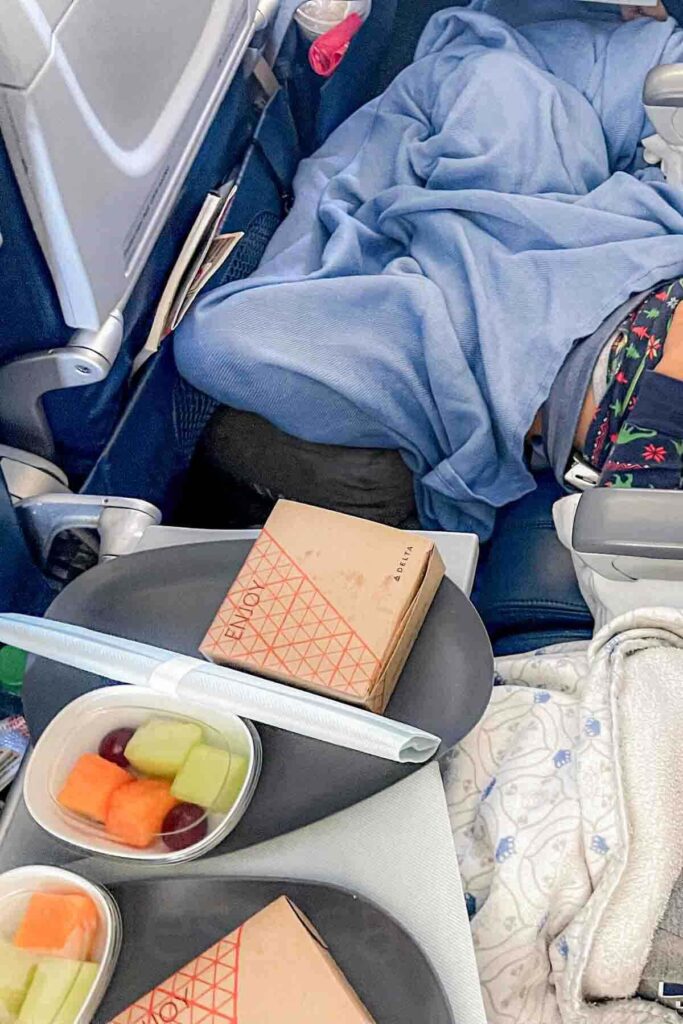
Just like toys, snacks should be revealed gradually.
If you pull out every snack option at the beginning of the flight, you lose one of your best tools. Spills are also more likely when multiple containers are open at once.
Instead:
- Small portions
- One at a time
- Save a few “special” items for later
Long haul flights often offer ice cream or another treat mid-flight. A little morale boost can go a long way at hour nine.
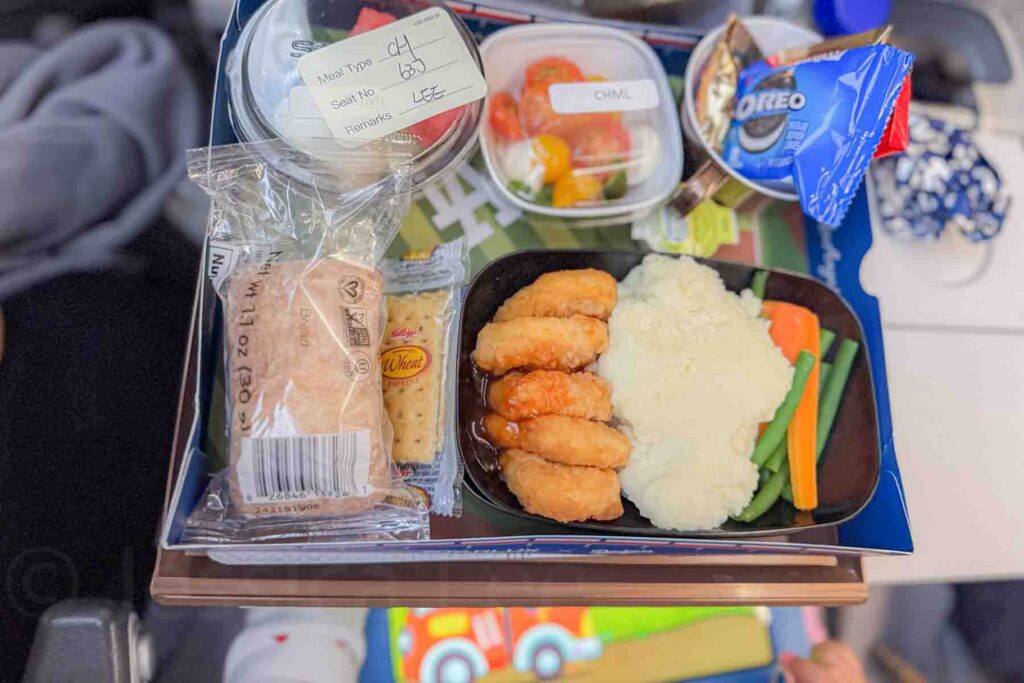
Request a child meal in advance
Most long haul flights offer child meals, but you often have to request them ahead of time.
Sometimes it is automatic.
Sometimes you must log into your reservation and select it.
Even if you request one, still bring backup food.
Your toddler may decide that airplane pasta is unacceptable. It happens.
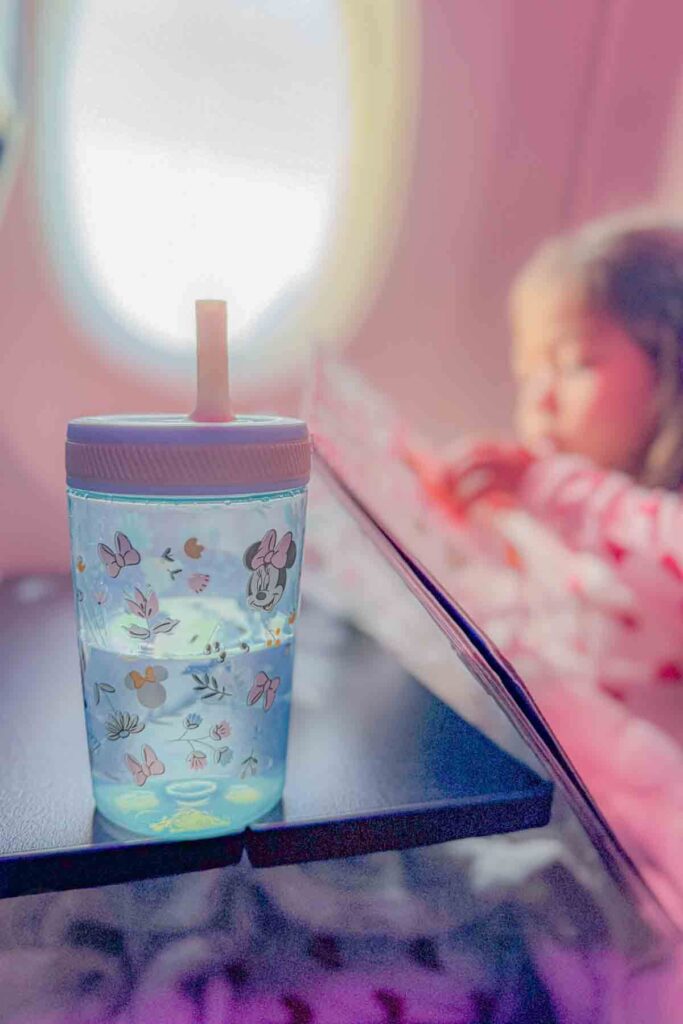
Bring a spill-proof cup
Airlines almost always serve drinks in open cups.
Toddlers and open cups on a moving plane are not a great combination.
Bring the cup your child already uses at home. Something with a lid. Something familiar.
You can pour whatever drink they are served into their cup and avoid unnecessary spills.
Quick note on toddler liquids
You are allowed to bring toddler food and drinks through security. Milk, water, purees, and juice for young children are generally permitted, even if they exceed the standard liquid limit.
I break this down fully in my TSA liquids post.
Potty Training on a Long Haul Flight
If your toddler is in the middle of potty training, a long haul flight is not the moment to prove anything.
This is a high-stimulation, low-control environment. Delays happen. Bathroom lines happen. Seatbelt signs turn on right when someone says they need to go.
Plan accordingly.
If they are newly potty trained
If your child has only been out of diapers for a short time, I strongly recommend using a pull-up for the flight.
This is not backtracking.
This is situational strategy.
The last thing you want is a soaked airplane seat two hours into a 12-hour flight.
If you want to maintain the sensation cue, you can:
- Put underwear on
- Layer a pull-up over it
That way, if there is an accident, they still feel it. Just know that changes will be more involved, so pack extra underwear and wipes if you go this route.
Depending on the exact stage of potty training, sometimes we brought gear to help us navigate.
- Portable toddler potty cover – to shrink the adult-sized toilet to toddler size
- Portable toddler potty – standalone on-the-go toddler potty. If we would use this at our destination, I brought it. I wouldn’t bring it only for the airplane.
If they are fully potty trained
Even confident 3 or 4-year-olds can regress temporarily in unfamiliar situations, or struggle to wait when the seatbelt sign is on for an extended period.
Expect more bathroom trips than usual.
Expect them to say they need to go right when the seatbelt sign is on.
Stay calm and flexible.
Use bathroom trips as a reset
Even if they do not urgently need to go, a bathroom trip can serve as:
- A movement break
- A lighting change
- A quick hand-washing reset
It breaks up the monotony of the seat.
Just remember that airplane bathrooms are small. Plan for quick, efficient visits. Bring wipes and hand sanitizer.
Pack for worst-case, hope for best-case
In your carry-on, have:
- Extra underwear
- Extra pull-ups or diapers
- Wipes
- Hand sanitizer
- At least one full spare outfit
You probably will not need all of it.
But if you do, you will be very glad you packed it.
What to Pack for a Long Distance Flight With a Toddler
When you are flying long haul with a toddler, your carry-on matters more than your checked luggage.
Everything you need to survive the next 10 to 15 hours should be within reach.
This is not about packing more.
It is about packing smarter.
The essentials
Pajamas
If it is an overnight flight, change them. The signal matters.
Two spare outfits
Spills happen. Bathroom accidents happen. Milk happens.
Pull-ups or diapers
Even if your toddler is newly potty trained, bring backup.
Wipes and hand wipes
For faces, tray tables, bathroom runs, and mystery stickiness.
Spill-proof cup
Airline drink cups are open. Toddlers are not steady.
Child-sized headphones
Test them at home. Make sure they actually fit and stay on.
Snacks and food
Bring:
- More snacks than you think you need
- A mix of filling and fun
- Familiar favorites
Reveal them slowly throughout the flight.
Do not depend entirely on airline meals.
Activities
You do not need an entire toy store in your backpack.
Bring:
- A few quiet fidgets
- One or two sticker or coloring activities
- A small imaginative toy
- One or two new-to-them items
Rotate. Do not reveal everything at once.
Optional sleep add-ons
If your toddler has their own seat:
- An inflatable footrest pillow if you plan to use one
- A small comfort item like a lovey
If they are sensitive to noise:
- A small portable white noise machine
None of this is mandatory.
All of it depends on your child.
Keep it manageable
You still have to carry this through the airport.
If your bag feels overwhelming before you even board, it will not feel better at hour nine of the flight.
Pack intentionally.
Not excessively.
FAQs About a Long Haul Flight With a Toddler
How do you survive a 10 hour flight with a toddler?
You survive a long flight with a toddler by structuring it. Break the time into small blocks with snacks, activities, short walks, and rest attempts. Do not rely on one toy or one show. Rotate slowly. Lower your expectations. Aim for safe, fed, somewhat rested, and arriving intact.
How do I keep my toddler entertained on a long haul flight?
Bring quiet, low-mess activities and reveal them one at a time. Reusable stickers, simple fidgets, Water Wow books, and a few small toys work well. Save screens and aisle walks for when you truly need them. Novelty and pacing matter more than quantity.
How do I get my toddler to sleep on a long haul flight?
Use familiar bedtime cues like pajamas, brushing teeth, and the same phrases you use at home. Reset expectations. Plane sleep is different from crib sleep. If your toddler has their own seat, consider a car seat or a seat extender setup. Aim for enough sleep, not perfect sleep.
How do you fly overnight with a toddler?
Treat it like a normal bedtime routine in a different location. Eat dinner, change into pajamas, low stimulation, dim light (with blanket drape) if possible, and attempt sleep. Expect interruptions from lights and announcements. Some toddlers sleep well. Others do not. Build in flexibility and focus on recovery after landing.
Is it safe to travel on a plane with a 2-year-old?
Yes, it is generally safe for a healthy 2-year-old to fly. Follow airline rules for seating and restraints. If your toddler has their own seat, using an approved car seat is the safest option during taxi and turbulence. Always check with your pediatrician if you have specific health concerns.
Should I buy my toddler a seat for a long flight?
If your toddler is under 2, they can legally fly as a lap child. That said, buying a separate seat often makes long haul flights easier, especially overnight. The extra space allows better sleep setups and reduces physical strain on the parent. Once they turn 2, you are required to buy them their own seat.
What if my toddler will not sit still on a long flight?
Expect movement. Toddlers are wired to move. Build in structured activity blocks and occasional aisle walks. Use snacks and small resets strategically. The goal is not perfect stillness. The goal is managing energy in small, controlled bursts.
You Can Do This, Even If It’s Messy
A long haul flight with a toddler is not easy. It takes planning, patience, and a reality check on your expectations.
There will likely be moments where you question your life choices. There may be tears. There may be spilled juice. There may be a stretch of hours that feels very….very long.
And then it will end.
You will land. You will gather your bags. You will step into a new place together.
We have had flights where our toddler barely slept. We have had flights where everything went surprisingly smoothly. The common thread was this. We arrived. We recovered. And the trip on the other side was worth it.
If you truly want to go, go. Prepare well. Adjust your expectations. Pace yourself.
The goal is not a perfect flight.
The goal is getting there.