
Long Haul Flight with Kids: Real Tips From a Parent Who’s Done It
Traveling on a long haul flight with kids can feel intimidating. The thought of keeping a baby, toddler, kids of any age, or even multiple kids content for 10-18 hours on a plane is enough to make many parents question the whole trip. If you’ve been Googling survival tips and wondering if you’re crazy for attempting it, you’re definitely not alone. And you’re not crazy either (maybe only a little bit).
Over the years, our family has taken several long haul flights with kids, including many ultra-long routes between the U.S., Europe, the Middle East, and Asia. Think flights like Houston to Tokyo, Houston to Dubai, LA to Seoul, LA to Taipei, and LA to London. Many in the 12–17 hour range. We’ve done them with babies, toddlers, preschoolers, a 6-year-old, an 8-year-old, and now we regularly hop on long flights with three kids at once.
Long haul flights with kids are rarely easy. I won’t lie to you. But they are far more doable than most parents expect. The key is understanding what actually matters on flights this long, setting realistic expectations for your kids (and yourself), and preparing in a way that makes the whole experience smoother for everyone.
Jump to: Biggest mistake, Age differences, Hardest age, Preparation, Best Seats, Car Seats, Sleep, Packing List, Key Takeaways, FAQs
If you’re flying with younger kids or more than one child, you may also find these guides helpful: my tips for mastering a long-haul flight with a baby, surviving a long-haul flight with a toddler, keeping big kids busy on airplanes, and what changes when you’re taking a long-haul flight with multiple kids.
Affiliate Disclosure: Familee Travel contains affiliate links and is a member of the Amazon Associates Program, we may earn commissions from qualifying purchases at no additional cost to you.
In a rush? Pin this or email it to yourself to read later! (Psst! Use the buttons at the very top or bottom of this post for ease.)

Quick Reality Check About Long Haul Flights with Kids
If you’re nervous about taking a long haul flight with kids, here’s the honest reality.
- Long flights with kids are rarely perfect.
- Most families have at least one tough moment during the flight.
- Preparation makes a huge difference in how the flight goes.
- The majority of long haul flights with kids end up being far more manageable than parents expect.
The goal isn’t to create a perfect flight. The goal is to get through the travel day and start your trip.
What Counts as a Long Haul Flight?
People often use the phrase long haul flight to describe anything that feels long. But in the aviation world, it usually refers to flights that last eight hours or more.
For many families traveling between continents, long haul flights are even longer than that. Routes between the United States and Europe often fall around 8 to 11 hours, while flights between the West Coast and Asia can easily reach 12 to 17 hours.
It’s also worth noting that parents often think of the entire travel day as the “flight.” When you factor in getting to the airport, security, boarding early with kids, layovers, and baggage claim, a long haul travel day can stretch well past 20 hours door to door. The total time is important to keep in mind when packing and preparing. But the actual time on the plane is what most people mean when they talk about the long haul flight time.

Why a Long Haul Flight with Kids Can Feel So Intimidating
For many parents, the idea of a long haul flight with kids immediately triggers worst case scenarios. A baby crying for hours. A toddler refusing to sit still. A meltdown at 35,000 feet with nowhere to go.
Planes are also one of those environments where parents often feel extra pressure and judgment. You are in a small shared space with hundreds of strangers, and it can feel like everyone is watching (or even waiting to see) if your child starts struggling.
Add in the length of the flight and the unknowns, and it’s easy to see why parents get anxious. A three hour flight is one thing. A 14 or 16 hour flight feels like an Olympic challenge.
The good news is that most long haul flights with kids are not the disaster parents imagine. There will almost always be challenging moments. But with realistic expectations and some preparation, most families get through these flights just fine and go on to have incredible trips together.

The Biggest Mistake Parents Make
One of the biggest mistakes parents make on a long haul flight with kids is expecting their child to suddenly behave above their age or developmental stage simply because they are on a plane.
A toddler who struggles to sit still for 20 minutes at home will not magically sit quietly for six hours. A baby who wakes frequently at night will not suddenly sleep perfectly just because the flight is overnight. When expectations are unrealistic, the flight becomes much more stressful for everyone.
It also creates a difficult cycle. Parents feel anxious about how their child will behave. Kids sense that tension. The pressure builds, and small challenges can quickly turn into bigger ones.
The key is adjusting your expectations before the flight even begins. When you plan with your child’s actual age, personality, and needs in mind, long haul flights become far more manageable. Instead of fighting the situation, you work with it.

Every Age Has Its Own Challenges
It’s easy to assume that long haul flights are only difficult with babies and toddlers. Those ages do bring very real challenges. But the truth is that every stage of childhood comes with its own version of difficulty on a very long flight.
Babies may wake often, struggle with ear pressure, or need constant holding. Toddlers often want to move, explore, and climb at exactly the moment they are expected to stay buckled in their seat. Preschoolers can become restless or overtired when their normal routines disappear.

But even older kids can have a tough time. A five, six, or seven year old might struggle with boredom, frustration, or exhaustion during a 14 hour flight. Elementary aged kids are more aware of time passing, which can make a very long flight feel endless to them.
The goal isn’t to find a magical age where flying suddenly becomes easy. Instead, it’s understanding that each age requires slightly different strategies. When you approach the flight with that mindset, it becomes much easier to plan in a way that actually works for your family.
Our Family’s Experiences
Over the years, our family has taken many long haul flights with kids, including several ultra-long routes between North America, Europe, the Middle East, and Asia. We’ve flown routes like Houston to Tokyo, Houston to Dubai, Barcelona to Boston, Los Angeles to Seoul, LA to Taipei, LA to London, Amsterdam to LA, Fiji to LA, and Da Nang to LA, along with plenty of others and return routes.
We’ve done these flights with kids at many different ages. Our first baby took his first long haul flight at seven months old. Our second baby flew long haul at six months old. Our third child had medical complications early in life, so her first long haul flight wasn’t until 15 months old, flying LAX to Seoul.

Since then, we’ve continued taking long flights with our kids through toddlerhood, preschool years, and elementary school. At this point, we regularly fly long haul with three kids at once, and many of our flights fall in the 12 to 16 hour range.
Some flights have been easier than expected. Others have had challenging moments. But despite all those miles in the air, we have never had a long haul flight with our kids that was a total disaster or made us swear off travel.
The biggest difference between the harder flights and the smoother ones has almost always come down to preparation and expectations.

What Age is Hardest for Long Haul Flights
Parents often want to know if there is a specific age that is hardest for long haul flights. In my experience, there definitely are certain stages that tend to be more challenging than others.
Very young babies can sometimes be refreshingly manageable. Many newborns and young infants still sleep frequently and are content being held. For some families, this can actually be one of the easier stages for a long flight.
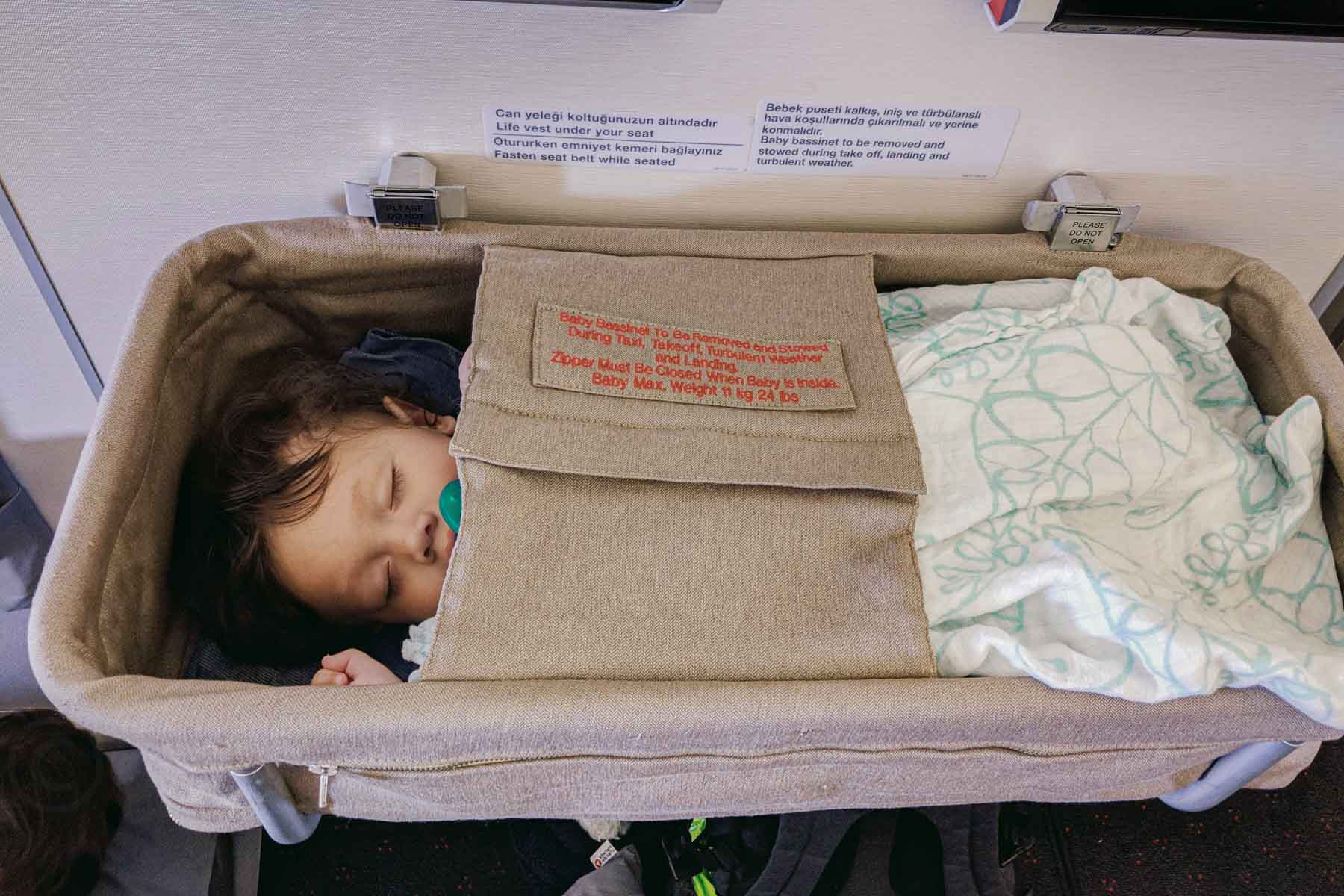
A common sweet spot for long haul travel is around six to eight months old. Babies at this stage are often curious and alert, but still fairly portable. They may sleep reasonably well and are often happy being held, fed, or entertained with simple interaction.
If you’re still deciding when to take your first big trip, I also share a deeper breakdown of timing in my guide to the best age to travel with a baby.
The stage that tends to surprise parents the most is the late baby to young toddler phase, roughly 10 months through about two years old. Kids at this age want to move constantly. They are exploring everything, testing limits, and often have a hard time sitting still for long periods. That can make a very long flight feel especially tiring for both the child and the parents.
If you’re flying with a toddler, I share specific survival strategies in my guide to surviving a long-haul flight with a toddler.

After age three, things often start to get easier again. Preschoolers can understand more about what is happening and can engage with activities, movies, or games for longer stretches. By the time kids reach five years old and beyond, long haul flights often become dramatically easier compared to the toddler stage.
That said, every child is different. Personality, temperament, sleep habits, sensory needs, and previous travel experience all play a role. Some toddlers do great on planes, and some older kids struggle with boredom or fatigue. The key is planning the flight around your specific child, not just their age.
The Toughest Stretch During a Long Haul Flight
Many parents assume the hardest part of a long flight will be the beginning. Takeoff nerves. Getting settled. The first few hours of figuring out how everything will go.
In my experience, the most difficult stretch usually happens after the halfway point but before the end of the flight.
You reach that moment where everyone realizes you’re only halfway there. Kids are getting restless. The novelty of the plane has worn off. Energy starts dipping, but you still have several hours left. It can feel like the flight suddenly slows down.

This stretch can be especially tough for kids of any age. Toddlers may want to move more. Preschoolers and elementary kids may start asking “How much longer?” every few minutes. Even adults feel that mental fatigue once the middle of a long flight drags on.
Plan ahead for this slowdown. Save something special, something novel, to get everyone through the hump.
The good news is that once you push through that middle stretch, things usually start improving again. As the flight gets closer to landing, energy tends to shift. Kids start getting excited about arriving, and the final hours often feel much more manageable than the long middle stretch.
The Flight that Scared Me the Most
One of the long haul flights I was most caught off guard by was a Houston to Dubai flight, which was about 17 hours. At the time, we were traveling with our first child, who was around 17 months old.
Up until then, our experience flying long haul with him had actually been fairly manageable. His first long haul flight was Houston to Tokyo at seven months old, and while it wasn’t easy, it was completely doable. So we went into the Dubai flight thinking it would probably be similar.
It was not.
What we didn’t fully understand yet was how dramatically different flying can feel once a baby turns into a toddler. Our toddler stayed awake for almost the entire flight, something like 15 hours straight, and it was exhausting. Not traumatic, not a disaster, but just incredibly tiring in a way we hadn’t experienced before.

Looking back, the biggest issue wasn’t the flight itself. It was that we were totally unprepared. We didn’t really think through how different a long flight with a 17-month-old would be compared to one with a younger baby.
That experience ended up teaching us one of the most important lessons about long haul travel with kids. Preparation makes an enormous difference. The flights we’ve taken since then, even with multiple kids, have all been much smoother than this one flight simply because we understood what to expect and planned for it.
Why Preparation Matters So Much on Long Flights
One of the biggest differences between a three hour flight and a 14 hour flight is that you can’t just wing it.
On a shorter flight, most families can survive by improvising. You buckle in, grab a snack, watch a show, maybe walk the aisle once or twice, and before long you’re landing. Even if parts of the flight are tough, you know it will be over soon.
Long haul flights are completely different.

When you’re staring down 15 hours on a plane, the experience becomes more like managing an entire day with your kids in a very small space. There will be times for meals, entertainment, boredom, sleep, restlessness, and probably a few emotional moments mixed in.
That’s why preparation makes such a big difference. When you bring the right things, plan realistic activities, and think ahead about sleep and routines, the flight becomes much easier to manage. Without that preparation, long haul flights can feel much more chaotic and exhausting than they need to be.
The Best Seats for a Long Haul Flight with Kids
Where you sit on the plane can make a difference on a long flight with kids. But it’s also something many parents stress about more than they need to.
When possible, many families like bulkhead seats, which are the rows with extra space in front. On some international flights, these seats also allow airlines to install a baby bassinet, which can be helpful for younger babies during part of the flight.
For toddlers and older kids, window seats can work well because kids can lean against the wall to rest and have something to look at during the flight.

If you’re traveling with multiple children, it often helps to book two seats together with a parent nearby, or an entire row if possible. That setup makes it easier to manage snacks, activities, and sleep during the flight.
Another factor many parents run into is paid seat selection. Some airlines charge extra to reserve specific seats in advance. If sitting together or securing certain seats will significantly reduce stress for your family, it may be worth paying for them when booking.
At the same time, it’s helpful to remember that seat selection isn’t everything. Families often worry that if they don’t get the “perfect” seats, the entire flight will be miserable. In reality, most long haul flights with kids are manageable regardless of the exact seats. Preparation, expectations, and what you bring on the plane usually matter much more.
Should You Bring a Car Seat on a Long Haul Flight?
Some parents wonder whether bringing a car seat onto the plane will make a long haul flight easier for their child.
From a safety perspective, the FAA recommends that children under age two ride in an approved child restraint system, such as a car seat, or CARES harness during flights. If you’re considering a CARES harness, make sure you purchase an official one, not a knockoff.
However, this is a recommendation, not a requirement. Many families instead choose to hold babies or toddlers under two as lap infants, especially on very long flights.
One practical factor that can help you decide is whether you will need the car seat at your destination. If you plan to use a car seat in rental cars, taxis, or rideshares during your trip, bringing it on the flight may make sense anyway. In that case, having your child sit in it on the plane can sometimes feel more familiar and comfortable, especially for babies and younger toddlers who are used to sleeping in their car seat.

On the other hand, traveling with a car seat through airports and onto a plane can be bulky and tiring, particularly on long international travel days. Some families prefer to check the car seat and use the regular airplane seat instead once their child is old enough.
There isn’t a single right answer for every family. Some parents prefer the added familiarity, safety, and structure of a car seat on the plane. Others prioritize simplicity and traveling with less gear. The best choice often depends on your child’s age, your travel plans at the destination, and what will make the overall trip feel more manageable for your family.
Test Things Before the Flight
One of the most helpful things you can do before a long flight with kids is test anything new ahead of time.
This might sound obvious, but many parents buy or pack things specifically for the flight and only try them once they are already on the plane. If something doesn’t work the way you expected, you are suddenly stuck dealing with the problem at 35,000 feet.
This can happen with all kinds of travel gear. Maybe you buy new headphones for your child so they can watch the seatback entertainment system, but when the flight starts, they refuse to wear them. Or you switch to a different type of bottle that’s easier to travel with, only to discover your baby won’t drink from it.
Food can create similar issues. Some parents plan to travel with powdered milk or new snacks because they are lighter or easier to pack. But if your child refuses them, you may suddenly lose one of the things you were relying on most.
The same idea applies to sleep strategies. Some families assume their child will fall asleep easily on the plane, or plan to try something new like melatonin for the first time during the flight. If it doesn’t work the way you expected, you could be left scrambling with a very overtired child.

Once, I bought my toddler a new reusable sticker book, which looked great in theory. But the stickers were smaller and thinner than I anticipated. Because of his age at the time and dexterity, he struggled to get the stickers on and off, which pretty much defeated the purpose of bringing it in the first place.
Trying things ahead of time at home can prevent a lot of these problems. Test the headphones. Let your child use the travel gear. Try the snacks or bottles. See how your child reacts.
It’s a small step that can make a huge difference once you’re actually on the plane.
Planning your own trip with kids?
I share one email a month with real-world family travel strategies, packing tips, and destination breakdowns that make planning easier.
Join below.
What to Pack for a Long Haul Flight with Kids
Packing for a long haul flight with kids doesn’t mean bringing half your house onto the plane. But a few key categories can make a huge difference in how smoothly the flight goes.
Focus on bringing items that help with entertainment, sleep, comfort, and snacks.
Entertainment
- A tablet with pre-downloaded shows or movies
- Small toys or travel games
- Coloring supplies or sticker books
- Audiobooks or music
- A favorite book or two
Headphones
- Child-size headphones for seatback entertainment or their tablet
- Soft headband headphones for younger children
Sleep Items
- Pajamas for overnight flights
- Favorite blanket or lovey
- Sleep sack for babies
- Optional inflatable footrest for toddlers
Snacks and Drinks
- Familiar snacks your child already likes
- Spill-proof water bottles
- Toddler milk or baby bottles if needed. If you’re bringing them, it helps to think through how you’ll manage them during travel. I share more in my guide to traveling with baby bottles and flying with milk for a toddler.
Backup Essentials
- Extra clothes for kids
- Wipes and tissues
- Hand sanitizer
- Small toiletries, including toothbrushes
- Plastic zip bags or wet bags for spills or messes

How to Help Kids Sleep on a Long Haul Flight
Sleep is important on a long haul flight with kids. If your child manages to sleep for even a few hours, the entire flight often feels dramatically easier.
One thing that has helped our kids is treating the plane like bedtime.
Before the flight, and again once we’re on the plane, I talk to them about what to expect. I explain that this is a sleeping plane. The flight is so long that we will get ready for bed and sleep on the airplane, just like we would at home.

Once the cabin lights start dimming, we follow a simplified bedtime routine. Kids might change into pajamas, brush their teeth, or get out their blanket or stuffed animal. Those familiar signals can help their bodies recognize that it’s time to wind down.
Different kids respond to different sleep cues. Some fall asleep more easily with a blanket, lovey, or stuffed animal.
Babies may sleep better in a sleep sack. Toddlers and preschoolers sometimes sleep more comfortably if their seat is slightly more supported with a pillow or footrest. Sleep can be one of the biggest challenges when traveling with babies, which is why I also share detailed strategies for helping babies sleep while traveling.
Of course, you can’t recreate a perfect bedroom environment at 38,000 feet. But orchestrating a few familiar cues that signal sleep, even in an unusual environment like an airplane, can make a difference.

And even if your child doesn’t sleep as much as you hoped, some rest still helps. Quiet time watching a movie, listening to an audiobook, or simply lying down can go a long way toward making a long flight feel more manageable.
Once you land, helping kids adjust to the new time zone becomes the next challenge. Our guide on jet lag in children can help with that transition.
Managing Meltdowns, Crying, and Tough Moments
One of the biggest fears parents have about a long haul flight with kids is what happens if things go wrong. A crying baby. A toddler meltdown. A child who needs to climb and run. A child who simply refuses to sleep or sit still.
The truth is, tough moments happen on long flights. Kids get tired, uncomfortable, bored, or overwhelmed. That’s completely normal when you’re asking them to spend 10+ hours in a very small space.
One of the most helpful things you can do is lower the pressure on yourself and your child. Many parents feel intense stress about how their kids will behave on a plane, especially because it’s such a public environment. But kids often pick up on that tension. The more anxious parents feel, the harder it can be for everyone to regulate when things get difficult.
Instead of expecting perfect behavior, it helps to focus on managing the moment. Walk the aisle if the seatbelt sign is off. Change activities. Offer a snack. Put on a show. Sometimes a simple reset can make a big difference.
It’s also worth remembering that most passengers are far more understanding than parents fear. Many people on long flights have traveled with kids themselves or are traveling with their own families. A child having a tough moment on a long flight is something most people recognize as part of flying.
And in reality, even flights that include some challenging moments are rarely the disasters parents imagine beforehand. Almost every family on a long haul flight has at least one moment where things feel hard. The important thing to remember is that it is just that, a difficult moment. And those moments pass.

It’s Okay to Bend Your Usual Rules
Some parents go into a long haul flight determined to keep their normal household rules exactly the same. Limited screens. Limited sweets. Strict routines.
In real life, a 14 or 16 hour flight is not a normal environment for a child.
You’re asking your kids to sit in a tight seat for an extremely long period of time, often crossing time zones, sleeping in a strange place, and navigating an unfamiliar routine. Because of that, it can help to loosen a few rules temporarily if it makes the flight smoother.

For some families, that means allowing more screen time than usual. Movies, shows, or games can fill several hours of a long flight and help kids relax when they might otherwise feel restless.
Other families bring special snacks or treats that they wouldn’t normally offer as often at home. Something small and exciting can sometimes help reset the mood when kids are getting tired or frustrated.
This doesn’t mean throwing all structure out the window. Kids still need boundaries and guidance. But allowing a little extra flexibility during a long haul flight can make the experience easier for everyone.
And once you land, routines can return to normal again.
More Doable Than You Think
It’s completely normal to feel intimidated before your first long haul flight with kids. When you picture 12, 14, or even 18 hours on a plane, it can feel intensely overwhelming.
But in reality, most long haul flights with kids end up going much better than parents expect.
There will probably be a few challenging moments. Maybe a toddler refuses to nap. Maybe your seven year old gets restless halfway through the flight. Maybe everyone feels tired and a little cranky at some point. That’s part of traveling with kids. That’s part of life with kids.
But those moments usually pass.
In our experiences, after many long haul flights with babies, toddlers, preschoolers, and elementary-aged kids, the flights themselves have never been the disaster we feared beforehand. In fact, most of them have gone surprisingly well.
What tends to matter most is preparation. When you plan ahead, set realistic expectations, and bring the right things to help your kids stay comfortable and entertained, long haul flights are far more manageable.
And once you land, the long flight quickly fades into the background as your trip begins.

Just One Day of the Trip
It’s easy to spend weeks worrying about the flight. But in reality, a long haul flight is just one day of your trip.
Yes, it can be tiring. Yes, there may be moments where everyone feels a little (maybe a lot) stretched. But with the right expectations and some preparation, most families get through long flights just fine.
And once you arrive, the long flight quickly becomes a small part of a much bigger experience. Exploring a new city, visiting family, seeing new cultures, or spending time together somewhere exciting tends to make the long travel day feel completely worth it.
For many families, that first long haul flight with kids ends up being the one that builds confidence for future travel.
Key Takeaways for Long Haul Flights with Kids
- Long haul flights are usually 8+ hours, with many international flights lasting 12–17 hours.
- Every age has different challenges, from babies to elementary school kids.
- The middle of the flight is often the hardest stretch.
- Preparation matters more than perfect seat selection.
- Bring entertainment, snacks, sleep cues, and backup essentials.
- Most long haul flights with kids end up being much easier than parents fear.
Flying Long-Haul With a Baby?
If your baby is under one and you’re preparing for an international flight, start here.
Download the Calm Long-Haul Baby Guide — a practical carry-on checklist and sleep strategy framework built for the 0–12 month stage.
Plus, I’ll send one calm, useful email per month with real-world travel guidance.
You don’t have to figure this out alone.
Frequently Asked Questions About Long Haul Flights with Kids
What is considered a long haul flight?
Most airlines consider flights of eight hours or more to be long haul flights. Many international routes between North America, Europe, and Asia fall into this category, with some flights lasting 12 to 17 hours.
Are long haul flights harder with toddlers or older kids?
Toddlers are often one of the most challenging stages because they naturally want to move and explore. However, kids of any age can find long flights tiring or boring. Each stage requires different strategies to keep kids comfortable and engaged.
What helps kids sleep on long haul flights?
Sleep cues can make a big difference. Changing into pajamas and brushing teeth, bringing a favorite blanket or stuffed animal, and following a simple bedtime routine can help signal that it’s time to sleep on the plane.
Should kids use tablets or screens on long flights?
Many families find that movies, shows, and games help pass the time on very long flights. Even families that limit screens at home often allow more flexibility during a long travel day.
What should you pack for a long haul flight with kids?
Helpful items often include entertainment, snacks, sleep items like pajamas or blankets, child-sized headphones, and basic backup essentials such as extra clothes and wipes.
Flying Long Haul with Kids is a Skill You Build
The first long haul flight with kids is usually the one that feels the most intimidating. You don’t know what to expect yet. Every unknown feels bigger than it probably is.
But like most things in parenting and travel, it gets easier with experience.
Each flight teaches you something. What your kids need. What helps them sleep. What keeps them busy. What you would pack differently next time.
And the reality is that most families get through their first long haul flight just fine. Maybe a little tired. Maybe a little rumpled. But also proud that they did it.
Long haul flights with kids are rarely perfect. But they are absolutely doable.
And once you land, the long flight quickly becomes a small part of a much bigger adventure.


