Baby’s First Flight: What to Expect and How to Prepare
If you’re preparing for your baby’s first flight, there’s a good chance your brain is running through every possible scenario right now.
What if they cry the whole time?
What if their ears hurt?
What if I forget something important?
What if this is just a terrible idea?
I’ve been there. Before our first flight with a baby, I had all the same thoughts. And now, after flying with three babies in very different stages and circumstances, I can tell you this with miles of experience: it’s not always easy, but it is absolutely doable.
Our first baby flew at just under 3 months old, and it was shockingly smooth. Our second baby’s first flight was still manageable, but now we had a toddler in the mix to throw our groove. Our third baby’s first flight was the hardest by far. We were traveling with three kids and heading across the country for her open heart surgery. Nothing about that trip felt simple.
And yet, we made it through every single one.
That’s the thing about flying with a baby. There is no perfect formula and no guaranteed smooth flight. But with the right preparation, realistic expectations, and a few key strategies, you can walk into it feeling calm, capable, and ready.
This guide will walk you through everything. How to think about your baby’s age, how to book your flight, what to pack, what to expect at the airport, and how to handle the flight itself.
If you read one thing before flying with your baby, this should be it.
Jump to: Before you book, Booking the flight, What to pack, Getting to the airport, At the airport, Boarding, During the flight, Reality, FAQs
Affiliate Disclosure: Familee Travel contains affiliate links and is a member of the Amazon Associates Program, we may earn commissions from qualifying purchases at no additional cost to you.
In a rush? Pin this or email it to yourself to read later! (Psst! Use the buttons at the very top or bottom of this post for ease.)

Before You Book: Should You Even Fly with a Baby?
When is it safe to fly with a baby?
One of the first questions most parents have is whether it’s even okay to fly with a baby in the first place.
In general, healthy, full-term babies can fly as early as a few weeks old. That said, many pediatricians recommend waiting until around 6 to 8 weeks when possible, mainly so your baby has had a little time to build up their immune system.
Ask your child’s pediatrician whether there are any concerns about your specific child.
Beyond that, it really comes down to your comfort level, your baby’s health, and your specific travel needs.
Our first baby flew at 11 weeks old, our second at 3 months, and our third at 6 months. All different stages, all different experiences, and all completely doable.
If you’re trying to decide what timing feels right, I go deeper into this here: How early is too early to travel with a baby?
What is the best age to fly with a baby?
There isn’t one perfect age, but there are definitely phases that feel easier than others.
- 0 to 4 months These early weeks can actually be one of the easiest times to fly. Babies are mostly sleeping, not mobile, and usually content with feeding and being held.
- 4 to 10 months This is a sweet spot for a lot of families. Babies are more alert and curious, but still fairly easy to entertain with new surroundings.
- 10 to 18 months This is where things get more challenging. Babies want to move, explore, and have strong opinions, but can’t yet understand why they need to stay seated.
Every baby is different, but setting expectations based on your baby’s stage makes a big difference.
If you want a deeper understanding of what to expect at each age and how that can impact a trip, you can read more here: Best age to travel with a baby.
Managing the anxiety before your baby’s first flight
This part matters more than most people expect.
For a lot of parents, the stress of the first flight starts long before you get to the airport. It’s the mental load of thinking through every detail and every possible “what if.”
What if they cry the whole time?
What if I can’t calm them down?
What if I forget something important?
I’m going to be honest. Something will probably not go perfectly. But that’s not because you did anything wrong, it’s just part of traveling with a baby.
What helped me the most was planning ahead and keeping my expectations in check. Not expecting a perfect flight, just a manageable one.
And once you get through that first flight, your confidence goes up fast. You realize you can handle it, even when it’s not smooth.
That first flight is the hardest mentally. After that, it often gets a lot easier.
Booking Your Baby’s First Flight: What Most Parents Don’t Know
Does your baby need a plane ticket?
This is one of the biggest points of confusion for first-time flyers.
If your baby is under 2 years old, they can usually fly as a lap infant, which means they don’t have their own seat and sit on your lap for the flight.
Even though they don’t have their own seat, they still need to be added to your reservation. Airlines need to account for every passenger on board, including babies.
If you show up at the airport without adding your baby in advance, they can usually still add them at check-in. But in my experience, this takes longer and adds unnecessary stress to an already busy airport day. So, ideally, add your baby to your reservation before arriving at the airport.
Should you book a seat for your baby or fly as a lap infant?
This is one of the most debated decisions when flying with a baby.
Here’s the simple breakdown:
Lap infant
- More affordable
- Baby stays on your lap
- Easier logistically, especially for shorter flights
Own seat (with car seat)
- More space for everyone
- Safer option
- Can make naps and sleep easier
With our first two babies, we flew with them as lap infants on their first flights. With our third, we bought her a seat and brought her car seat onboard.
Both approaches worked. It really comes down to your safety preferences, your budget, your flight length, and what you think will help you manage the flight best.

How to actually book a flight with a baby
This is the part a lot of parents don’t realize until they’re in the middle of booking.
In many cases, especially for domestic flights, you can’t always fully add a lap infant online when you book your tickets. You may need to:
- Book your own tickets first
- Then call the airline to add your baby as a lap infant
Some airlines do allow you to add a lap infant online, but not all do, and it’s not always consistent.
Technically, you can also add a lap infant at the airport. I’ve done it before, and it worked fine, but it slowed everything down at check-in.
Calling ahead and adding your baby in advance is usually the smoother option.
Bassinets: what they are and when they matter
If you’ve come across bassinets while researching, here’s what to know.
Bassinets are small beds that attach to the bulkhead seats on certain long-haul flights. They allow your baby to lie flat and sleep during the flight.
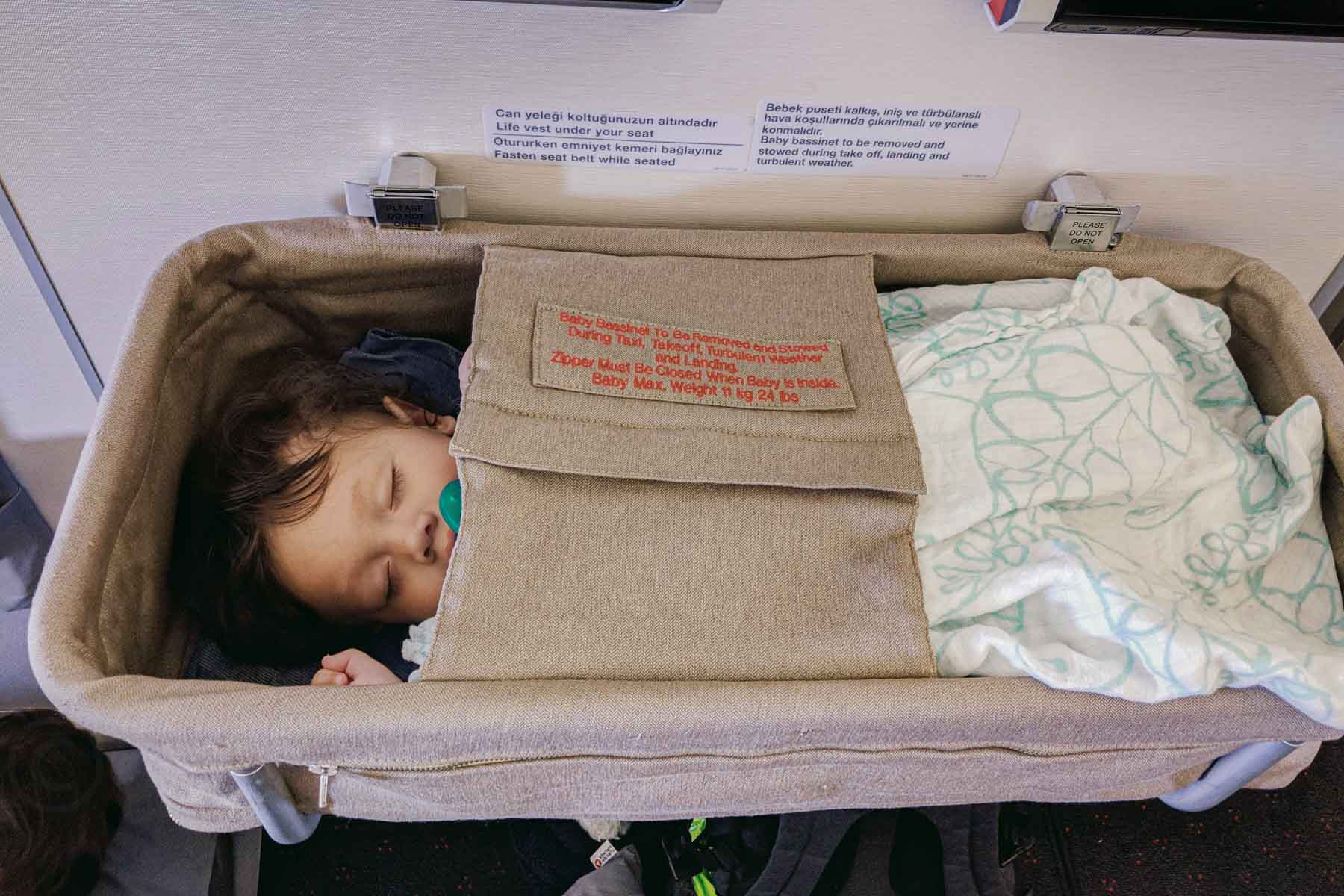
A few important things:
- They are only available on certain long-haul routes and aircraft
- There is a limited number on each flight
- They are not guaranteed, even if you request one
- Your baby must be a lap infant to use one
- Most airplane bassinets are for younger babies
We’ve used bassinets successfully on longer international routes, and they can be incredibly helpful. But for a baby’s first flight, especially if it’s shorter, this usually isn’t something you need to worry about.
If you are flying long-haul, I go into much more detail here: How to master a long haul flight with a baby.
Flying Long-Haul With a Baby?
If your baby is under one and you’re preparing for an international flight, start here.
Download the Calm Long-Haul Baby Guide — a practical carry-on checklist and sleep strategy framework built for the 0–12 month stage.
Plus, I’ll send one calm, useful email per month with real-world travel guidance.
You don’t have to figure this out alone.
What to Pack for Your Baby’s First Flight (Without Overpacking)
The balance: prepared but not overloaded
Packing for a baby can seem like so much to think about and so much to bring.
It’s easy to fall into the trap of bringing everything “just in case,” but more stuff usually makes travel harder, not easier. You end up juggling bags instead of focusing on your baby.
At the same time, underpacking can create stress if you don’t have what you need.
The goal is to find the middle ground. Bring what you’ll realistically use for the airport and flight, not your entire baby setup for the trip.
For the rest of the trip, I have a separate guide to packing light with a baby so you can keep the checked luggage under control too.
Flight-day essentials checklist
This isn’t your full packing list for your destination. This is just what you’ll want easily accessible for the airport and plane.
At a minimum, I recommend:
- Diapers and wipes – Bring more than you think you’ll need, especially for delays.
- At least 2 extra outfits – Blowouts happen. Spit-up happens. This is one of those things you don’t want to risk underpacking.
- Feeding supplies – Bottles, formula, breast pump, nursing cover, snacks, whatever your baby needs based on their age
- A lightweight blanket – Useful for warmth, naps, or just creating a more comfortable space
- A baby carrier – This is one of the most helpful tools in the airport. Being hands-free makes everything easier
- A few simple toys or books – Keep it minimal. You don’t need a full toy bag for most babies
Smart packing strategies that make travel easier
How you pack matters just as much as what you pack.
A few things that made a big difference for us:
- Use a backpack instead of a shoulder bag – Being hands-free is huge when you’re managing a baby, bags, and everything else
- Group items together – Keep outfits in one section, feeding supplies in another, diapering essentials together. This makes it much easier to grab what you need quickly
- Use small pouches or packing cubes – Instead of digging through a bag, you can pull out exactly what you need
- Keep your most-used items easy to access – Think diapers, wipes, and anything you might need quickly on the plane
If you want a deeper breakdown of gear that actually makes a difference, you can read more here:
- Baby Travel Registry
- Baby travel gear for feeding and eating
- Baby travel gear for sleep
- Why I love using packing cubes
Getting to the Airport with a Baby
This is one of the most overlooked parts of flying with a baby, and it can feel surprisingly complicated.
Before you even get to security, you have to figure out how you’re physically getting yourself, your baby, and all the stuff to the airport.
Your transportation options
What works best depends on your setup, your airport, and how much you’re bringing.
- Driving yourself – Most flexible and easiest logistically, but parking can be expensive and may require a shuttle
- Uber or taxi – Convenient, but you’ll need to install your car seat and manage loading everything
- Public transportation – More affordable and might avoid traffic, but can be harder to manage with a baby and bags
- Private car service – Easiest option if it fits your budget. Some offer car seats and extra help with luggage
There’s no one right answer. The best option is the one that feels most manageable for your family and trip situation.
What to do with your car seat and stroller
This is where things can get tricky if you haven’t thought it through in advance.
You have a few options:
- Bring your stroller and car seat through the airport and onboard
- Gate check them before boarding
- Check them at the counter
Early on, we gate checked our stroller, but over time we realized how much easier it was to travel with a compact stroller we could bring on board.
Once we switched to a travel stroller, everything felt smoother and more manageable.
If you’re considering one, we’ve used the Babyzen YOYO for years, and it’s made a huge difference: Babyzen YOYO stroller review
Why a baby carrier makes everything easier
If there’s one thing I recommend for your baby’s first flight, it’s this.
Wearing your baby through the airport makes a big difference.
It keeps your hands free, simplifies security, and often helps your baby stay calm in a busy environment.
We used an Ergo Baby carrier for all three of our babies, and it made getting through the airport feel much more manageable.
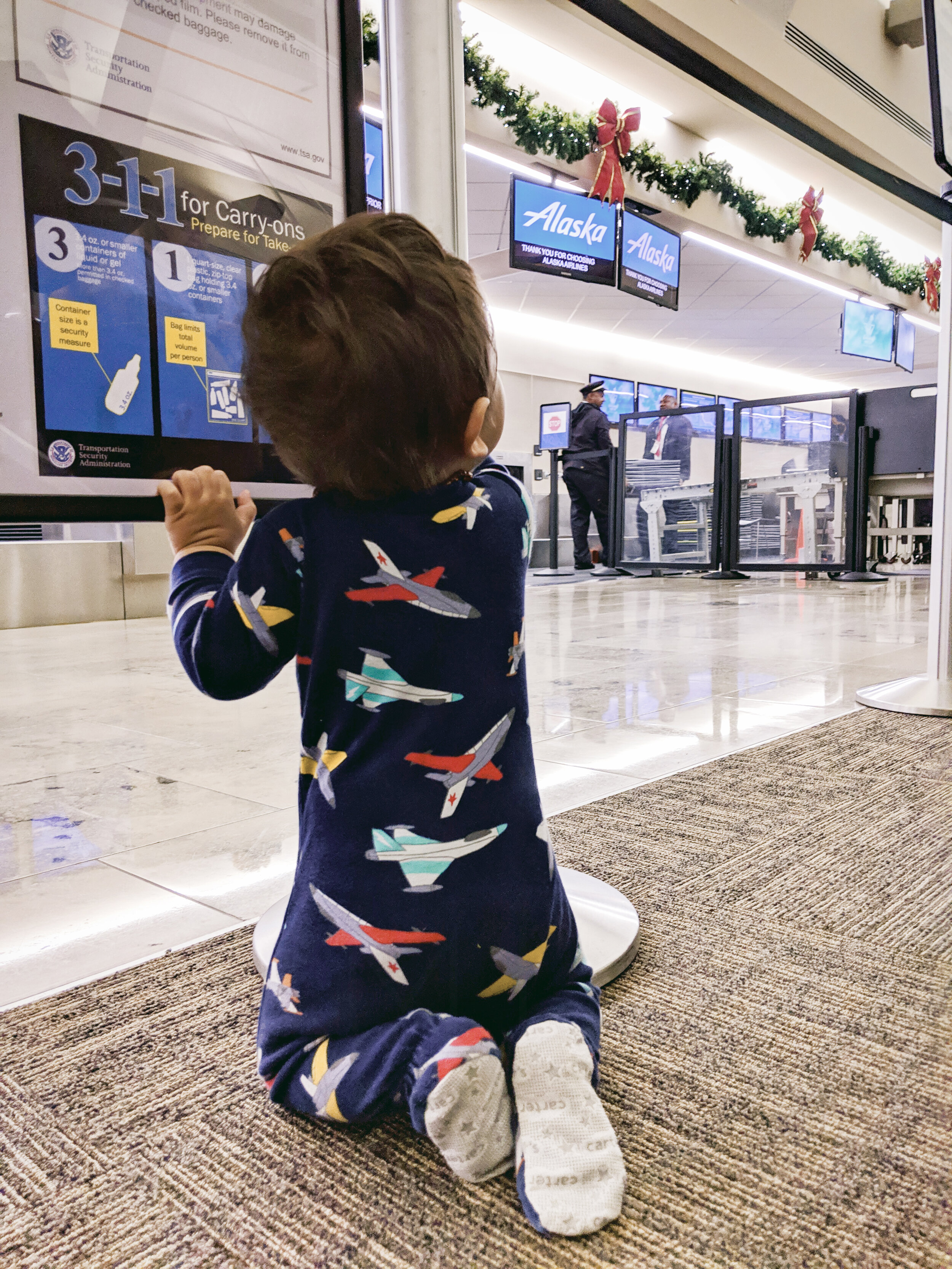
At the Airport: What to Expect Step by Step
Check-in with a baby
Even if you’re used to checking in online or at a kiosk, flying with a baby can change that.
If you’re traveling with a lap infant, many airlines will require you to check in at the full-service counter so they can verify your baby’s age. This is because lap infants must be under 2 years old.
You may be asked to show proof of age. I’ve found that a photo of your baby’s birth certificate on your phone is usually enough, so you don’t need to carry the original.
Even in cases where kiosks are available, it’s often just easier to go straight to the counter when traveling with a baby and get everything handled at once.
Going through security with a baby
This is one of the parts that feels the most overwhelming, but you manage and get through it.
If you’re using a baby carrier, this is where it really helps. In some cases, especially with TSA PreCheck, you can walk through security with your baby still in the carrier.
If you’re using a stroller, you’ll usually need to:
- Take your baby out
- Collapse the stroller
- Send it through the scanner if it fits, or have it manually checked
If you have a car seat attached, that adds another step. You’ll need to separate everything and then put it all back together on the other side.
It can feel like a lot in the moment, especially if you’re traveling solo, but just take it one step at a time.
Traveling with liquids, milk, and baby food
This is another area where parents get nervous, but the rules are actually in your favor.
For babies, items like formula, breast milk, water for mixing formula, and baby food are considered medically necessary. That means you can bring more than the standard liquid limits through security.
You may need to take them out of your bag for screening, and occasionally they’ll do additional checks, but it’s all very routine.
If you want a full breakdown of exactly what you can bring and how it works, I go into detail here: Traveling with baby bottles: navigating the airport and security
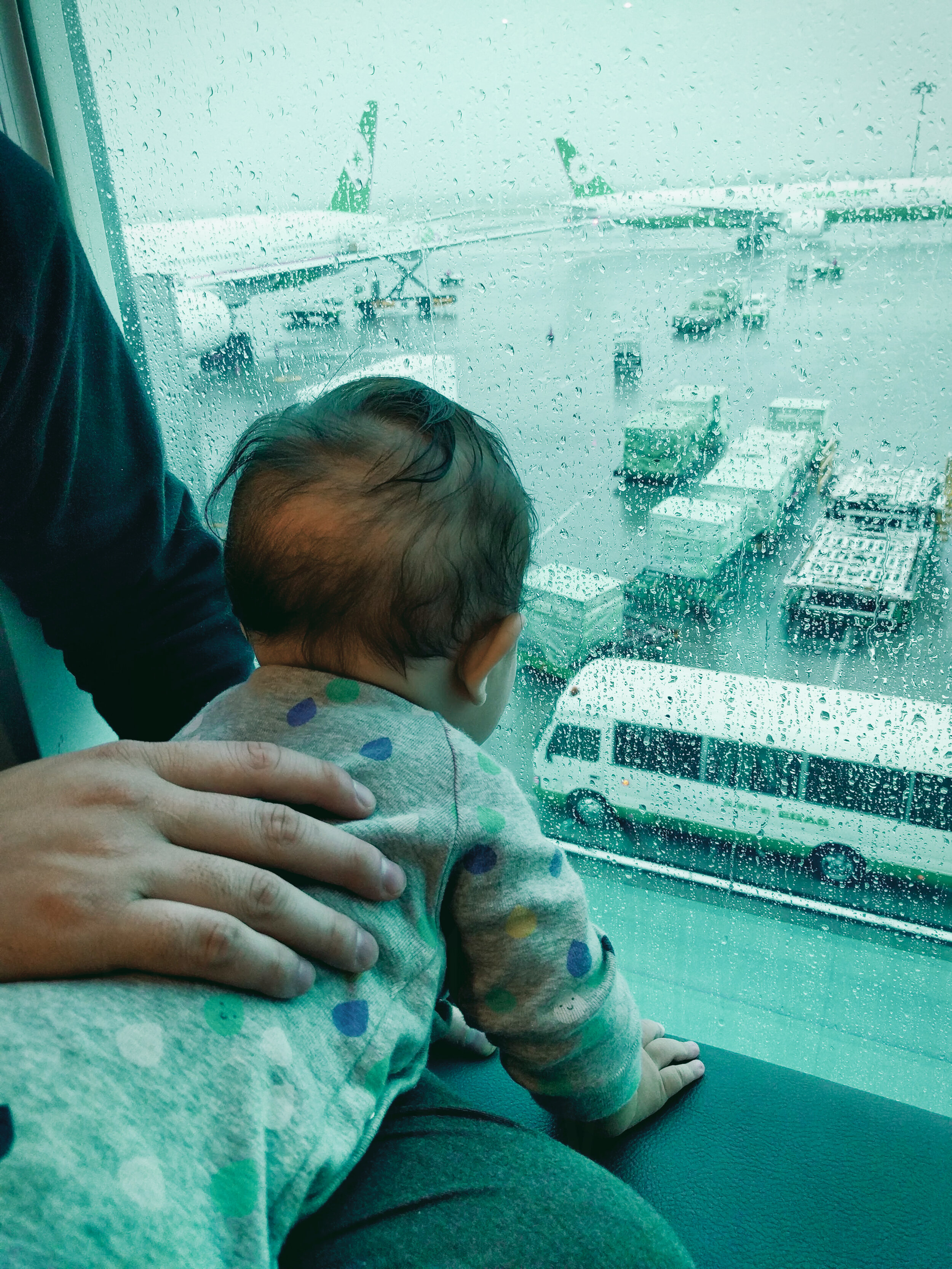
Waiting at the gate with a baby
Once you’re through security, you’ve already done a lot of the hard work.
What you do here depends on your baby’s age and energy level.
- Younger babies may be happy to stay in the carrier or stroller, feed, and rest
- More active babies may need some time to move around before the flight
If you have time, this is a good opportunity to:
- Walk around and change scenery
- Let your baby move and get some energy out
- Look for a quieter or less crowded gate area
Some airports have small play areas, which can be helpful if your baby is more mobile.
One simple tip that makes a difference. Change your baby’s diaper right before boarding, even if it doesn’t feel urgent. It can buy you more time before needing to deal with it on the plane.
Gate checking your baby gear
If you’re not bringing your stroller or car seat onboard, this happens at the gate.
Before boarding, go up to the gate agent and ask them to tag your items for gate check. They’ll give you tags, and you’ll keep the items with you until you walk down the jet bridge.
At the end of the jet bridge, you’ll fold everything up and leave it for the crew to load underneath the plane.
When you land, your items are usually brought back to the jet bridge, and you’ll wait a few minutes to get them before heading into the airport.
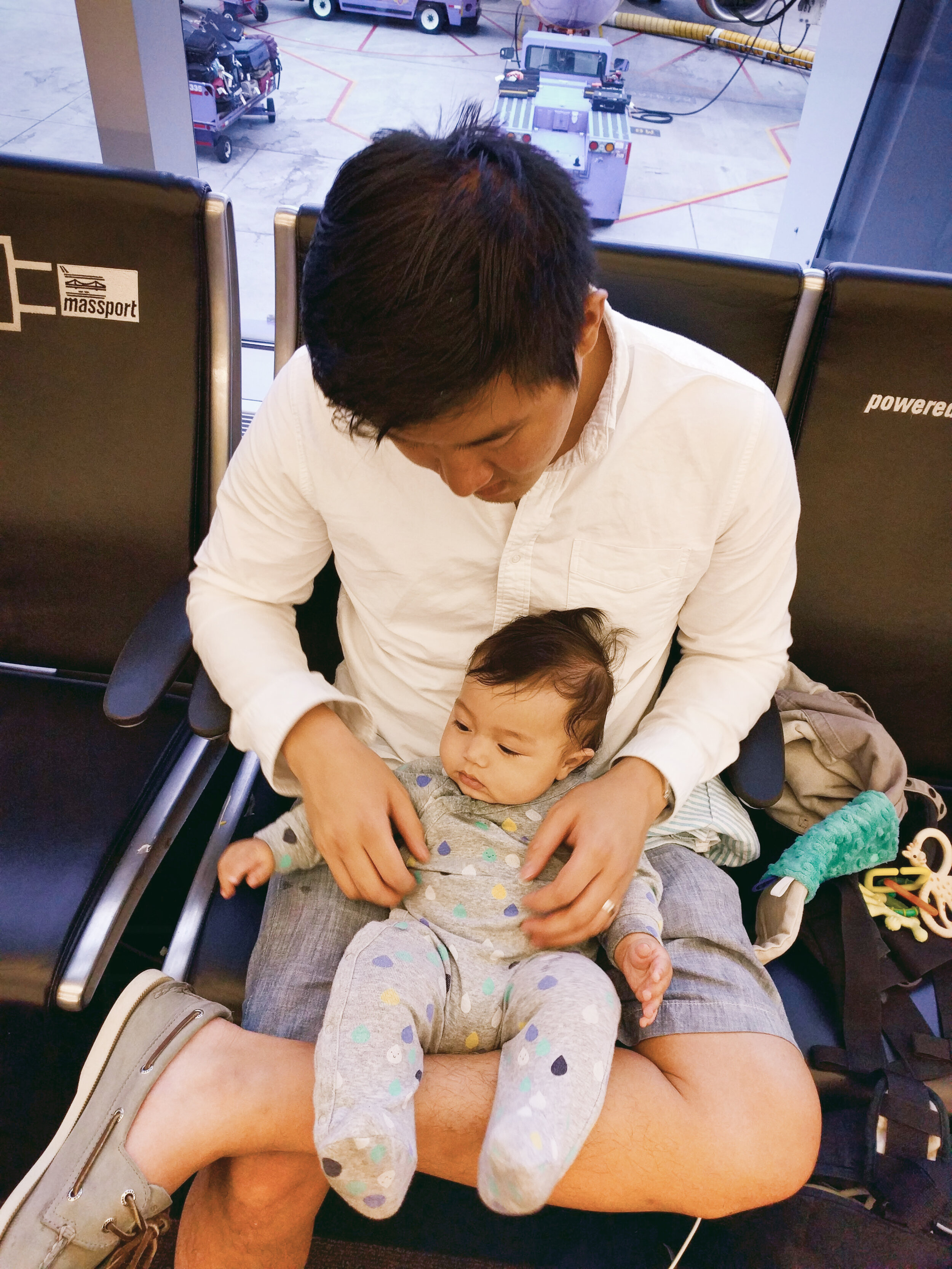
Boarding and Getting Settled on the Plane
Should you board early with a baby?
Most airlines offer some form of family boarding, especially for passengers with young babies.
Whether you use it or not comes down to your preference.
- Board early if you want time to get settled – You can organize your space, get your bags in place, and ease into the flight without feeling rushed
- Board later if your baby does better with less time confined – Some parents prefer to stay in the terminal as long as possible and board closer to departure
Personally, I almost always board early. I feel less rushed and more in control once I’m settled in my seat. But both approaches can work.
Setting up your seat for an easier flight
Before you sit back and relax, take a few minutes to set up your space so you’re not constantly digging through your bag mid-flight.
I like to pull out:
- A couple of diapers
- A small pack of wipes
- One extra outfit
- A burp cloth or blanket
- A pacifier or small toy
- My kindle
Keep these in the seat-back pocket or within arm’s reach.
Everything else can stay in your bag under the seat. That way, you’re not getting up or reaching around constantly, especially if your baby falls asleep on you.
Bringing a car seat on the plane
If you bought your baby their own seat and plan to use a car seat onboard, there are a few things to know.
- The car seat must be FAA-approved
- It needs to be installed in a window seat
- You’ll install it using the airplane seatbelt
This setup can work especially well for longer flights or for babies who sleep well in their car seat. It gives them their own space and can make the flight more comfortable for everyone.
Make sure you have a plan for getting your car seat through the airport too. You don’t want to be stuck carrying it by hand the whole way.
For an infant bucket seat, the easiest option is usually attaching it to a stroller so you can roll it through the airport and quickly detach and reattach as needed. A car seat backpack is another option that works well for some families.
If your baby is using a convertible car seat, most parents find a car seat dolly to be the easiest way to move it through the airport.
If you’re traveling with a car seat but didn’t book your baby their own seat, you can ask the gate agent if there are any open seats available. If there are, they may allow you to bring the car seat onboard and use it.
This isn’t guaranteed, and with how full flights are these days, it’s unlikely. But it doesn’t hurt to ask. If you want to guarantee that your baby has a seat for their car seat, you’ll need to book them their own ticket.
What to expect with a lap infant
If your baby is on your lap, this is how it typically works.
During boarding, you’ll carry your baby on or wear them in a carrier. In many cases, flight attendants will ask you to remove the baby from the carrier for takeoff and landing.
On some international airlines, you may be given an infant seatbelt that attaches to your own seatbelt for those phases of the flight.
Otherwise, your baby will stay on your lap for most of the flight, and you’ll adjust as needed for feeding, sleeping, and comfort.
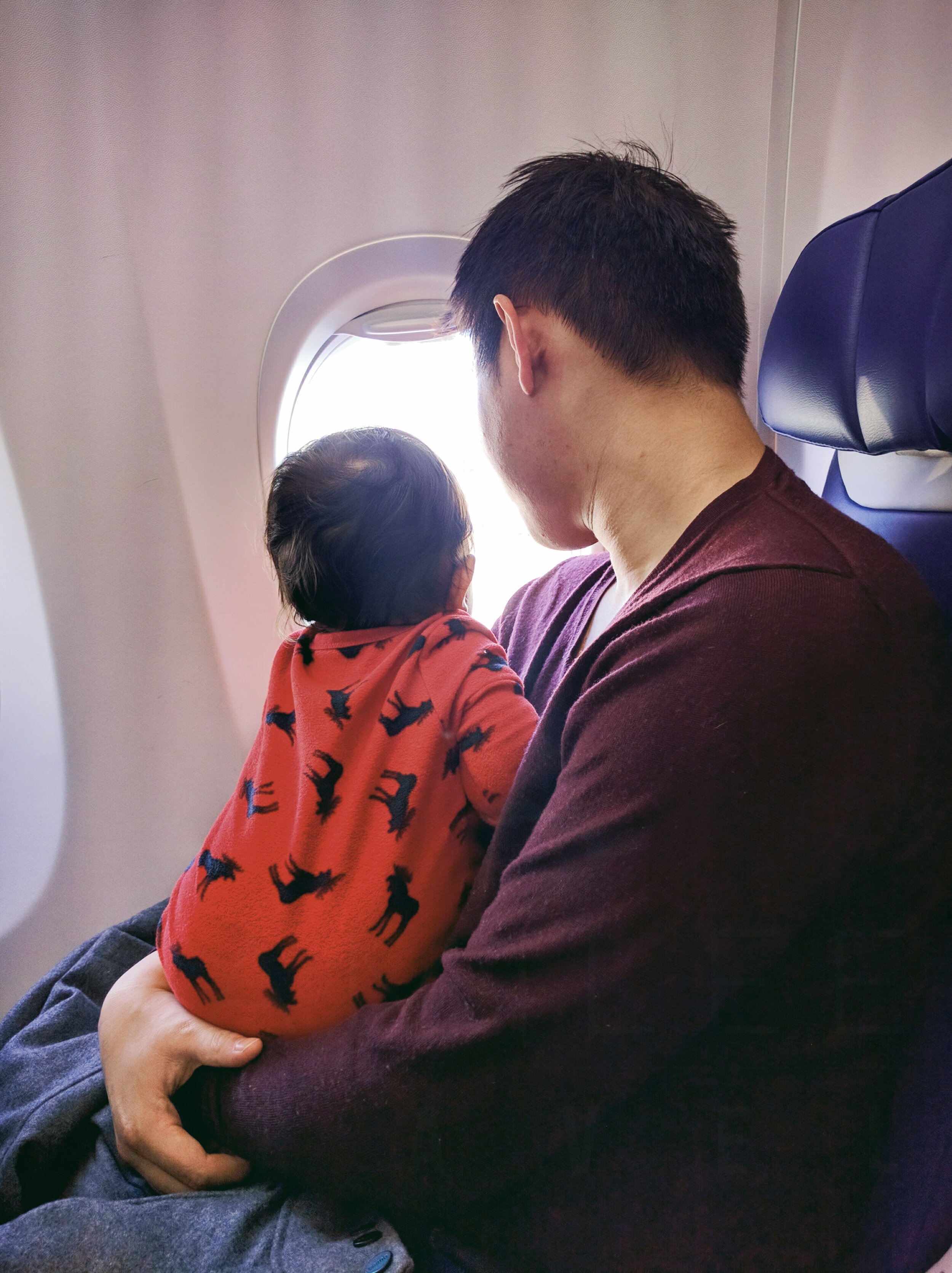
What to Expect During Your Baby’s First Flight
Takeoff and landing: helping your baby’s ears
The biggest concern for many parents is ear pressure during takeoff and landing.
The key is helping your baby swallow, which can ease the pressure change.
What works best:
- Nursing
- A bottle
- A pacifier (less effective, but still helpful)
If possible, try to time a feeding for takeoff. Even if your baby isn’t on a strict schedule, it can help to hold off slightly so they’re ready to eat during that window.
Landing is a little less predictable, but once you start to feel the pressure change, that’s your cue to offer another feed or pacifier.
Most of our babies handled this just fine. Our third baby had a harder time, and we couldn’t use feeding to help because of her medical needs. A pacifier helped some, but not as much as feeding would have.
Every baby is different, but having a plan going in makes a big difference.
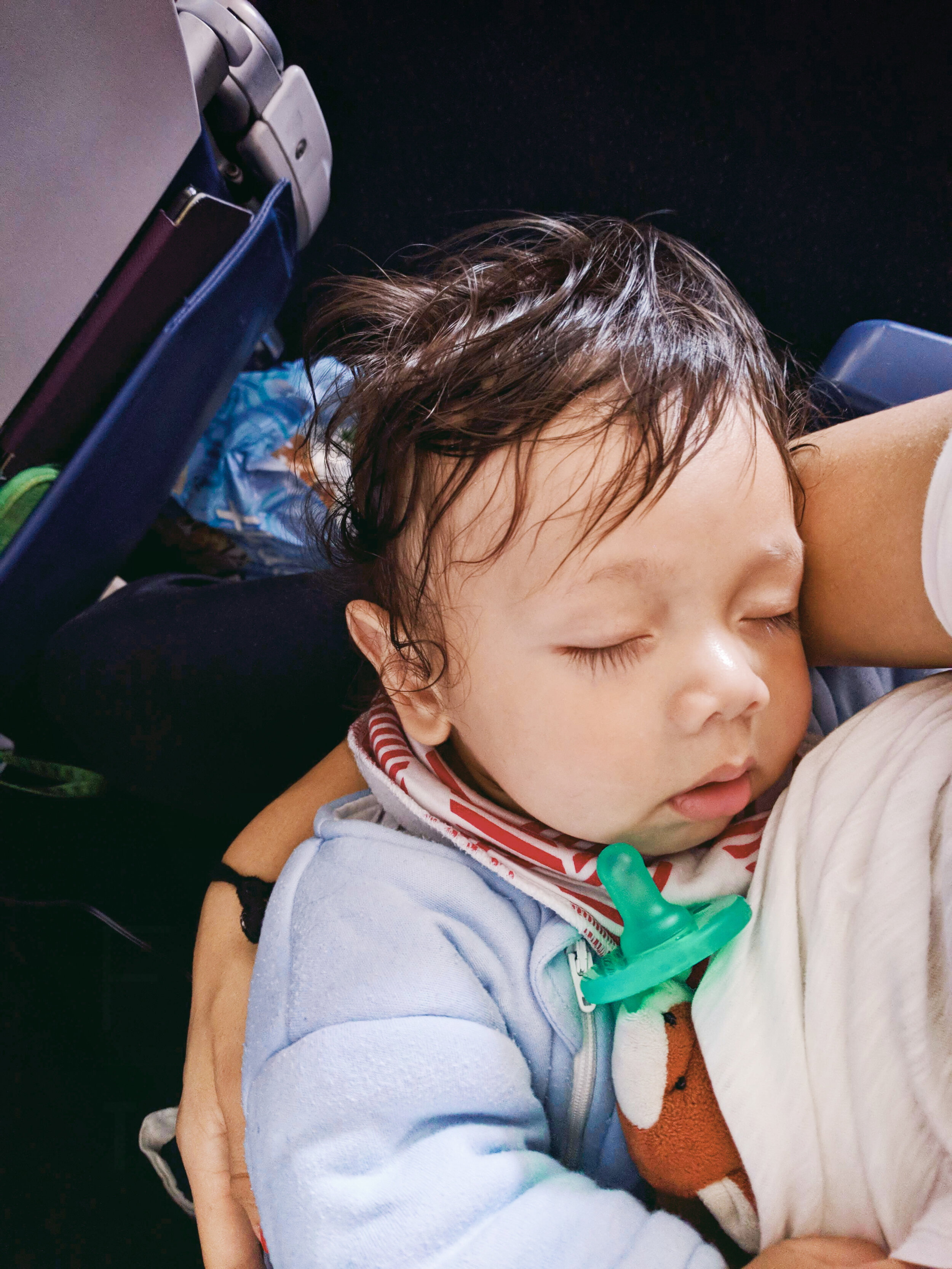
Do babies need headphones or earmuffs on a plane?
You may have seen baby headphones or noise-reducing earmuffs recommended for flights and wondered if they help with ear pressure.
They don’t.
Headphones and earmuffs can help reduce noise, but they don’t do anything for the pressure changes that happen during takeoff and landing. Ear discomfort is caused by changes in air pressure, not sound.
What actually helps is swallowing. Nursing, a bottle, or even a pacifier can help your baby adjust to the pressure change more comfortably.
That said, noise-reducing headphones can still be useful in certain situations. If your baby is sensitive to noise or has trouble settling in busy environments, they can help reduce stimulation and make it easier to rest, especially on longer flights.
For most babies, though, they’re optional. You don’t need them for your baby’s first flight unless you know your baby is particularly sensitive to noise.
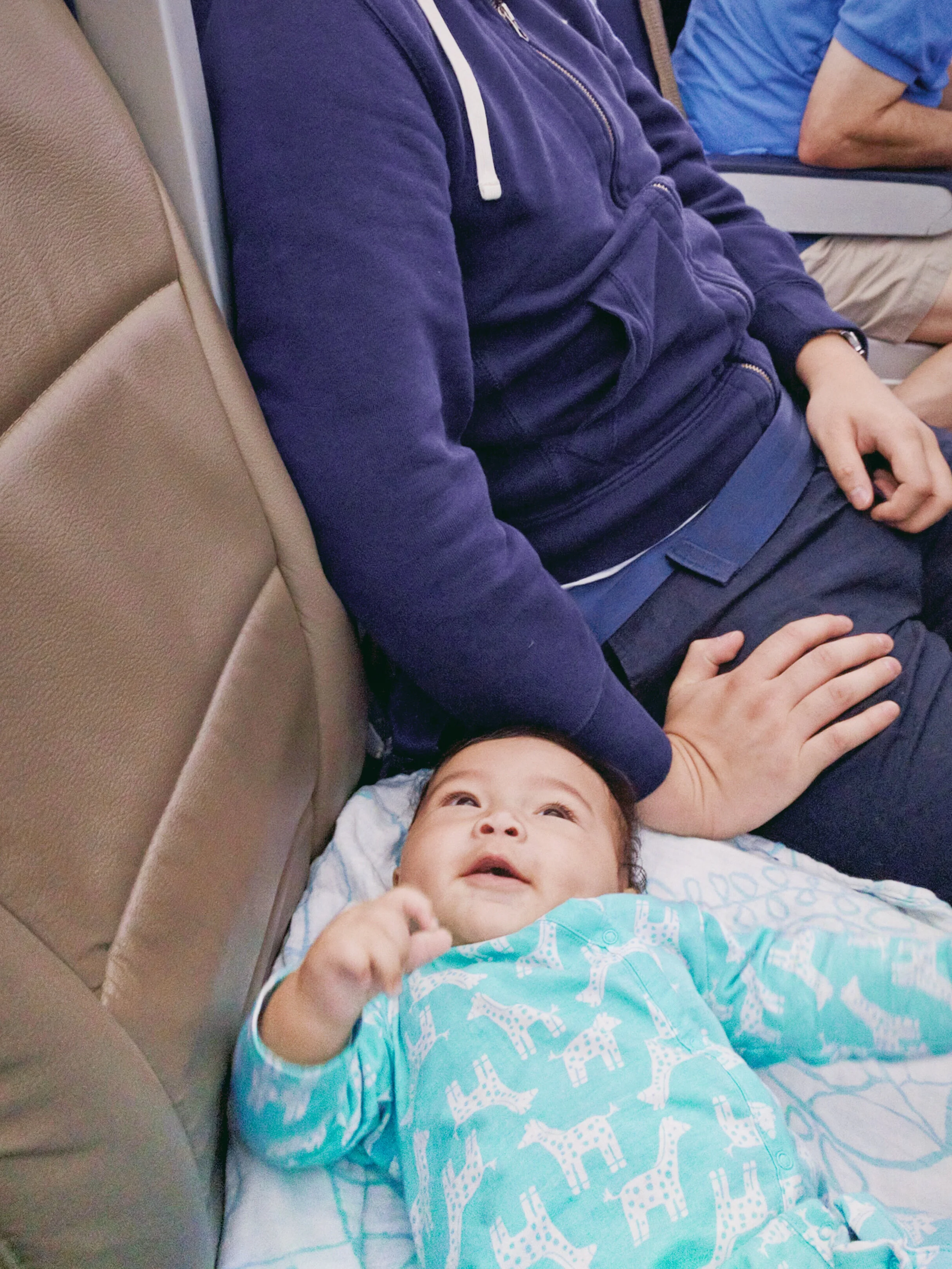
If your baby cries on the plane
This is the part a lot of parents are most anxious about.
Your baby might cry at some point. That’s normal. Babies cry. It doesn’t mean anything has gone wrong.
You are allowed to be on that plane. Your baby is allowed to be on that plane.
Most people are far more understanding than you expect. In our experience, we’ve had more smiles, kind words, and helpful interactions than anything negative.
If your baby is upset:
- Stay calm
- Talk to them
- Hold them close
- Try feeding, rocking, or walking if you can
Your presence is the most regulating thing for your baby in a completely new environment.
Feeding, soothing, and helping your baby settle
Once you’re in the air, your goal is simple. Keep your baby as comfortable as possible.
That might look like:
- Feeding
- Letting them sleep
- Talking or singing to them
- Letting them look around and take in the environment
Planes are full of new sounds, lights, and people. Some babies love the stimulation, others feel overwhelmed.
One thing that helps more than people expect is your voice. Talk to your baby, sing to your baby, even if you feel a little self-conscious. That familiar sound can go a long way in helping them settle.
Changing diapers on a plane (yes, you can do it)
It’s not glamorous, but it’s completely doable.
Most airplane bathrooms have a fold-down changing table, usually above the toilet. It’s small, but it works.
A few tips that make this easier:
- Bring just what you need into the bathroom – One or two diapers, wipes, and a small changing pad – a portable changing pad and bag can help keep everything contained and ready to go
- Always bring more than one diaper – This is one of those lessons you only need to learn once
- Use disposable pads if things are extra messy – They’re incredibly helpful for blowouts and easy cleanup
You might feel cramped, but you’ll figure out your system quickly.
Do you need toys and entertainment?
For younger babies, not as much as you might think.
The environment itself can be entertaining. New faces, new sounds, new surroundings. That goes a long way.
Bring a few simple items:
- A small toy
- A board book
- A teether
That’s usually enough.
You don’t need to pack a full activity bag. Keeping it simple makes your life easier.
If you want more ideas, I share more here: Best tips and favorite toys for entertaining babies and toddlers on a plane
Your Baby’s First Flight Might Not Be Perfect
Every baby is different, and every flight is too
One of the biggest things I’ve learned is that no two flights are the same.
Our first baby’s first flight was easy. He nursed, slept, and it all felt surprisingly smooth.
Our second baby’s first flight was still manageable, but now we were juggling a baby and a toddler. A new challenge.
Our third baby’s first flight was the hardest. We were traveling with three kids and heading across the country for her open heart surgery. She cried during takeoff and landing, and we couldn’t use feeding to help because of her medical needs.
Same parents. Same general approach. Completely different experiences.
That’s why it’s so important to go in with flexible expectations.
What actually matters is getting through it
It’s easy to feel like your baby’s first flight needs to go perfectly.
It doesn’t.
What matters is that you get through it.
You’ll figure things out as you go. You’ll adjust in real time. And even if parts of it feel messy or stressful, you’ll land and realize you did it.
And that first flight changes you.
Once you’ve done it once, the fear drops significantly. You know what to expect. You know what works for you and your baby. You feel more capable.
And this is what paves the way to traveling more as a family.
You can do this
Flying with a baby can feel intimidating before you’ve done it.
But you are more prepared and more capable than you think.
With a little planning, realistic expectations, and a willingness to adapt, it becomes something you can handle.
Maybe even something you enjoy.
And once you get that first flight behind you, it gets easier from there.
FAQs About Baby’s First Flight
Do babies need a plane ticket?
Babies under 2 years old can usually fly as a lap infant, which means they don’t need their own seat. However, they still need to be added to your reservation and issued a ticket for safety and tracking purposes.
For domestic flights, lap infants typically fly for free. For international flights, you have to pay a portion (usually 10%) for a lap infant ticket.
If you prefer more space or want to use their car seat, you should buy your baby their own seat.
Do babies need ID to fly?
For domestic flights in the U.S., babies typically do not need a formal ID. However, airlines may ask for proof of age for lap infants.
A copy or photo of your baby’s birth certificate is usually enough and easy to show at check-in.
For international flights, babies will need a passport.
What can I bring for my baby on a plane?
You can bring more than you might expect.
Items like formula, breast milk, water for mixing formula, baby food, and snacks are allowed through security in reasonable quantities, even if they exceed standard liquid limits.
You may need to remove them for screening, but they are permitted.
For a full breakdown, see: Traveling with baby bottles: navigating the airport and security
Is it better to fly with a newborn or an older baby?
It depends on your baby and your preferences, but many parents find that younger babies are easier to fly with.
Newborns and younger babies tend to sleep more and are less mobile, which can make the flight feel more manageable.
Older babies can still travel well, but may need more movement and entertainment during the flight.
You can read more here: Best age to travel with a baby
Do babies’ ears hurt on planes?
Some babies are more sensitive to pressure changes than others.
Helping your baby swallow during takeoff and landing, through nursing, a bottle, or a pacifier, can help reduce discomfort.
Many babies handle it just fine, but it’s helpful to be prepared just in case.
Should I bring a car seat on the plane for my baby?
If your baby has their own seat, bringing a car seat can be a great option. It gives them a familiar space and can make it easier for them to sleep. Having a baby properly restrained in a car seat on a plane is the safest option for them.
If your baby is flying as a lap infant, you won’t have a seat to use their car seat onboard.
What if my baby cries the whole flight?
This is one of the most common worries, and it’s completely understandable.
Your baby might cry at some point, and that’s okay. Babies cry, especially in new environments.
Focus on comforting your baby and doing your best. Most people are far more understanding than you expect, and you’re unlikely to see them again.