Getting Around Japan with Kids: Trains, Tips and What to Know
Getting around Japan with kids can feel like a lot when you first start to plan your routes. There are trains, subways, different systems, and stations that seem huge on the map.
We’ve done multiple trips as a family of five, from baby to bigger kids, and relied almost entirely on trains, walking, and the occasional taxi. Once you get your bearings, how it actually works day to day, it’s very doable and maybe even easier than you expect.
I’ll walk you through how getting around Japan as a family really works, including trains, IC cards, walking, taxis, and when it might make sense to use something else.
If you’re still planning your trip, start with our Japan with kids travel guide. It walks through where to go, where to stay, and how to plan everything step by step.
Jump to: Quick start, Ways to get around, Reality check, IC cards, Set up before your trip, Walking, Biggest mistake, Where to stay, Taxis and rides, Car rental, Strollers and accessibility, Luggage, Shinkasen vs flying, FAQs
Affiliate Disclosure: Familee Travel contains affiliate links and is a member of the Amazon Associates Program, we may earn commissions from qualifying purchases at no additional cost to you.
In a rush? Pin this or email it to yourself to read later! (Psst! Use the buttons at the very top or bottom of this post for ease.)

Quick Start – How to Get Around Japan with Kids
If you only remember a few things before your trip, start here.
- Use trains for almost everything – subways, local trains, regional trains, and the Shinkansen will get you where you need to go
- Get an IC card for each person – you can’t share, and kids need their own
- Plan fewer stops per day than you think – stations and transfers take time, especially with kids
- Budget extra time – give yourself more time than your directions suggest for getting to your destination and attractions
- Avoid rush hour – try to plan your transit outside of rush hour if in one of the major cities
- Expect to walk a lot – it’s part of the experience, not just how you get from point A to B, pack supportive shoes
- Use taxis strategically – think rain, tired kids, or airport days with luggage
- You don’t need a car in Tokyo, Kyoto, or Osaka – public transportation is easier in these areas
- Have a luggage plan – forwarding your bags can make travel days much smoother
If you keep these in mind, getting around Japan with kids feels far more manageable once you’re there.

The Main Ways to Get Around Japan with Kids
Most families rely on a mix of transportation in Japan, but it’s all built around the same core system. Once you understand how each piece fits, it starts to feel very intuitive. Like many things in Japan, transportation in Japan just makes sense.
Trains
Trains are the backbone of getting around Japan. This includes subways or metros in cities like Tokyo and Osaka, local and regional trains like Rapid Express and Limited Express (Tokkyu) trains, and longer-distance options like the Shinkansen.
You’ll likely use trains multiple times a day. They’re reliable, clean, and connect just about everything, which is why most families don’t need a car.

Walking
Walking is a bigger part of getting around Japan than some people expect.
You’ll walk between train lines, through stations, and between nearby neighborhoods or attractions. Some of our favorite moments came from this, like stumbling across a street of Korean food shops or a quiet shrine at night that wasn’t on our plan.
It’s not just how you get around, it’s part of the experience.

Taxis and ride apps
Taxis and ride apps are available and easy to use, but they’re more of a support tool than your main way of getting around.
They’re especially helpful on rainy days, late at night, or when a child falls asleep, and you just need a simple way back to your hotel.

Domestic flights
For longer distances, flying can make sense.
We used a domestic flight to get from Tokyo down to the Okinawan Island, Ishigaki. It’s not something most families need for a typical Tokyo, Kyoto, Osaka route, but domestic flights can be worth considering depending on your itinerary.
Rental cars
Most families visiting Japan don’t need a rental car.
If you’re staying in major cities and taking day trips, public transportation is usually easier. A car can be helpful in more remote areas, but it requires extra planning, including an international driving permit and car seat considerations for younger kids.
The Reality Of Using Trains in Japan with Kids
Trains are the easiest way to get around Japan with kids, but they’re not always effortless.
They’re incredibly reliable, clean, and well-connected. You can get almost anywhere using a mix of subway lines, local trains, and longer routes. Once you get the hang of it, it becomes part of your day-to-day flow.
Where families tend to struggle isn’t the trains themselves. It’s everything around them.
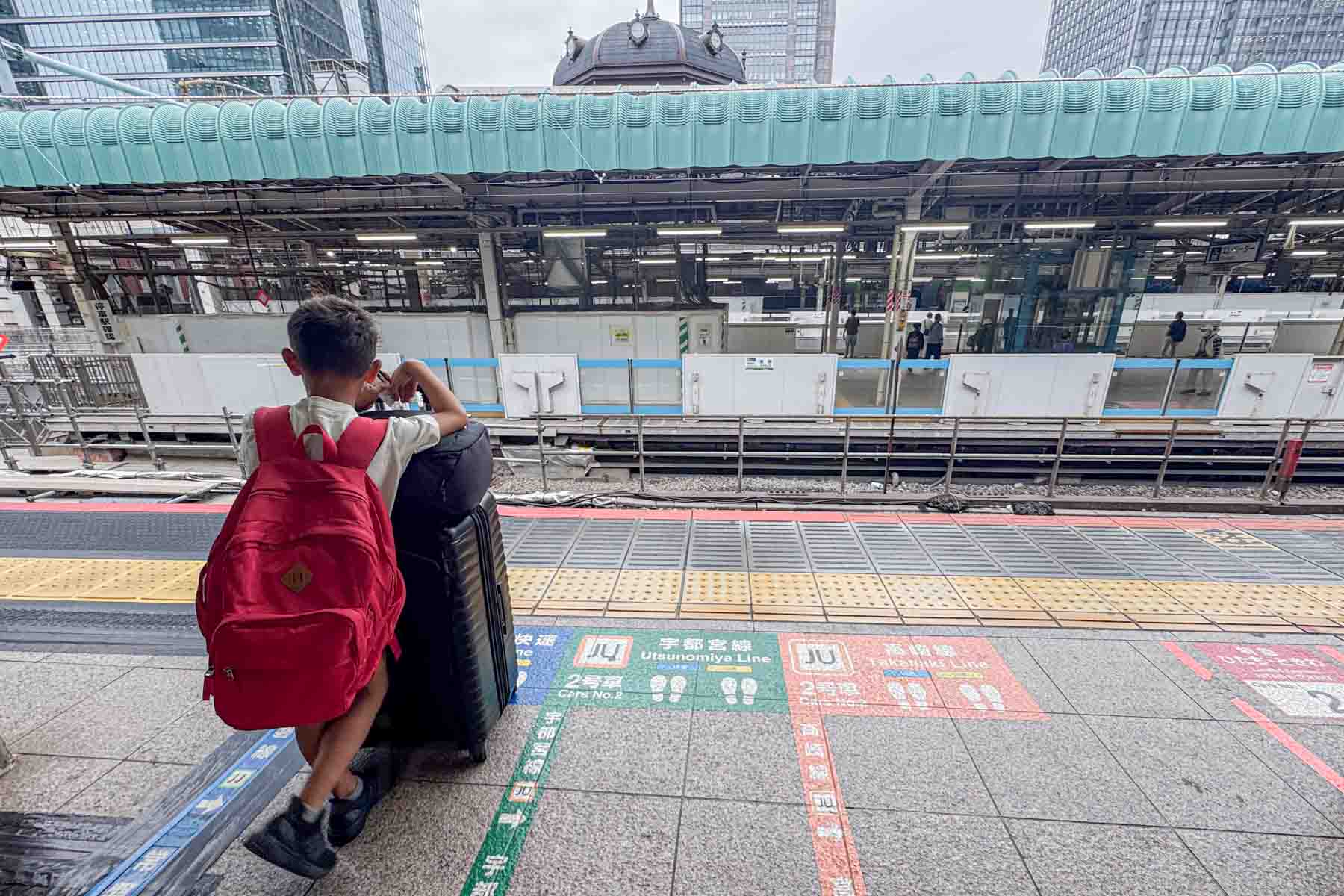
Stations can be massive. Transfers can take longer than expected. Rush hour can shock everyone. And when you stack multiple train rides, transfers, and long walking distances into one day, it can start to feel overwhelming, especially with kids.
We felt this most on days when we tried to do too much. What looked close on a map sometimes meant navigating a huge station, switching lines, and walking more than expected, all with tired kids by the end of the day.
The takeaway isn’t that trains are hard. It’s that pacing matters.
If you plan fewer stops, group activities by area, and give yourself extra time to move between places without rushing, navigating Japan with kids can feel smooth and manageable.

IC Cards in Japan – What Families Need to Know
IC cards are one of the most important things to understand before getting around Japan with kids.
Cards like Suica or Pasmo let you tap in and out of train stations instead of buying individual tickets each time. You load money onto the card, tap when you enter, tap when you exit, and it automatically calculates your fare based on distance.
It makes getting around much faster and easier, especially when you’re taking multiple trains a day.
Everyone needs their own card
This is where it gets a little trickier for families.
Each person needs their own IC card. You can’t share one card across multiple people because the system tracks where each individual taps in and out.
For adults, you can add a card to your phone, which is very convenient. But for kids, especially younger ones without phones, you’ll need physical cards.
Some travelers have successfully adding multiple IC cards on a single phone for family use, but you have to toggle which one is active and it can get confusing.
Kids’ cards are worth it
Kids don’t just need their own card. They should have a child card.
Child fares are lower than adult fares, so using an adult card for them means you’ll be overpaying. The catch is that child cards can sometimes require a bit more effort to get, depending on where you are.
We got ours easily at the airport when we landed, which I highly recommend if you can.
Train fares for kids in Japan
Train fares in Japan are age-based, and it’s helpful to understand this ahead of time when planning for your family.
- Ages 12 and up → pay full adult fare
- Ages 6–11 → typically pay about half the adult fare
- Ages 1–5 → usually ride free if they don’t need their own seat (up to two children per adult)
Once kids turn 6, they’ll need their own ticket or IC card to ride.
This is another reason it’s worth getting a proper child IC card when you arrive, so you’re paying the correct fare for your kids.

A real-life hiccup to learn from
One of our kids lost their Suica card mid-trip, and replacing it wasn’t as straightforward as we expected.
We ended up buying a Pasmo card and, for a few days, had to use an adult fare instead of a child fare because getting a replacement child card required extra steps we didn’t have time for.
It wasn’t a huge deal, but it’s a good reminder that these little logistics matter when you’re traveling as a family.
Practical tips for families
- Don’t load too much money at once, especially on kids’ cards
- Have a system so kids don’t lose their cards (lanyard, small wallet, or parent holds it)
- Plan to get cards at the airport if possible, it’s usually the easiest
Once everyone has their own IC card set up, getting around Japan becomes much more seamless.

What to Set Up Before Your Trip
A few small things set up ahead of time can make getting around Japan as a family much easier once you arrive.
You don’t need a lot, but having these ready will save time and reduce stress.
Transportation essentials to prepare
- IC card (Suica, Pasmo, or mobile version) – This is the easiest way to pay for trains, subways, and even small purchases at konbini and vending machines. Each person needs their own card, including kids. Add one to your Apple wallet for yourself before you leave, and plan to purchase a physical card for your kids after landing.
- Google Maps – Essential for navigating trains, routes, and transfers in real time. Works extremely well in Japan. Download offline maps of the areas you’ll visit so you can still navigate even if disconnected.
- Taxi apps (GO, Uber, DiDi) – You likely won’t use them constantly, but having at least one set up ready to go ahead of time is helpful.
Private airport transfers (optional)
Some families choose to book a private airport transfer in advance, especially after a long international flight.
This usually means a pre-arranged car or van that meets you at the airport and takes you directly to your hotel. Many people book these through platforms like Klook.
It’s more expensive than trains or buses, but it’s also the most straightforward option.
When this can be worth it
- After a long-haul flight with tired kids
- Traveling with a lot of luggage
- Late-night arrivals
- If you just want the easiest possible arrival experience
For many families, it’s less about cost and more about removing friction from that first day.

How this fits into your overall plan
You don’t need a private transfer to get around Japan regularly.
But for arrival day, it can be a helpful way to start your trip smoothly before switching to trains and public transportation for the rest of your stay.
Why this matters
Trying to figure these things out after you land from a long haul flight with kids, can slow you down quickly.
Once everything is set up, getting around becomes much more seamless. You can focus on getting where you need to go rather than setting up your cards and maps.
What we actually used
- IC cards daily for trains and small purchases
- Google Maps constantly
- Uber and DiDi occasionally, for convenience
Walking in Japan with Kids – The Best and Hardest Part
Walking ends up being a much bigger part of getting around Japan than most families expect.
You’ll walk through train stations, between lines, to and from attractions, and often between neighborhoods that look close on a map but take longer in real life. By the end of the day, those steps add up, especially for little legs.

But this is also where some of the best parts of your trip happen.
Some of our favorite moments in Japan came from just walking without a plan. We found a whole street of Korean food shops and stopped for a quick lunch. One night in Shinjuku, after walking a bit further out of the busy areas, we came across Shrine Homotsuden, lit up and nearly empty. In Setagaya, we stumbled into a small bakery that ended up being one of our favorite snacks of the trip.
Those moments don’t happen when you’re just moving from one planned stop to the next.

The reality with kids
Walking is amazing, but it’s also where things can get hard.
- Kids get tired faster than you expect
- Strollers help, but can be tricky in stations with lots of stairs
- End-of-day meltdowns are much more likely if you’ve been on your feet all day
We found that the hardest moments weren’t from the trains themselves, but from stacking too much walking on top of everything else.

How to make it work
- Plan fewer stops and leave space in your day
- Group activities by neighborhood to reduce backtracking
- Build in breaks for snacks, parks, or just sitting
- Expect to slow down, and plan for it
Walking in Japan isn’t just how you get around. It’s a big part of the experience. When you plan for it carefully, instead of as an afterthought, it can become one of the highlights of the trip.

The Biggest Mistake Families Make Getting Around Japan
The biggest mistake isn’t choosing the wrong type of transportation.
It’s trying to do too much in one day.
Japan is so efficient that everything looks close and easy to access when you’re planning. A few train rides, a couple of neighborhoods, one more stop before dinner. On paper, it all seems doable.
In real life, each of those steps takes more time and energy than you expect.
You’re navigating large stations, finding the right platforms, transferring between lines, and walking more than you planned, all with kids who are getting more tired as the day goes on.

What this looks like in real life
We felt this most on days when we stacked too many stops.
What looked like a quick hop between areas turned into:
- a long walk through a major station
- a transfer to another line
- more walking on the other side
- and tired kids before we even got to the next activity
It adds up quickly.
It’s tempting to try to fit in everything, especially in a city like Tokyo. Having a clear list of priorities, like these fun things to do in Tokyo with kids, can help you focus your days.
How to avoid it
- Plan fewer destinations per day than you think you need
- Group activities in the same area instead of bouncing around the city
- Leave space in your schedule for walking, snacks, and breaks
- Be okay skipping something if the day is already full
Getting around Japan with your kids works best when you slow it down.
The transportation system is easy to use. The challenge is pacing your days so it stays that way.

Choosing Where to Stay Matters More Than You Think
Where you stay in Japan has a direct impact on how easy it is to get around each day.
When you’re planning accommodations, it’s not just about the hotel itself. It’s about how that location fits into your daily movement through the city and beyond to your next destination.
What to look for
Close to a major train or subway station
This makes a huge difference when you’re heading out multiple times a day
Easy access to main lines or transfer hubs
Especially important in cities like Tokyo, where not all stations are equal
Walkable to food, convenience stores, and a few attractions
So you’re not relying on trains for every single outing

Why this matters for families
A hotel that looks great on paper can feel frustrating if:
- It requires multiple transfers just to get anywhere
- The nearest station is far or inconvenient
- You’re constantly navigating complex routes with tired kids
On the flip side, a well-located stay can make your entire trip feel easier.
You’ll spend less time figuring out logistics and more time actually enjoying where you are.
How this fits into getting around Japan
Getting around Japan isn’t just about trains and transportation systems.
It starts with where you base yourself. If you’re still deciding where to base yourself, here’s exactly how we think about where to stay in Tokyo with kids.
Choosing the right neighborhood and location can reduce how much you need to move around in the first place, which makes a big difference when you’re traveling with kids.
This is just one piece of the puzzle, but it makes a big difference in how your trip feels. If you’re still figuring out the bigger picture, our Japan with kids travel guide walks through how to plan your trip step by step.

Taxis, Uber, and Ride Apps in Japan with Kids
Taxis in Japan are not the main way most families get around, but they can be incredibly helpful in the right moments.
They’re clean, safe, and very reliable. They’re also more expensive than in many parts of the world, so it’s not something you’ll likely use all day, every day.
What it’s like to take a taxi in Japan
Taking a taxi in Japan feels a little different in the best way.
The first time we did it in Tokyo, I remember being surprised by how formal everything felt. The drivers were older, dressed professionally, wearing white gloves, and the car doors opened and closed automatically.
It felt very polished and very Japanese.
The island version was much more relaxed, a la Japanese-Hawaiian style.

Uber vs GO vs DiDi vs street taxis
You have a few options, but they all connect back to the same taxi system.
- Uber – Often functions as a way to call a taxi or a higher-end car service. We used it for an airport transfer, and once when it was raining, and one of our kids fell asleep
- GO Taxi app – A popular local app that lets you call standard taxis easily. Helpful if you don’t want to flag one down
- DiDi – Another ride-hailing app we used in Okinawa. Works, similar to Uber, connecting you with local drivers or taxis, depending on the area
- Street taxis – Easy to find in busy areas. Same pricing as app-based taxis

When taxis are worth it
Most of the time, trains are still the easier and more practical choice.
But taxis really shine in specific situations:
- When it’s raining
- When kids are exhausted
- When someone falls asleep
- When you’re traveling with luggage
- For short, direct trips
Those are the moments where paying a bit more might be worth it.

What to expect with cost
Taxis in Japan are generally more expensive than in places like Southeast Asia, and closer in price to major U.S. or European cities.
Short rides can feel reasonable, but longer distances add up quickly.
That’s why most families use taxis occasionally rather than relying on them as their main way to get around.

Do You Need a Car in Japan with Kids?
For most families, the answer is no.
If you’re staying in Tokyo, Kyoto, and Osaka and taking day trips from those cities, public transportation is easier, faster, and far less stressful than driving. Trains go almost everywhere you need to go, and you won’t have to worry about parking, navigation, or traffic.
If you’re based in Osaka, it’s also a great starting point for exploring nearby areas. Here are some of our favorite day trips from Osaka with kids to add to your itinerary.
When you don’t need a car
- You’re visiting the Tokyo–Kyoto–Osaka route
- You’re relying on trains for intercity travel
- Your itinerary is focused on cities and popular day trips
In these cases, a car usually adds more complexity than convenience.
When a car can be helpful
A rental car can make sense if you’re heading to more rural or remote areas where train access is limited or less frequent.
This is more common in places like smaller towns, countryside regions, or certain islands where public transportation doesn’t reach as easily.
What to know before renting a car
- You’ll need an international driving permit
- Car seats are required for children under 6 in rental cars
- Driving rules are strictly followed and enforced
We’ve personally never rented a car on our Japan trips, and in the main cities, we’ve never felt like we needed one.
That said, we did consider renting one in Ishigaki when we realized how hard it was to reach certain places we wanted to visit. We hadn’t planned ahead for an international driving permit, so it wasn’t an option for us on that trip.
For most families, sticking with trains, walking, and the occasional taxi is the easiest way to get around Japan with kids. But if you’re heading somewhere more remote, a car can be worth planning for in advance.

Strollers, Stations, and Accessibility
Japan is generally very stroller-friendly, but it’s not always as easy as you might expect.
Train stations have elevators, escalators, and wide gates for strollers, and you can usually find a path that works. There are also clean, accessible restrooms in stations, which is a huge help when you’re out all day with kids.
The reality in stations
The challenge is that stations can be very large and spread out.
Not every entrance or exit has an elevator, and sometimes the most direct route is stairs. You can go out of your way to find an elevator or escalator, but it often takes longer and adds extra walking.
A lot of times, we found it faster to just carry the stroller up or down a set of stairs and keep moving.

Beyond the stations
Once you’re out exploring, stroller access can vary more.
Many temples and shrines have:
- Gravel paths that are harder to push through
- Stairs at entrances or throughout the grounds
- Uneven walking surfaces
Some are easier than others, but it’s not something you can always predict ahead of time.
We often ended up using a baby carrier when our baby was younger. Or taking turns carrying the stroller or leaving it to the side briefly while exploring certain areas. If you’re planning a trip with a baby, our guide on traveling to Japan with a baby can help with more baby-specific details.

A helpful tip
If you’re using Google Maps, you can turn on the accessibility setting.
It’s designed for wheelchair users, but it works well for strollers too. It will try to guide you toward routes with elevators and easier access points, which can save time and frustration.
What works best
- A lightweight, easy-to-fold travel stroller
- Being flexible with your route when needed
- Expecting that not every path will be perfectly smooth
Overall, getting around Japan with a stroller is very doable. You just need to be prepared for a mix of easy access and the occasional workaround.


Luggage Strategy – The Secret to Making Japan Easier
Traveling around Japan with your kids gets a lot harder when you add luggage into the mix.
Trains are easy. Stations are manageable. But navigating both while carrying multiple suitcases, a stroller, and kids can quickly turn into a stressful mess.
Why luggage makes things harder
- You’ll be walking through large stations
- Not every route has an easy elevator option
- Trains can get crowded, especially during busy times
- Managing bags and kids at the same time is a lot
Even short travel days can feel overwhelming if you’re dragging everything with you.
What makes it easier
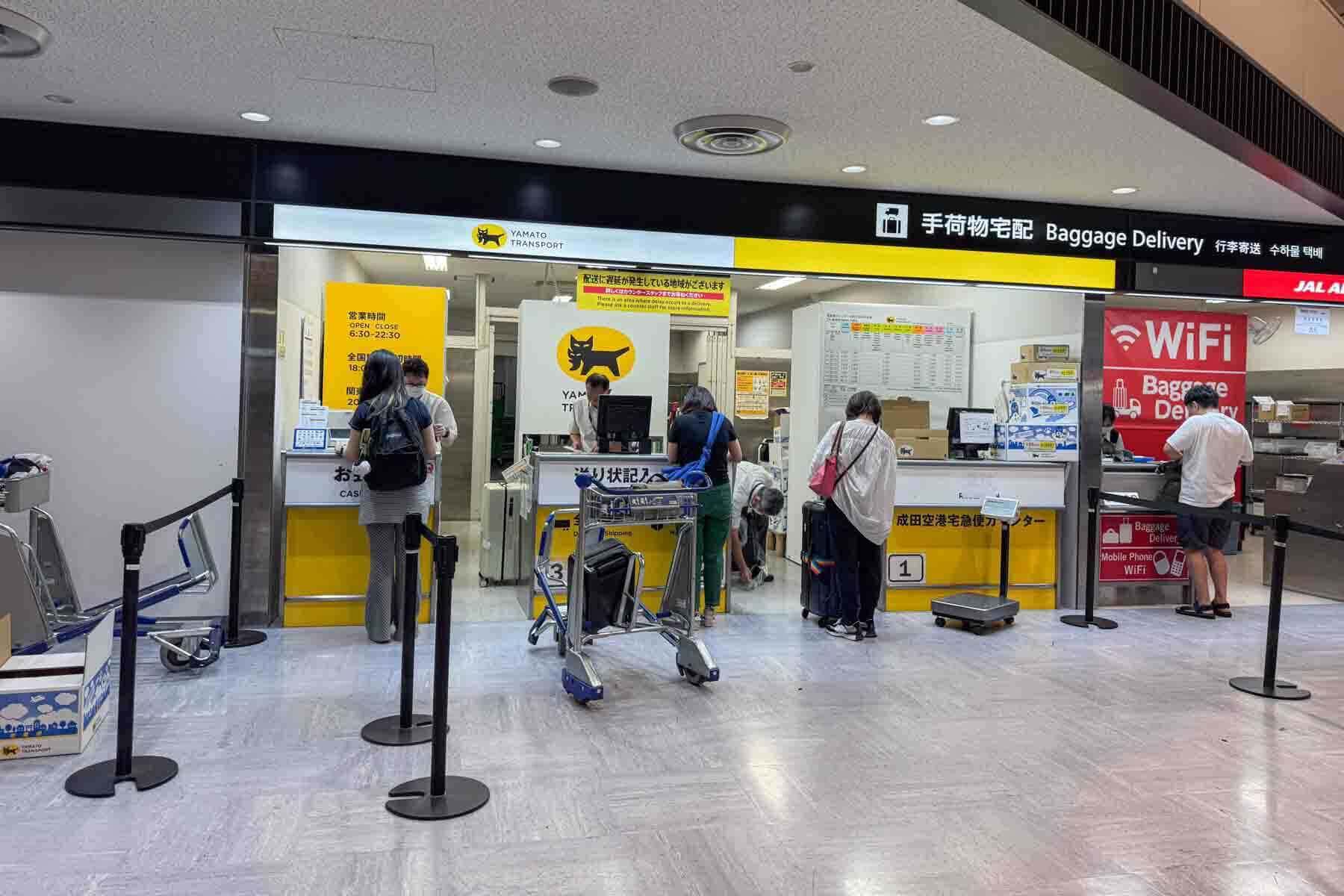
This is where Japan’s luggage delivery service can completely change your experience.
Instead of bringing your suitcases with you, you can send them ahead to your next hotel and travel with just a small overnight bag.
It makes moving between cities and even between neighborhoods feel significantly lighter and more doable.
What we recommend
If you’re moving between cities or hotels, especially with kids, it’s worth planning to use luggage forwarding at least once during your trip.
It turns stressful travel days into a more relaxed journey.

Shinkansen vs Flying with Kids
If you’re traveling between cities in Japan, you’ll usually be choosing between the Shinkansen and flying.
Sometimes you have a choice. Other times, you don’t.
When to take the Shinkansen
For most families doing the Tokyo, Kyoto, Osaka route, the Shinkansen is the easiest option.
- Stations are centrally located
- No airport security or long check-in times
- Frequent departures throughout the day
- Comfortable and straightforward with kids
It’s also part of the experience. Riding the high-speed train is something many kids get excited about, and it’s a very smooth, predictable way to travel between cities.


When flying is required or makes more sense
In some cases, flying isn’t just an option. It’s necessary.
For example, if you’re heading to Okinawa or Ishigaki, you’ll need to fly. There’s no train option to reach these islands.
For other routes, like Tokyo to Sapporo or Tokyo to Fukuoka, you can choose between flying or taking the train. In those cases, it comes down to time, cost, and how you want your travel day to feel.
We flew from Tokyo to Ishigaki, and it made sense for that part of the trip.

How to decide
- Main city routes (Tokyo, Kyoto, Osaka) → Shinkansen is usually easiest
- Islands like Okinawa or Ishigaki → flying is required
- Longer routes with both options → compare time, cost, and logistics
For most first-time trips, you’ll rely heavily on the Shinkansen. But for repeat visitors, once you start venturing further, flights can become an important part of traveling around Japan with kids.

Sample Routes – What This Looks Like in Real Life
It helps to see how all of this actually plays out day to day.
Most of the time, getting from place to place in Japan with kids isn’t about choosing one type of transportation. It’s about combining a few different ones in a way that feels manageable.
Example 1: Tokyo to Osaka
This is one of the most common routes for families.
- Get to a central station like Tokyo Station
- Take a direct Shinkansen to Shin-Osaka
- Continue by local train or short taxi to your hotel
This is typically the easiest and most straightforward option. It’s fast, simple, and doesn’t require dealing with airports.

Example 2: Tokyo to Fukuoka (train vs flight)
This is where the decision becomes more real.
Shinkansen:
- Direct and straightforward
- No airport logistics
- But a long travel day
Flight:
- Much faster overall
- But requires getting to the airport, security, and transfers
For routes like this, families often weigh convenience vs total travel time.
If you want the simplest experience, the train can still work. If you want to save time, flying may be the better option.
Example 3: A typical day in Tokyo
A normal day often looks like a mix of walking and trains.
- Walk from your hotel to the nearest station
- Take a subway or local train to your first area
- Walk between nearby attractions, shops, and restaurants
- Possibly take another short train ride to a second area
- Walk back to your hotel or take a final train ride
Even on a simple day, you’ll likely combine walking with two or three (or six) train rides.
If you’re planning your time in the city, here are 60+ fun things to do in Tokyo with kids to help you map out your days.
What to notice
- You’re rarely using just one form of transportation
- Walking is always part of the day
- The goal is to keep things simple and grouped by area
What it Really Feels Like to Get Around Japan with Kids
Getting around Japan as a family might feel like a lot when you’re planning, but once you’re there, it starts to feel very natural.
Trains are reliable, walking becomes part of your day, and you’ll quickly find a rhythm that works for your family.
The biggest challenge isn’t mastering the system. It’s planning your days so you can move through them without rushing.
When you do that, getting around Japan with kids doesn’t just feel manageable. It becomes part of what makes the trip so enjoyable.
If you’re still working out your full itinerary, you can also read our complete Japan with kids travel guide for everything from where to stay to what to do.

FAQs About Getting Around Japan with Kids
Do you need a car in Japan with kids?
No, not for most trips.
If you’re staying in Tokyo, Kyoto, and Osaka and taking day trips, public transportation is easier and more convenient than driving. Trains will get you almost everywhere you need to go.
A car can be helpful in more remote areas, but it requires extra planning, including an international driving permit and car seat considerations.
Is Japan easy to get around with kids?
Yes, once you understand how it works.
Trains are reliable, stations are well-organized, and everything runs on time. The biggest challenge for families is usually not the system itself, but pacing your days and managing walking and transfers.
Do kids need their own train card in Japan?
Yes.
Each person needs their own IC card because the system tracks where you tap in and out. Kids should have a child card so you’re not paying adult fares.
Is the Shinkansen good for kids?
Yes, it’s very family-friendly.
It’s clean, comfortable, and easy to navigate. There’s space for luggage, bathrooms on board, and it’s a smooth ride. Many kids also get excited about riding the high-speed train.
Can you use Uber in Japan with kids?
Yes, but it’s not the main way to get around.
Uber is available, though it often connects you with licensed taxis or higher-end car services. Many families use it occasionally for things like airport transfers, rainy days, or late nights.
Is Japan stroller-friendly?
Mostly, yes.
Train stations have elevators, wide gates, and accessible restrooms. But you’ll still run into stairs, large stations, and places like temples or shrines with gravel paths and uneven surfaces.
A lightweight travel stroller can help you stay flexible.
Do you have to walk a lot in Japan with kids?
Yes.
Walking is a big part of getting around Japan, from navigating stations to exploring neighborhoods. It’s also where many of the best moments happen, but it’s important to plan your days with that in mind.
Is it better to take the train or fly in Japan with kids?
It depends on the distance.
For routes like Tokyo to Kyoto or Osaka, the Shinkansen is usually easier. For longer distances, like traveling to Fukuoka or Okinawa, flying may save time or be required.
More reading on Japan:
- Japan with Kids: The Complete Family Trip Guide
- Where to Stay in Tokyo with Kids
- Day trips from Osaka to take with Kids
- 60+ Family Friendly Things to Do in Tokyo
- Traveling to Japan with a Baby
Planning your own trip with kids?
I share one email a month with real-world family travel strategies, packing tips, and destination breakdowns that make planning easier.
Join below.