
12 European Destinations to Visit with a Toddler, From Our Own Travels
Traveling Europe with a toddler can sound like a lot. Cobblestones and crowded cities, stairs and long sightseeing days, quiet museums and ancient, fragile artifacts. But after bringing our toddlers everywhere from Rome and Santorini to Naxos, Kotor, Brașov, and beyond, I’ve been reminded again and again that a destination doesn’t need to be perfectly easy to be worth it.
I’ve personally visited every place on this list with a toddler. Some required surprisingly little effort. Others took more flexibility, more carrying, or a little extra planning. I’d still recommend all of them, just for different families and different kinds of trips.
And I’m not calling these the 12 “best” places in Europe with toddlers. Europe is huge, and there are other incredibly family-friendly destinations I’ve visited without a toddler that aren’t included here.
Instead, these are 12 European destinations I can speak to from firsthand experience, including what worked, what didn’t, and what I’d want another parent to know before going.
And if getting across the Atlantic feels more intimidating than choosing where to go, I also have a full guide to surviving a long-haul flight with a toddler based on what has worked for us over years of flying internationally with young kids.
Traveling with a younger baby instead? I’ve also shared 20 surprisingly baby-friendly travel destinations around the world, based on our own and our travel friends’ family travels.
If ease is your top priority, Lake Garda, Naxos, Kos, Brașov, and Munich were some of the places that worked most naturally for us. But if your heart is set on somewhere like Rome, Venice, or Santorini, I wouldn’t rule those out just because you have a toddler.
Jump to: Toddler-friendly considerations, Quick destination comparison, Rome, Venice, Lake Garda, Athens, Santorini, Naxos, Milos, Kos, Kotor, Brasov, Basel, Munich, Good to know, FAQs
Affiliate Disclosure: Familee Travel contains affiliate links and is a member of the Amazon Associates Program, we may earn commissions from qualifying purchases at no additional cost to you.
In a rush? Pin this or email it to yourself to read later! (Psst! Use the buttons at the very top or bottom of this post for ease.)

What Makes a Destination Toddler-Friendly?
There’s no single definition of a toddler-friendly destination. Every family has different priorities, and every toddler has different needs.
For me, two things matter most: whether toddlers (and their parents) feel welcome and whether they have safe spaces to move.
Toddlers need room to move
A playground is great, but it doesn’t have to be a playground.
Pedestrian-only streets, big town squares, waterfront promenades, beaches, parks, and car-free old towns can work just as well.
Some of our easiest travel days happened in places where our toddler could simply walk, wander, and explore alongside us instead of constantly being pulled back from traffic or strapped into the stroller.

Feeling welcome matters
Traveling with a toddler is much easier when you don’t feel like your child is disrupting everyone around you.
That doesn’t mean every restaurant needs a kids menu or every waiter needs to fuss over your toddler. It’s more about whether children seem like a normal part of everyday life.
We’ve traveled places where people went out of their way to smile, play, and engage with our kids, and others where families were simply left to do their thing. Both can work.

Toddlers don’t always need toddler attractions
I think parents sometimes put a lot of pressure on themselves to find enough things for their toddler to “do.”
But toddlers can be satisfactorily entertained by the world around them.
Boats in Venice. Rocks and caves in Milos. Blue domes in Santorini. Cats wandering an old town. A huge open square. A tiny neighborhood slide. Or just rocks on the side of a walkway.

A destination doesn’t necessarily need to entertain your toddler. It needs to make it reasonably easy for your toddler to participate in the trip.
That won’t work exactly the same way for every child. Some toddlers need regular playground breaks, familiar routines, quieter spaces, sensory downtime, or more structured activities. That’s completely valid.
The point isn’t to avoid or obsessively seek out kid-focused activities. It’s simply that you may not need to build your entire trip around them.
The flight is a little different. I’m much more intentional about having a few distractions ready for long travel days, and I’ve shared the airplane toys and activities that have worked best for our toddlers separately.

Quick Comparison of These European Destinations with Toddlers
This isn’t a ranking. Some of these destinations were easier than others, but each works for a different type of family or trip.
| Destination | Particularly Good For | Stroller Reality | Toddler Freedom | Main Consideration |
|---|---|---|---|---|
| Rome | Bucket-list history | Mixed | Good in piazzas | Some major sights are difficult with a stroller |
| Venice | A unique trip worth adapting for | Doable, but bridges add work | Mixed | Canals require close supervision |
| Lake Garda | Nature, towns, swimming, easy family fun | Very workable | Excellent | Stay strategically if you won’t have a car |
| Athens | Ancient history | Mixed | Good in some areas | Major sights add stroller challenges |
| Santorini | A long-dreamed-about trip | Works well in parts | Good in pedestrian villages | Stairs, cliffs, adult-oriented spaces |
| Naxos | Beaches, culture, relaxed island travel | Generally workable | Excellent | Terrain varies outside town |
| Milos | Natural beauty and adventure | Activity-dependent | Good outdoors | Getting around takes planning |
| Kos | Easy logistics and beaches | Easy where we stayed | Excellent | More tourism-oriented |
| Kotor | Atmospheric old-town exploring | We used carriers | Excellent in Old Town | Hiking requires a different setup |
| Brașov | History without big-city intensity | Bumpy but doable | Excellent | Cobblestones and uneven paving |
| Basel | A regional Switzerland base | Mixed | Some | Hills, stairs, high costs |
| Munich | Easy big-city family travel | Easy | Good | Appeal is overall ease rather than one standout attraction |
Rome: Bucket-List History with Some Extra Friction
We first visited Rome when our oldest two were 2.5-years-old and 6-months-old, and more recently with our youngest as a 3-year-old. Rome is typically a destination that makes the extra effort worthwhile.
Particularly good for: Families who don’t want to put a major bucket-list history trip on hold during the toddler years.
Know before you go: A stroller is useful around plenty of Rome, but it won’t work everywhere, including some of the historic sights you may most want to see.


Rome is incredible. There is so much history layered into the city that you don’t have to work very hard to make the day interesting, even for a toddler. There are fountains, ruins, piazzas, people, food, and something new constantly happening around you.
Those piazzas and pedestrian areas are especially helpful with toddlers because they provide space to get out of the stroller and move.
We also found Italy welcoming toward our kids overall. Rome had more big-city energy than some smaller Italian destinations we’ve visited, and restaurants can be tight, but we never felt like bringing young children was a problem.
Food is another easy win. Pasta, pizza, bread, and simple familiar options make it relatively easy to find something many toddlers will eat.


The stroller is where things get trickier. We used ours throughout much of the city, but the Roman Forum is a good example of an area where ancient, uneven terrain makes it much less practical.
That becomes even more important in summer heat. If your toddler won’t walk far and carrying them sounds miserable, you need a plan for those moments.

Rome isn’t the smoothest destination on this list. It’s crowded, accommodations can be expensive for the space you get, and some sightseeing takes extra flexibility.
But if Rome is somewhere you’ve always wanted to go, I wouldn’t avoid it because you have a toddler.


Venice: More Doable Than Its Reputation
We spent three nights in Venice with our 2.5-year-old and 6.5-month-old baby, and it was much more manageable than I expected.
Particularly good for: Families willing to accept some extra logistical effort for a destination unlike anywhere else.
Know before you go: Venice isn’t stroller-friendly in the traditional sense, but that doesn’t necessarily mean leaving the stroller behind is easier.


Before our trip, I had heard plenty about how difficult Venice is with a stroller.
And yes, the bridges are a pain.
We sometimes had to pick up our lightweight YOYO and carry it over the steps. But between the bridges, we used it plenty.
For us, that tradeoff was worth it. It was hot, we were already carrying our baby, and I didn’t want to carry our toddler everywhere too. The stroller also held bags and all the extra stuff that comes with traveling with two very young kids.
Venice itself provides plenty of entertainment.
There are boats everywhere. We rode the vaporetto, watched traffic on the canals, wandered through piazzas, and took a boat out to colorful Burano.


Even just walking around Venice feels unusual enough to keep a little kid interested.
The canals do mean toddlers can’t free-roam everywhere. If you have a child who darts away, you’ll need to stay especially close around the water. We were also traveling with extended family on this trip, so having extra adults helped.
I wouldn’t call Venice effortless with a toddler.
But I also wouldn’t skip it because you’re traveling with young kids. For us, it was much more doable than its reputation suggested.


Lake Garda: One of the Easiest Fits for Our Family
We visited Lake Garda with our 3-year-old (and older kids), and this was a destination that simply worked well for everyone.
Particularly good for: Families who want an easy mix of beautiful scenery, historic towns, swimming, and kid-friendly fun.
Know before you go: If you aren’t renting a car, where you stay matters a lot.


Lake Garda is gorgeous, with beautiful water, historic towns, and dramatic mountain scenery toward the northern end.
What made it especially easy with a toddler was how naturally the experience gave her room to move.

Many of the historic areas we explored were pedestrian-focused, with waterfront promenades, beaches, parks, squares, and plenty of opportunities for her to walk without us constantly worrying about traffic.

People were genuinely warm toward her, too.
We used our YOYO stroller regularly and barely thought about it. There were occasional cobblestones, uneven patches, or a couple of steps, but nothing that made the stroller feel like a burden.
The bigger challenge was transportation.
We stayed in Lazise, but our house was uphill from the historic center. It was roughly a 20-minute walk just to reach the edge of town and closer to 25 or 30 minutes to get down toward the water.
That distance wasn’t terrible on paper. In roughly 90-degree summer heat, with little shade and an uphill return, it felt very different.

We also learned not to count on Uber or taxis. Buses existed, but the route near our accommodations was infrequent enough that we often just walked.
Knowing what I know now, I would either rent a car if staying farther out or prioritize accommodations within an easy walk of the town center and waterfront.
Lake Garda also has plenty of traditional kid attractions if you want them. We spent the Fourth of July at Gardaland, where our toddler loved Peppa Pig Land, and we also had fun at LEGOLAND Water Park.


But that wasn’t why Lake Garda worked.
It worked because normal days of boats, towns, swimming, seeing the ducks, good food, lots of treats, and wandering were already easy for our family.

Athens: Worth It If You Really Want Athens
We’ve visited Athens twice with young kids: first with our 2.5-year-old and 7-month-old baby, then again with our kids at ages 5 and 3.
Particularly good for: Families who really want to experience ancient Greek history during the toddler years.
Know before you go: Athens is completely doable with a toddler, but it isn’t one of the easiest destinations on this list.


The Acropolis alone is reason enough to visit Athens.
We’ve seen it on two different trips, and it still makes me stop and stare. There’s something wild about seeing such a huge piece of ancient history sitting above a modern city.

But Athens is a good example of why “toddler-friendly” and “easy” don’t always mean the same thing.
There were plenty of places where we could use the stroller normally, but major historic areas required more flexibility. I’d plan to have a carrier available or a toddler who can walk when visiting the Acropolis.

We found some areas easier with kids than others. On our second visit, I appreciated Athens more after spending time around pedestrian streets and atmospheric corners of Plaka.
One of my favorite experiences with the kids was the Panathenaic Stadium. It was historically interesting to us, while the kids also had space to move and even run on the track.

The Acropolis Museum felt different. During our visit, I remember feeling like we needed to keep the kids especially close and controlled. It’s an incredible museum, but not somewhere I personally relaxed with a wandering toddler.
Food was easy, with plenty of straightforward Greek dishes that worked for our kids.

If your main goal is the smoothest possible European trip with a toddler, Athens probably wouldn’t be my first choice.
If standing beneath the Acropolis is something you’ve always wanted to do, though, I wouldn’t let having a toddler stop you.

Santorini: Go Because You Want Santorini
I’ve visited Santorini three times with my kids, including with a 2.5-year-old and 7-month-old baby in 2018, a 5-year-old and 3-year-old in 2021, and kids ages 9, 7, and 3 in 2025.
Particularly good for: Parents who have dreamed about Santorini and don’t want to wait until their toddler is older.
Know before you go: Stairs, cliffs, and adult-oriented spaces mean you’ll need some flexibility.

Santorini is an interesting one because I wouldn’t describe it as one of the easiest destinations in Europe with toddlers.
And yet my kids love Santorini.
They’ve loved it at different ages and still bring it up as one of their favorite places in Greece.

Whitewashed buildings, blue domes, bright Vespas, boats below the cliffs, winding pedestrian paths, and little passageways are all pretty entertaining when you’re small, and everything is new.
My kids have always been happy wandering through Oia and Fira, looking around and making their own fun.

I was also pleasantly surprised by how welcoming people were toward our kids. Restaurant staff smiled at them, engaged with them, and sometimes brought out crayons or other little things to keep them occupied.

At the same time, Santorini is heavily oriented toward couples and honeymooners. Some accommodations and restaurants are adults-only, while others simply aren’t the easiest fit for a toddler.
And then there are the stairs.
In the main village areas, we found plenty of relatively smooth paths where a stroller worked. But the farther you go down the cliffside, the more likely you are to hit long stretches of stairs.

On our latest trip, friends borrowed our lightweight stroller. Their daughter fell asleep before we descended to a cliffside restaurant, so they ended up carrying the stroller between the two of them down a long series of steps.
Doable? Yes.
Easy? No.
Santorini also isn’t the Greek island I’d choose primarily for an easy sandy-beach vacation.
But if Santorini itself is somewhere you’ve dreamed of seeing, I don’t think having a toddler needs to stop you.

Naxos: A Family-Friendly Greek Island Sweet Spot
We spent three nights on Naxos with our 3-year-old and 5-year-old, and it ended up being one of my favorite family-friendly surprises in Greece.
Particularly good for: Families who want beaches, culture, good food, and plenty of room for a toddler to simply be a toddler.
Know before you go: A stroller works well in many places, but beach and island terrain still means it won’t go everywhere.


I had heard Naxos was especially family-friendly, but I wasn’t entirely convinced it would wow me.
Then we got there, and I loved it.
Naxos doesn’t have Santorini’s dramatic cliffside setting, but that’s partly what makes it easier with young kids.
There are beautiful sandy beaches where kids can spread out and play, beachside restaurants, outdoor dining, and a relaxed rhythm that made our days feel simple yet enjoyable.


We could spend time at the beach, wander around town, get gelato, eat outside, and explore without every outing feeling like a major production.
Naxos also gave us enough history and culture to keep the adults interested.
We visited the Portara overlooking the water and explored the older Kastro area. Both added historic interest without requiring a long museum day or hours at an archaeological site.

The main areas we explored were generally easier and flatter than Santorini, and we could use our stroller around town without much trouble.
The island also felt very accustomed to families. We saw plenty of other kids, people were welcoming, and the casual outdoor dining worked especially well with ours.

Naxos is one of the destinations on this list I would highly recommend because you’re traveling with a toddler, not simply despite it.

Planning your own trip with kids?
I share one email a month with real-world family travel strategies, packing tips, and destination breakdowns that make planning easier.
Join below.
Milos: Natural Beauty without the Kid Attractions
We visited Milos with our 3-year-old and 5-year-old, and it is still my favorite Greek island we’ve visited so far.
Particularly good for: Families who want incredible natural scenery and outdoor adventure more than traditional kid-focused attractions.
Know before you go: Milos takes more planning than some Greek islands, particularly if you want to explore beyond the main towns without a car.

Milos was just wow.
The natural beauty is extraordinary, with dramatic white volcanic landscapes, caves, rocky coastline, and brilliantly blue water.
We stayed around Adamas, which had enough restaurants and shops for us but still felt compact and low-key.
There weren’t toddler attractions everywhere, and we didn’t need them.
One of our favorite days was a sailing trip around part of the island.
Our kids lounged on the catamaran, swam with us, watched the coastline go by, and explored caves and swimming spots. We saw places like Kleftiko from the water, and the whole day worked incredibly well across ages.

Another day, we visited Sarakiniko.
Our toddler loved climbing around and exploring the moon-like rocks, but this was a place where we needed to stay very alert. It was extremely windy during our visit, the water was rough, and the rocky terrain obviously wasn’t carefree toddler territory.
That balance comes up often on Milos. There is plenty of open space and nature, but some of the most beautiful environments require close supervision.

Transportation deserves thought, too.
We didn’t rent a car, so we experienced a lot of the island from the water rather than trying to reach every beach by land.

Our visit was in 2021, so I would check current transportation and accommodation options rather than assuming everything works exactly as it did during our trip.
Milos isn’t necessarily the easiest Greek island with a toddler.
But if your family loves boats, swimming, nature, and dramatic scenery, it can be an incredible one.


Kos: Easy Mode for a Greek Island Trip
We visited Kos with our 3-year-old and 5-year-old, and it was probably the easiest Greek island we experienced with young kids.
Particularly good for: Families who prioritize easy logistics, beaches, and established tourism infrastructure.
Know before you go: Kos can feel more tourism-oriented than some Greek islands, but that same infrastructure makes family travel easier.

I’ll admit, Kos didn’t immediately wow me the way Milos did.
Kos Town felt surprisingly built up and touristy by comparison, with lots of restaurants, shops, boat tours, resorts, and other signs of a well-established vacation destination.
But traveling with young kids made me appreciate the upside pretty quickly.

Kos was easy.
The main areas we explored were flat, walkable, and very stroller-friendly. There’s a broad waterfront promenade, bike paths, plenty of restaurants, and lots of other families around.
We stayed in an apartment in Kos Town, which also made it easy to walk out the door and explore without coordinating transportation every time.


The island still has history and culture, including Neratzia Castle near the harbor and other archaeological sites around Kos.
We only had a couple of nights, so we didn’t get to explore nearly as much as I would have liked.
Kos probably wouldn’t be my first Greek island if I were specifically looking for somewhere quieter or less developed.
But if you’re planning Europe with a toddler and thinking, I just want this to be easy, Kos makes a lot of sense.


Kotor: Small Scale Can Be a Toddler Advantage
We visited Kotor on a cruise stop with our 2.5-year-old and 7-month-old baby.
Particularly good for: Families who love atmospheric historic towns where normal sightseeing gives a toddler room to move.
Know before you go: Wandering Old Town and hiking above Kotor require completely different toddler setups.

Kotor is compact, beautiful, and tucked between the mountains and the Bay of Kotor.
The old walled town feels medieval, with narrow lanes, little squares, stone buildings, and plenty of cats wandering around.
What stood out most with a toddler was how much freedom he could have.
Much of Old Town is pedestrian-only, so exploring didn’t require constantly worrying about cars or keeping him strapped into a stroller.

That makes a bigger difference than it sounds.
In a large city, you can spend a surprising amount of energy managing roads, crowds, public transportation, and getting from attraction to attraction.
In Kotor, wandering the historic center was the sightseeing.
We also hiked above Old Town toward the fortifications. The views over the bay were incredible, but this was definitely not stroller territory. It was steep, hot, and physically demanding, and we used both a toddler carrier and a baby carrier.

Because Kotor was a cruise stop for us, I can only speak to experiencing it for the day rather than staying there for several days.
But even during that shorter visit, it stood out as somewhere young kids fit naturally into the experience. And a place I would gladly return with my kids for a longer stay.

Brașov: History without Big-City Intensity
We spent four nights in Brașov with our 2-year-old, along with our older kids ages 8 and 6, staying right in the historic center.
Particularly good for: Families who want a charming historic city with plenty to explore but less intensity than a major capital.
Know before you go: The old streets make for a bumpier stroller ride, but ours remained completely useful.

Brașov was another destination I liked more than I expected.
Tucked into Transylvania, it has a colorful medieval feel without being so small that you run out of things to explore immediately.

Staying directly in Old Town worked especially well.
Much of the historic center is pedestrian-focused, and the huge central square gave our kids space to move. Our toddler could run around rather than constantly being told to hold a hand or watch for cars.
There were narrow passageways to explore, pastel buildings to point out, cats wandering around, medieval walls, modern street murals, bakeries, and a playground we encountered along the way.

Simply exploring Brașov worked for them.
The stroller was sometimes bumpy on older paving, but it was still completely usable.
We also took the train from Bucharest, which worked well with the kids, and Brașov made a convenient base for exploring more of Transylvania.
People were warm toward our children, and the fairly simple food we encountered was easy for them.

Brașov hit a nice middle ground: enough history and atmosphere for the adults, but compact and relaxed enough that our toddler could have some independence.

Basel: Workable, but Not a Toddler-First Choice
We spent four nights in Basel with our 2-year-old, along with our older kids ages 8 and 6.
Particularly good for: Families whose larger itinerary already brings them through the Switzerland, France, and Germany border region.
Know before you go: Hills, stairs, and Switzerland’s prices are the biggest drawbacks.


I chose Basel largely because it made sense geographically for our trip. I had always wanted to visit Switzerland, but Basel itself wasn’t somewhere I was particularly excited about beforehand.
It ended up surprising me.
The historic center was cuter and more interesting than I expected, with old streets, small squares, chocolate shops, and plenty to explore by wandering.


There are pedestrian areas where our toddler could have more freedom, although Basel didn’t have quite the same effortless free-roaming feel we found in Brașov or Kotor.
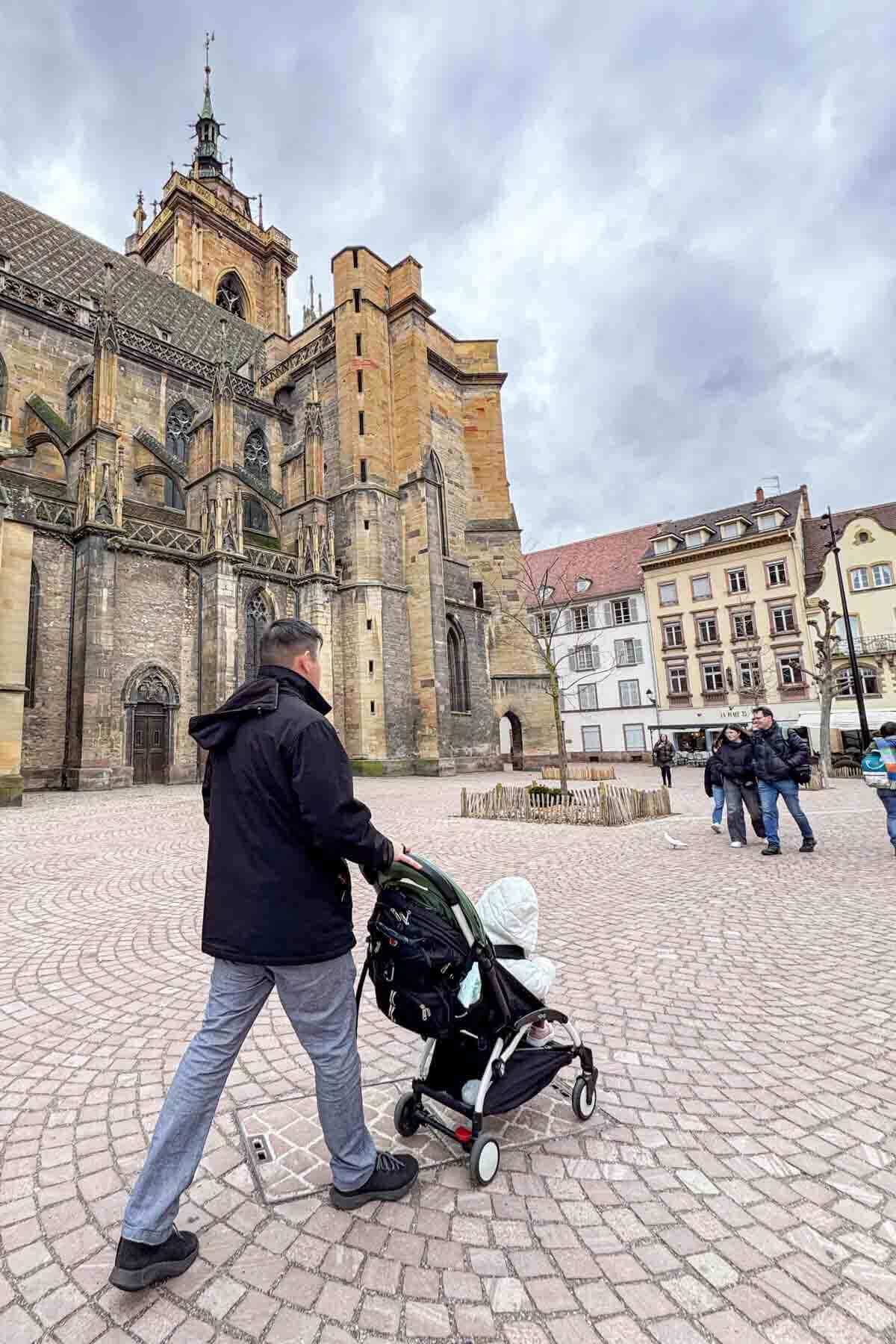
We brought our stroller out regularly and were glad to have it, but the city was hillier than I expected. Some routes were gradual and manageable, while others involved stairs or sections where we carried it.
We also made time for Spielplatz Lange Erlen, which gave the kids a great dedicated place to run and play.

A big part of Basel’s appeal for us was its location. We used it as a base for day trips to Colmar and Mulhouse in France and Freiburg im Breisgau in Germany, giving us plenty of variety without repeatedly changing accommodations.
The biggest downside was cost.

Switzerland is famously expensive, and even coming from Southern California, restaurant prices caught us off guard.
Basel wouldn’t be one of the first places I’d recommend solely because you’re traveling with a toddler.
But if it fits your route or you want a base for exploring this corner of Europe, I wouldn’t hesitate to bring one.

Munich: A Big City That Feels Livable with Kids
We spent five nights in Munich with our 3-year-old, along with our older kids ages 9 and 7.
Particularly good for: Families who want the variety of a major city without sacrificing easy transportation, parks, and everyday family spaces.
Know before you go: Munich’s family appeal isn’t really about one major toddler attraction. It’s how easily the normal pieces of a city trip work together.


Munich felt very livable to me.
It’s relatively flat, our stroller worked well, and getting around by public transportation was straightforward. I also explored with the kids on my own while my husband worked and never found the city especially difficult to manage.

Some of my strongest toddler memories are quite simple.
We stayed in an apartment with a tiny neighborhood playground nearby. There was basically a little play structure, slide, and sand area.
Our kids loved it.
They begged to stop every time we passed and could happily stay far longer than I expected.

We also visited public swimming pools, which were an even bigger hit and made for an easy break from sightseeing.
Beer gardens were another pleasant surprise.
Before visiting Munich, I associated them much more with adults. In reality, many felt very family-friendly: casual, outdoors, relaxed, and completely normal places to bring children.
We visited one in the English Garden with a playground right there, which made the whole setup especially easy.

We still did plenty of adult-interest sightseeing, including the BMW Museum, palaces and parks, and a longer day trip to Füssen and Neuschwanstein Castle.

Food was easy for the kids, too, with pretzels, sausages, fries, and simple breaded meats everywhere.
Munich may not have the immediate toddler appeal of a beach destination, but it was one of the larger European cities where family life seemed to fit into the city naturally.

What Traveling Europe with Toddlers Has Taught Me
After visiting all of these places, three practical lessons have shaped how I plan European trips with young kids.
“Stroller-friendly” is rarely a simple yes or no
I almost always bring a stroller, even when I know it won’t work everywhere.
Lake Garda and Munich were easy. Brașov was bumpier but manageable. Venice meant carrying it over bridges. Santorini had perfectly smooth stretches followed by stairs. Rome and Athens required different plans at certain historic sights.
The question I find more useful is:
Will having the stroller make enough of my day easier that I’m willing to carry it occasionally when it doesn’t work?
For us, the answer is usually yes.
Walkable doesn’t always mean easy without a car
Lake Garda taught us this particularly well.
A town can be wonderful to explore on foot once you’re there, while still making accommodations, beaches, neighboring towns, or other sights inconvenient to reach without a vehicle.
With a toddler, I pay much more attention now to what the walk from our accommodations actually looks like.
Twenty minutes along flat, shaded streets is very different from 20 minutes uphill in summer heat.


Choose somewhere you actually want to go
Having a toddler doesn’t mean you have to choose the objectively easiest destination.
If you’ve dreamed about Rome, Venice, Santorini, or Milos for years, the extra stairs, carrying, or planning may feel completely worthwhile.
Another family may look at those same tradeoffs and be much happier somewhere like Naxos or Lake Garda.
Neither approach is wrong.
The better question is often not “What is the best place in Europe with a toddler?”
It’s “Which destination’s challenges are worth it for my family for this specific trip?”

FAQs About Visiting Europe with Toddlers
What are the best places in Europe with toddlers?
There isn’t one objectively best destination for every family.
From the places I’ve personally visited with a toddler, Lake Garda, Naxos, Kos, Brașov, and Munich were among the easiest because they combined manageable logistics with plenty of room for kids to move.
But easiest doesn’t automatically mean best.
If you’ve dreamed about Rome, Venice, Santorini, or Milos, those destinations can absolutely be worth a little extra effort with a toddler.
Is Europe toddler-friendly?
Overall, I’ve found Europe very doable with toddlers, but there’s obviously huge variation between destinations.
One major advantage is how many places have pedestrian streets, public squares, promenades, parks, beaches, and other spaces where young kids can move more freely.
The flip side is historic infrastructure: cobblestones, stairs, small restaurants, old buildings, and plenty of places that weren’t designed with modern strollers in mind.
For us, the benefits have consistently outweighed those inconveniences.
Is Europe stroller-friendly?
Sometimes.
I almost always bring a stroller to Europe, even when I know I won’t be able to use it everywhere.
A lightweight stroller has worked well for our family because I’d generally rather carry the stroller for a short stretch than carry a tired toddler for a long one.
But whether that tradeoff makes sense will depend on your toddler’s age, how much they walk, whether they nap in the stroller, and how comfortable your family is using a carrier.
Is it worth taking a toddler to Europe if they won’t remember it?
I think so.
My toddler may not remember every castle, boat ride, or Greek island years from now, but that doesn’t make the experience meaningless.
We remember it. We experienced those places together as a family. And our kids experienced the novelty, connection, food, movement, people, and surroundings in the moment, even if they won’t retain a detailed adult memory of it later.
I don’t travel with my kids only to create memories they can remember decades from now.
I travel because I want us to experience the world together while they’re growing up.

Choosing the Right European Destination for Your Toddler
The easiest place to visit with a toddler isn’t automatically the right one for your family.
Think about how heavily you rely on a stroller, how much room your toddler needs to move, whether you’re comfortable renting a car, how your family handles heat and crowds, and whether you’d rather spend your days at beaches, in cities, outdoors, or mixing a little of everything.
Most importantly, think about where you actually want to go.
Some of these destinations were easier with a toddler than others. That doesn’t make them better.
Toddlerhood doesn’t have to mean putting Europe on hold or replacing every destination you’ve dreamed about with somewhere designed specifically for kids.
Understand the tradeoffs, choose the ones that fit your family, and bring your toddler along for the experience.
More Help Planning a Europe Trip With a Toddler
Choosing the destination is only part of the planning. If you’re getting ready for an international trip with a toddler, these may help with some of the logistics that come next:
- Surviving a long-haul flight with a toddler: what has helped us manage sleep, meals, entertainment, and a very long travel day.
- Airplane toys and activities for toddlers: the things I actually pack to keep little kids occupied in flight.
- Preschoolers on a plane: activities to keep older toddlers and preschoolers engaged while flying
- Flying with milk for a toddler: what to know about bringing milk through airport security and keeping it available during the trip.
- My Babyzen YOYO stroller review: why this has been our go-to stroller for navigating cobblestones, trains, stairs, and long sightseeing days.


