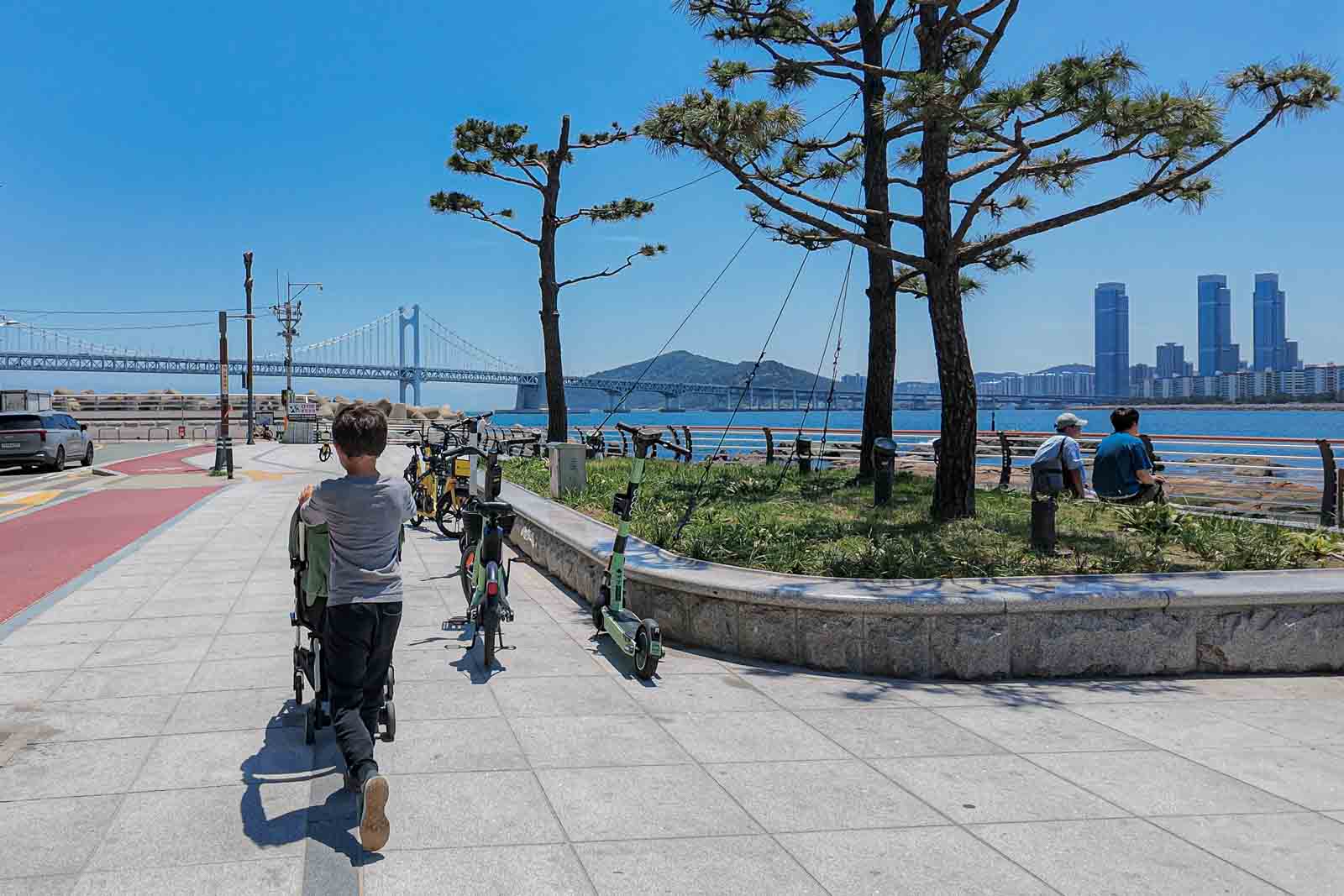
Getting Around Busan with Kids: Metro, Buses, Taxis and More
Getting around Busan with kids is surprisingly easy. Getting across Busan quickly? That takes a little more strategy.
We spent three weeks based in Haeundae with our three kids, ages 10, 8, and 4, and explored all over the city without renting a car. I frequently headed out alone with the kids, using the Busan Metro almost daily, plus buses, Uber, and taxis, plenty of walking, and even the Haeundae Beach Train.
The transportation itself was not the hard part. Busan is clean, safe, affordable, and relatively easy to navigate as a foreign visitor. The bigger challenge is that Busan is huge, and the fastest option is not always the obvious one.
Below, I’ll break down how to use the Metro and buses, T-money with kids, Naver Map, taxis and Uber, strollers, walking, and how to choose the easiest way to get around Busan with your family.
If you’re planning the rest of your trip too, start with my complete Busan with kids guide for family-friendly attractions, neighborhoods, food, beaches, and more practical planning advice.
Jump to: At a glance, Naver Map, T-Money, Busan Metro, Buses, Taxis and Uber, Walking around, Beach train, Arriving in Busan, Metro day pass, Tips, FAQs
Affiliate Disclosure: Familee Travel contains affiliate links and is a member of the Amazon Associates Program, we may earn commissions from qualifying purchases at no additional cost to you.
In a rush? Pin this or email it to yourself to read later! (Psst! Use the buttons at the very top or bottom of this post for ease.)

Is Busan Easy to Get Around with Kids?
Yes. Busan is very manageable with kids, even without renting a car.
The Metro is clean, affordable, and easy to follow. Buses fill in many of the gaps, taxis are relatively inexpensive, and several neighborhoods are easy to explore on foot.
I regularly traveled around Busan alone with our three kids and a stroller, including longer trips across the city. I never felt like the transportation itself was difficult or overwhelming.
The important thing is to stay flexible. The best option might be the Metro for one outing, a taxi for another, or a combination of both.
Here’s the quick breakdown:
| Transportation | Best For | Keep in Mind |
|---|---|---|
| Metro | Longer routes across the city and predictable travel times | It does not reach every attraction directly |
| Bus | Filling gaps and getting closer to places between Metro stations | Usually slower and affected by traffic |
| Taxi or Uber | Tired kids, bad weather, awkward routes, steep areas, saving time | Cars can be small for a family of 5 |
| Walking | Exploring Haeundae, Gwangalli, Centum City, and individual neighborhoods | Busan is too spread out to walk between most sightseeing areas |
| Haeundae Beach Train | Exploring the Mipo, Cheongsapo, and Songjeong coastline | It is a separate attraction, not regular public transportation |

Busan Is Much Bigger Than It Looks
Busan is easy to get around, but it is not compact.
We stayed in Haeundae on the eastern side of the city, which was a great family base. But several popular attractions, including Gamcheon Culture Village, Songdo, Jagalchi Market, BIFF Square, and Nampo, are much farther west.
A route can be completely straightforward and still take an hour or more.
Sometimes the Metro involved a long ride and transfer. Other times, the closest station still left us with a bus, taxi, or substantial walk at the end.
This is why I recommend grouping your Busan itinerary geographically rather than bouncing back and forth across the city.

For example, pair Jagalchi Market with BIFF Square, or Songdo with other western Busan attractions, rather than returning to Haeundae in between.
I break down the places we found most worthwhile, along with practical family logistics, in my complete guide to visiting Busan with kids.
Where you stay also matters more in Busan than in some other cities. We loved using Haeundae as our base, but there is no single neighborhood that puts you close to everything.
If you are still choosing your base, read my guide to where to stay in Busan with kids for a breakdown of the best family-friendly areas.

Download Naver Map Before Getting Around Busan
If you normally use Google Maps for everything, South Korea requires a little adjustment.
Google Maps works partially in Busan, and I still opened it constantly out of habit. But I would not rely on it as your primary navigation tool.
We ran into limited walking and bus directions, incomplete route options, and the occasional incorrect business hour or map pin.
For actually getting around Busan, we relied heavily on Naver Map.
Naver Map provides public transportation routes, real-time tracking and arrival information, walking and driving navigation, and alerts for when to get on and off transit. It currently supports Korean, English, Japanese, and Chinese maps, plus English navigation.
It made getting around much easier.

Using Naver Map in English
Naver Map is much more useful in South Korea than Google Maps, but the English experience is not perfect.
Many major attractions and businesses can be searched in English. Others only appeared reliably when I searched using the Korean name.
When an English search did not work, I usually:
- Found the attraction or restaurant in Google, its website, or a regular web search.
- Copied the Korean name.
- Pasted it into Naver Map.
- Checked the photos and location to make sure I had the right place.
- Used Naver Map for the actual route.
Papago or Google Translate can also help when you run into something written only in Korean.
It adds an extra step here and there, but once I had the correct destination pulled up, navigating Busan was straightforward.

Check the final walk too
Do not only look at the bus or Metro portion of your route.
When I took the kids to the Busan National Science Museum, the bus ride itself was easy. The final walk was the awkward part.
We ended up along a more car-oriented stretch with inconsistent sidewalks, a bridge, parked work vehicles, and no other pedestrians.
We got there without a problem, but it was one of the least pleasant walks we had in Busan.
Before choosing a route with kids, especially with a stroller, zoom in on the last section. A route that looks perfectly reasonable on a map may still involve a steep hill, stairs, a major road, or an inconvenient final walk.

Using T-Money in Busan with Kids
For most visitors, a transportation card is the easiest way to pay for Busan public transportation.
We used T-money on both the Metro and city buses.
Every rider who needs to tap should have their own card. You cannot use one T-money card to tap several fare-paying family members through the system.
For our family, I used MobileTmoney on my iPhone, our 10 and 8-year-olds each had their own physical card, and our 4-year-old rode free without one.

Current Busan public transportation fares
As of 2026, these are the standard transportation-card fares for the services most visitors will use:
| Rider | Busan Metro | Regular City Bus |
|---|---|---|
| Adult | ₩1,600 to ₩1,800 | ₩1,550 |
| Youth, ages 13–18 | ₩1,050 to ₩1,200 | ₩800 |
| Registered child, ages 6–12 | Free | Free |
| Children 5 and under | Free | Free |
Busan Metro fares vary by distance. Cash and one-time QR fares can cost more, and the free fare for children ages 6 through 12 requires a properly registered child transportation card.
Using MobileTmoney on an iPhone
A major recent improvement is that international visitors can now use MobileTmoney much more easily.
The foreigner-friendly app launched in March 2026. The current app allows visitors to get started without signing up and top up through Apple Pay using supported overseas Mastercard, American Express, UnionPay, and JCB cards.
I set mine up before our trip, added it to Apple Wallet, and loaded it with my US American Express card.
With Express Transit turned on, I did not need to unlock my phone or open Wallet. I simply tapped my phone at the Metro gate or bus reader.
It worked every time for me during our three weeks in Busan, with no hiccups.
Because the international MobileTmoney setup is still relatively new, I would check the current app requirements before your trip. Physical transportation cards also remain an easy option if you would rather rely on something physical.

How to get a child T-money card in Busan
Our older kids needed physical cards because they do not have phones.
On our first full day, I walked them to Haeundae Station and bought cards at a convenience store inside the station.
I brought both of their passports, and the employee used their birth dates to register the cards in the child category.
The cards themselves happened to have cute Zootopia designs, but you do not need a special-looking child card. The important part is having the child’s date of birth properly registered.
Officially, Busan requires the birth date to be registered on the child transportation card. The exact identification process at a convenience store may vary, but bringing the kids’ passports made it straightforward for us.
Afterward, I loaded about ₩5,000 onto each card at a station machine using cash.

Kids ages 6 through 12 ride free in Busan
This confused me during our trip because my kids’ T-money balances never seemed to decrease.
I kept checking the cards and wondering why they still had the ₩5,000 we originally loaded.
It turns out Busan gives children ages 6 through 12 free rides on qualifying Busan city and village buses and Metro lines when they use a registered child transportation card.
The program includes foreign children too. The fare automatically registers as ₩0 when the card is properly set up. Cash riders do not receive the free fare, and the Donghae Line and some other services are excluded.
Our 10 and 8 year olds still tapped every time we used the Metro or bus. Their cards made a different sound when tapped, but their balances did not decrease.
Mystery solved.

What about younger kids?
Our 4-year-old did not need a T-money card.
On the Metro, she simply walked through with one of us. We usually used the wider accessible gate because we also had our stroller.
On city buses, she boarded normally without tapping or speaking to the driver. We never had an issue.
Busan also currently allows accompanied children younger than 6 to ride free, with limits on the number of young children accompanying each paying passenger.

Do you tap T-money when getting off?
Yes.
On the Metro, tap when entering and again when exiting.
On buses, tap when boarding and again before getting off. Tapping off is also necessary to receive eligible transfer benefits between public transportation services.
Once everyone had the correct cards set up, paying for transportation was one of the easiest parts of getting around Busan.
You can use T-money for more than transportation
T-money is not only for buses and the Metro.
You can also use it as a payment method at many convenience stores and some other participating shops and businesses around South Korea.
We mainly treated ours as transportation cards, but it is useful to know that any leftover balance does not necessarily have to go toward another train or bus ride. Look for the T-money logo at the register if you want to use your card for a small purchase.

Taking the Busan Metro with Kids
The Busan Metro was our main transportation method.
We used it roughly five days a week during our three-week stay, sometimes multiple times in a day. I frequently took all three kids and our stroller on my own, and I also rode the Metro alone later at night.
Overall, it felt clean, safe, affordable, and very manageable with kids.
Is the Busan Metro easy for foreign visitors?
Yes.
If you have used a subway or Metro system in another major city, Busan should feel pretty straightforward.
Station names, line numbers, and important signs were displayed in Korean and English. Train and station announcements also included English, Japanese, and Chinese.
There were also signs directing visitors toward major attractions and the correct exits.
Compared to visiting Seoul with kids, I found the Busan Metro smaller and easier to navigate. Compared with Tokyo, it was dramatically less overwhelming.
I still used Naver Map to tell me exactly which line, direction, transfer, and exit to take, but following the route once inside the system was easy.


How crowded is the Busan Metro?
Most of the time, crowds were not a problem.
There were rides when we had to stand and occasional trains where everyone was packed a little tighter.
Seomyeon was probably the most consistently busy station we encountered because Lines 1 and 2 intersect there. Busan Station and Centum City could get busier too, depending on the day and time.
Still, during three weeks of regularly using the Metro, I never encountered anything close to the extreme rush hour crowds we have experienced in Tokyo.
There was never a point when I looked at a train with our three kids and stroller and thought, nope, we are not getting on that.

Is the Busan Metro safe with kids?
I felt very comfortable using the Busan Metro with our kids and on my own.
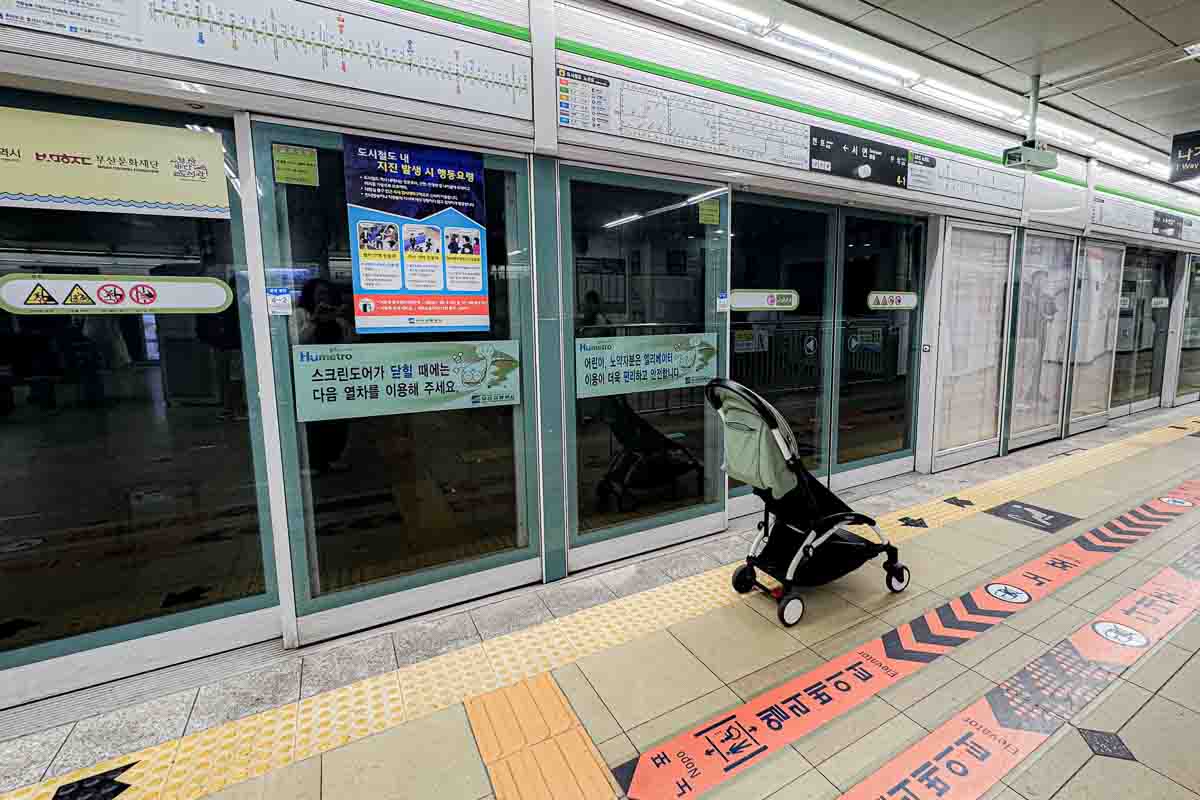
Stations and trains were generally clean, and the platforms we used had screen doors separating passengers from the tracks. The doors only opened once a train was in place, which is especially reassuring with younger kids.
I also felt comfortable riding later at night.
One of the sweeter parts of using public transportation in Busan was how frequently older passengers interacted with our kids.
People would scoot over to make room, smile, wave, try to chat with them in Korean or English, and occasionally offer them a packaged piece of candy.
It made getting around feel especially welcoming as a family.

Taking a stroller on the Busan Metro
We used our lightweight travel stroller regularly and had very few problems bringing it on the Metro.
Every station we used had a wider accessible gate somewhere for wheelchairs, luggage, and strollers. It was not necessarily at every row of fare gates, but we could always find one.
There were also plenty of elevators.

The catch is that the elevator does not necessarily lead to the exit closest to where you actually want to go.
Sometimes taking the elevator meant coming above ground slightly farther away or on another side of a major road.
With our compact stroller, I occasionally decided it was easier to carry it up some stairs or carefully use an escalator rather than detour for the elevator.
With a heavier stroller, plan on using the elevators and allow a little extra time.

Finding the right Metro exit
Busan Metro stations can have several exits, and choosing the wrong one can add unnecessary walking.
Major stations usually had signs pointing toward nearby attractions, sometimes specifically naming places like Haeundae Beach or BIFF Square in English.
I still found it easier to follow the exit recommended by Naver Map.
It could tell me not only which station to use, but which exit put us closest to where we were actually going.

Finding restrooms in Busan Metro stations
Metro stations also became one of our reliable places to find public restrooms.
More than once, when we were above ground and asked where the closest bathroom was, someone pointed us toward a Metro station.
The restrooms we used had standard Western toilets and were generally clean and easy enough to use with kids. Most of the ones we encountered were outside the paid fare gates.
This came in handy during one longer Metro ride when our 4-year-old suddenly decided she absolutely could not wait any longer.
My husband hopped off with her, tapped out, used the restroom in the station, and tapped back in while I stayed inside with our boys.
When traveling with younger kids, knowing Metro stations are a good place to look for a bathroom is a very useful little piece of information.

Taking Buses Around Busan with Kids
We used buses much less than the Metro, but they were useful when the route fit.
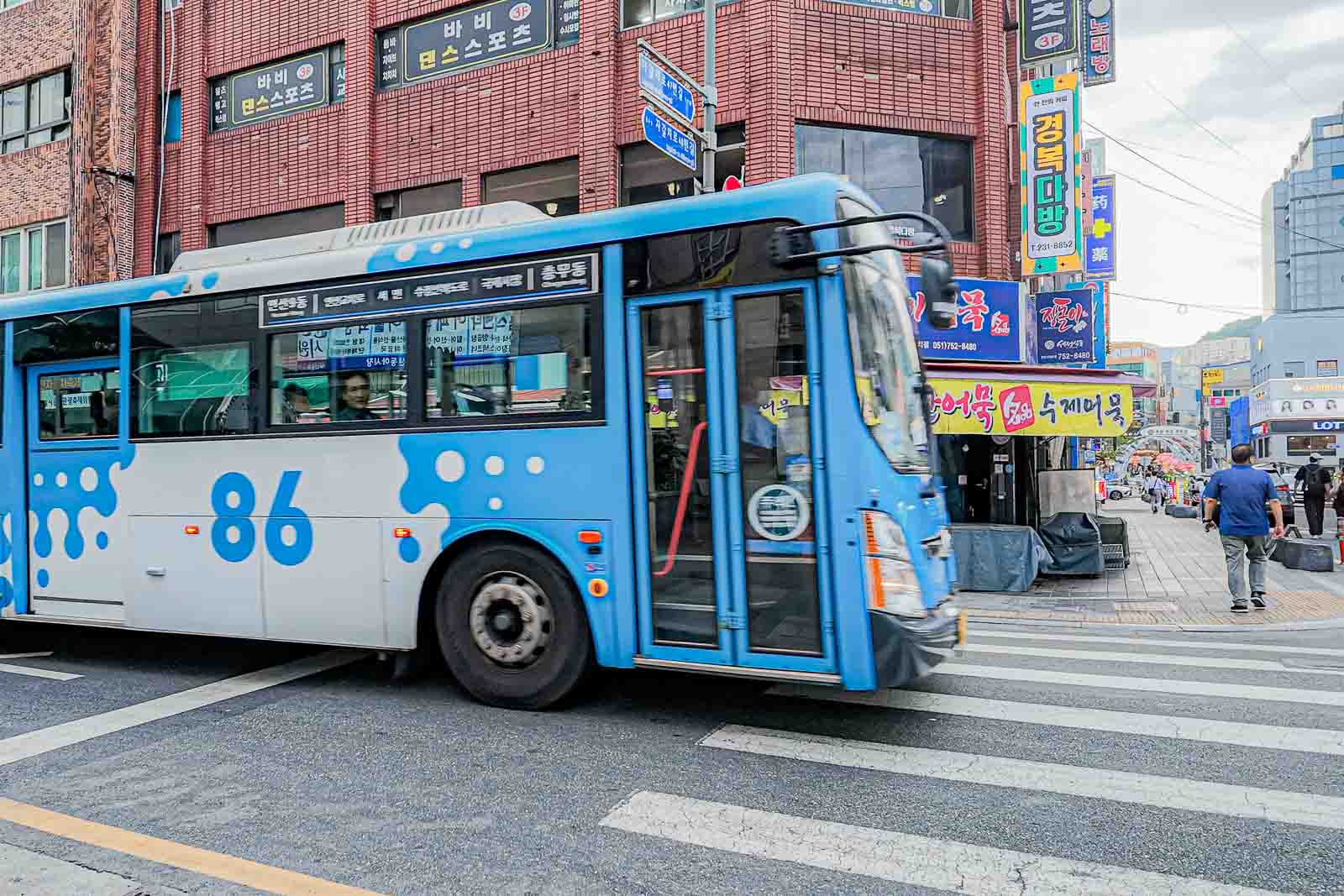
Busan buses felt similar to public buses in other major cities. Stops were clearly marked, announcements were in Korean and English, and Naver Map made it easy to see when the bus was coming and follow our progress once we were on board.
Our kids also thought riding the bus was fun, so sometimes I chose it simply because we had the time and they wanted to ride one.

How to ride a bus in Busan
The process is straightforward:
- Wait at the designated stop.
- Tap your T-money card when you board.
- Follow your route in Naver Map.
- Press the stop button before your destination.
- Tap your T-money card again when you get off.
Busan’s official instructions also specify pressing the stop button and exiting through the rear door.
I especially liked using Naver Map on buses because it tracked us along the route and showed how many stops remained. I did not have to depend solely on recognizing or hearing the stop name.
Taking a stroller on a Busan bus
We brought our lightweight travel stroller onto buses without much trouble.
Some buses had a few steps at the entrance, so I simply lifted the stroller on while it was still open.
Once aboard, I either parked it in the marked wheelchair and mobility area or kept it beside my seat. When I used the designated area, I set the stroller brake and kept it out of the aisle.
Of course, that space should be cleared if a passenger using a wheelchair needs it.
The buses we rode were never especially crowded, so managing our stroller was easy. On a busy route or with a much larger stroller, folding it may be more practical.

When taking the bus made sense for us
One of our easiest bus trips was to a playground near Jangsan Station.
The bus stop was closer to our apartment than the Metro, and it dropped us closer to the playground. Taking the Metro for only one stop would have added extra walking without saving much time.
We also took a bus toward the Busan National Science Museum.
In that case, the Metro route seemed to require unnecessary backtracking, while the bus traveled more directly toward the area.
The bus itself was simple. The less convenient part was the walk after we got off.
That experience reinforced why I always look at the entire route now, not just which bus or train gets closest.
When I would skip the bus
With kids, I would compare:
- Total travel time
- Number of transfers
- Final walking distance
- Hills or major roads
- Weather
- Everyone’s energy level
- Taxi cost
Sometimes the bus is exactly what you need.
Other times, spending a little more on a taxi saves enough time and effort to be worth it.

Using Taxis and Uber in Busan with Kids
Taxis filled in plenty of gaps during our stay.
We still used the Metro most often, but there were times when a taxi made more sense because of weather, timing, a difficult final walk, or simply tired kids.
Compared with many major cities, Busan taxis were affordable enough that I did not feel like we had to reserve them only for emergencies.
Does Uber work in Busan?
Yes.
We used the regular Uber app throughout Busan without a problem. It connected us with local taxis, while the pickup location and payment stayed within the familiar Uber app.
A couple of drivers sent messages before arriving, but the app translated them automatically. I never needed to speak Korean to arrange the ride.
Pickup pins were generally accurate too.
The main exception was somewhere huge, like Busan Station, where several exits and taxi pickup areas exist. In those situations, double-check where you are standing before requesting the ride.

Uber or Kakao T?
Kakao T is another popular taxi app in South Korea.
I downloaded it before our trip but never actually needed to use it.
Uber worked well enough for us, and I found it easier to navigate because the interface was already familiar.
Kakao T is still useful to know about as a backup, but Uber was our go-to.

Can a family of five fit in one taxi in Busan?
We were never refused as a family of five.
Usually my husband sat in the front passenger seat while I sat in the back with our three kids.
However, fitting and fitting comfortably are two different things.
Most of the taxis we rode in were fairly small. We could squeeze everyone in, but four people across the back was tight.
If you are traveling as a family of five, I would not assume a standard taxi will be spacious. It worked for us, but comfort will depend on the exact vehicle and the size and ages of your children.

Is UberXL actually large in Busan?
UberXL appeared as an option in Busan, and I usually tried to order it when available.
Still, I would not expect an American-style large SUV or minivan.
All of the UberXL vehicles we ordered did not feel significantly bigger than the regular taxis around us.
If your family really needs extra room, Busan also has jumbo taxis intended for larger groups and substantial luggage. The city describes these as vehicles accommodating 5 to 10 passengers. These were not an option to book through Uber during our visit, though.
Taking a taxi with luggage
When we arrived at Busan Station from Seoul, we had three kids, three suitcases, backpacks, and our travel stroller.
Somehow, all of us and all of our luggage fit into one UberXL to Haeundae.
It worked, but I would not use our experience as proof that every family with that much luggage will fit in one vehicle.
If you have several large suitcases, car seats, a large stroller, or bulkier gear, two taxis or a prearranged larger vehicle may be easier.
We saw other travelers using the Metro with luggage, and it is definitely possible. But after a travel day with three kids and multiple bags, door-to-door transportation was worth it for us.
How much do taxis cost in Busan?
The current standard Busan taxi base fare is ₩4,800 for the first 2 km.
That was almost exactly what we paid for one of our most useful short rides.
After taking the Metro across the city to Toseong Station, we took an Uber the final stretch uphill to Gamcheon Culture Village.
The ride was about 1.45 km, took around 4 minutes, and cost ₩4,800 (USD ~$3.40).
On a much longer day, I took the kids from our apartment in Haeundae to Songdo Sky Park. That Uber ride took about 37 minutes and cost ₩25,500 (USD ~$18.00).
For a family, those fares made taxis realistic enough to use strategically when they saved a lot of time or energy.

When is a taxi worth it in Busan?
I would consider a taxi when:
- Public transportation takes dramatically longer
- The route involves several transfers
- The destination is far from a Metro station
- The final walk is steep or inconvenient
- It is raining, windy, or extremely hot
- The kids are exhausted
- You are traveling with luggage
- You have a tight schedule
There were even times when Naver Map showed that the Metro would be faster than driving because of traffic.
Always compare the options rather than assuming a car will automatically be quickest.
If your child needs a car seat or booster, plan for that separately. The standard taxis and Uber-arranged taxis we used did not offer car seats.

Combine the Metro with a Taxi
One of my favorite Busan transportation strategies was combining different modes within the same trip.
Gamcheon Culture Village was the perfect example.
Coming from Haeundae, we took the Metro across most of the city to Toseong Station and then ordered an Uber for the final uphill stretch.
The Metro handled the long cross-city portion. The taxi handled the annoying part.
The final ride took about 4 minutes and cost ₩4,800.
This can work especially well when:
- The Metro covers most of the distance efficiently
- Your destination is not close to a station
- The final section is steep
- A bus connection adds a lot of time
- You want to keep the taxi portion short
With kids, the easiest route is often the one that removes the hardest part of the journey, not necessarily the one using a single transportation type from beginning to end.

Walking Around Busan with Kids
Busan is very walkable within individual neighborhoods, but it is not a city where you will walk between most major attractions.
We walked a ton during our three weeks, especially around Haeundae.
Haeundae was flat, comfortable with a stroller, and easy to explore on foot. Gwangalli and Centum City were similarly straightforward.

Other areas were more mixed.
Nampo and Jagalchi were generally flat, but some streets felt tighter and had less formal sidewalk separation. Around BIFF Square, the pedestrian areas were easy, while nearby streets could feel a little more chaotic.
Gamcheon Culture Village was easily the hardest neighborhood with a stroller because of the hills, stairs, and narrow lanes.

Is Busan stroller friendly?
Overall, yes, with some caveats.
The Metro, major sidewalks, beach promenades, and newer neighborhoods were generally easy with our Yoyo travel stroller.
The bigger challenges came from individual neighborhoods and attractions rather than the transportation system itself.
A lightweight stroller was especially helpful because there were occasional times when carrying it up a few stairs was easier than detouring for an elevator.


Crossing streets with kids
I found pedestrian crossings in Busan easy to manage with our three kids.
Major intersections were clearly marked, and some larger crossings near Haeundae even had shade umbrellas while you waited. A few areas around Gunam-ro also had misting systems during warmer weather.
Some crossing lights felt a little long, but nothing felt particularly difficult.
Compared with places like Taiwan or Vietnam, we also saw far fewer scooters and motorcycles using pedestrian areas, which made walking with kids feel more relaxed.

Using the Haeundae Beach Train to Get Around
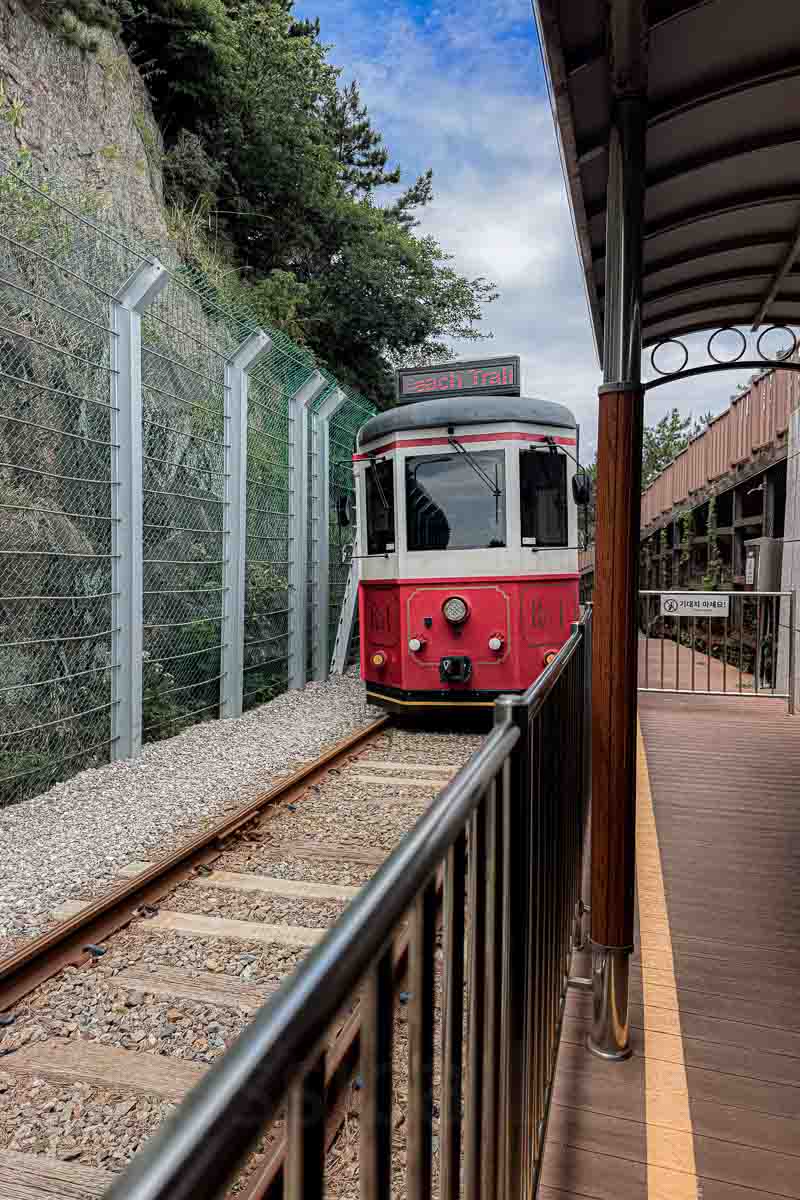
The Haeundae Beach Train is technically an attraction rather than part of Busan’s regular public transportation network, but it can still be useful for getting around this specific stretch of coastline.
We used it to move between Mipo, Haewol Observatory, Cheongsapo, Daritdol Observatory, and Songjeong.
With the all-stops pass, we could get off, explore, and continue along the route. The current ticket allows passengers to use all stations during the day, although boarding twice from the same station is not permitted.

For that reason, the Beach Train felt much more like transportation than the Sky Capsule, which is primarily a dedicated sightseeing experience.
Our stroller was allowed on the Beach Train, but we had to fold it before boarding.
If you are already planning to visit Haeundae Blue Line Park, it is a fun way to combine sightseeing with transportation along the eastern coast.
For ticket options, stops, Sky Capsule versus Beach Train, and planning the experience with kids, read my full guide to Haeundae Blue Line Park with kids.
Arriving in Busan with Kids and Luggage
Getting around feels a little different when you first arrive and are juggling children, suitcases, backpacks, and a stroller.
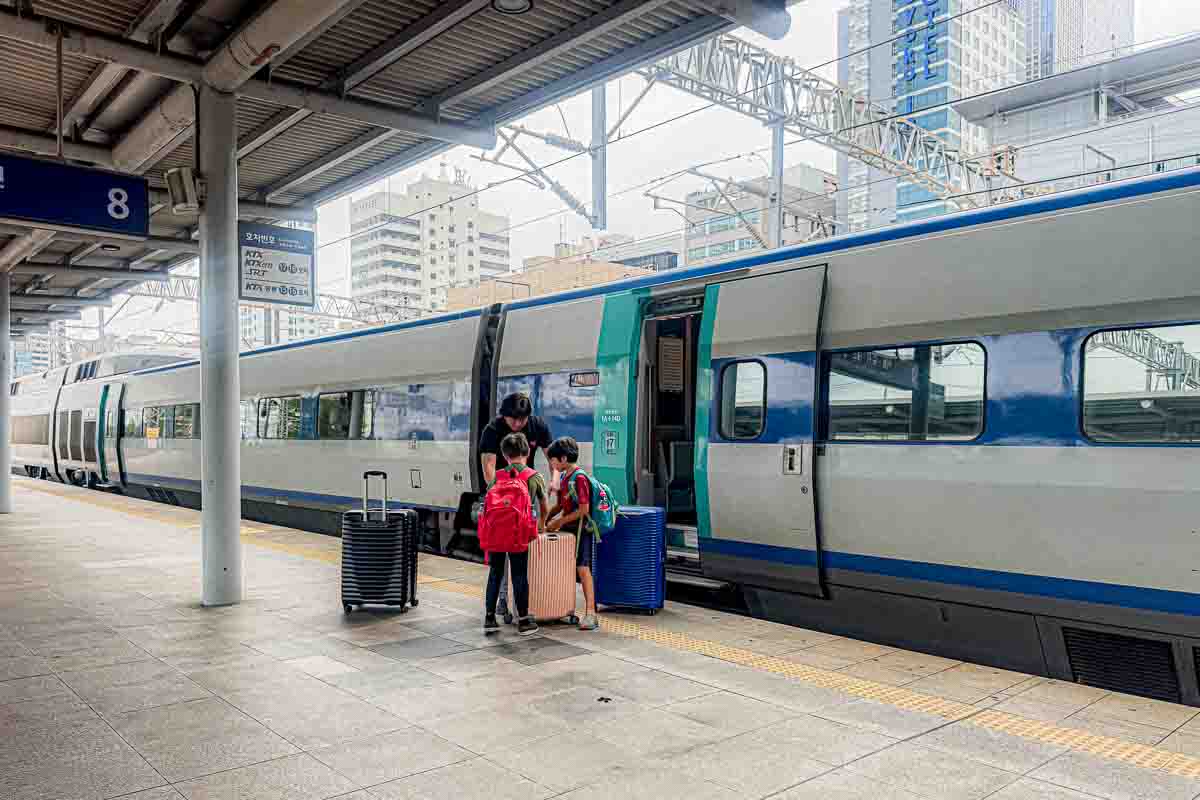
We arrived in Busan by KTX from Seoul with our three kids, three suitcases, backpacks, and travel stroller.
Busan Station was easy enough to navigate with everything in tow.


Taking the KTX to Busan
We booked our KTX tickets ahead of time and traveled from Seoul Station to Busan Station.
The stations are built to handle travelers with luggage, with elevators, escalators, and smooth floors. The elevators at Busan Station were also larger than many of the elevators we encountered at regular Metro stations.
Once we arrived, we did not attempt to take all of our luggage onto the Busan Metro.
We saw other travelers doing it, and it is certainly possible. But with three kids and multiple suitcases, I preferred not to add Metro transfers and extra walking to our travel day.
Planning your own trip with kids?
I share one email a month with real-world family travel strategies, packing tips, and destination breakdowns that make planning easier.
Join below.
Getting from Busan Station to Haeundae
We ordered an UberXL directly from Busan Station to our apartment in Haeundae.
Somehow, we managed to squeeze two adults, three kids, three suitcases, backpacks, and our stroller into one vehicle.
Would I guarantee every family can recreate that? Definitely not.
Busan Station has multiple exits and pickup areas, so pay attention to where you are standing before requesting a taxi.
If you have several large bags or bulky family gear, you may be more comfortable taking two taxis or arranging a larger vehicle.
For us, paying for door-to-door transportation after the KTX was worth it.

Getting from Gimhae Airport into Busan
We did not fly into Gimhae International Airport on this trip, so I cannot speak to the airport transfer firsthand.
Families can use the Busan-Gimhae Light Rail with a Metro connection, buses, taxis, or arrange private transportation.
Busan also currently operates an airport limousine route serving Haeundae and the eastern Busan area, with stops around Haeundae Beach, Jangsan, Osiria, and other destinations. The route was reorganized in January 2026, so check the current stops and schedule before relying on older airport-transfer information online.
With young kids and a lot of luggage, I would compare the entire journey rather than automatically choosing the cheapest option.
A door-to-door taxi may be worth paying more for after a long flight.

Is a Busan Metro Day Pass Worth It?
We never used a Busan Metro day pass during our stay.
T-money made much more sense because we mixed Metro rides with buses, taxis, and walking rather than spending entire days hopping on and off the subway.
For a shorter, sightseeing-heavy visit, however, a Metro pass may save money.
Busan currently offers:
- 1-day Metro pass: ₩6,000 for adults
- 3-day Metro pass: ₩13,000 for adults
The passes provide unlimited Busan Metro rides during their valid period, but they do not cover city buses, the Donghae Line, or the Busan-Gimhae Light Rail.
With standard adult Metro fares starting at ₩1,600, the 1-day pass generally begins to make financial sense around your 4th Metro ride of the day.
Registered children ages 6 through 12 already ride qualifying Busan Metro services free, so they do not need a day pass for those rides.
For our mixed transportation style, I would choose T-money again. For a short trip with a Metro-heavy itinerary, compare the numbers.

Tips for Spending Less Time Getting Around Busan
Busan transportation is easy enough to use, but the size of the city makes a little planning worthwhile.
These strategies helped us most:
- Group attractions by area. Spend a day around eastern Busan and another around Jagalchi, BIFF Square, Nampo, and Songdo rather than crossing the city repeatedly.
- Compare Metro and taxi times. A taxi is not automatically faster. Traffic can make the Metro the quicker option.
- Mix transportation types. The Metro plus a short taxi worked especially well for Gamcheon.
- Check the final walk. A short-looking connection may involve a steep hill, stairs, major road, or poor sidewalk.
- Use Naver Map for the actual route. Google Maps was still useful for finding and saving some places, but Naver Map was far more dependable for navigation.
- Copy the Korean name when search fails. Finding the place elsewhere and pasting the Korean name into Naver Map solved many search problems.
- Use Metro stations as bathroom stops. This was especially helpful on longer days with our 4-year-old.
- Do not assume UberXL means huge. The Busan vehicles we received were often still fairly compact.
- Use taxis strategically in bad weather or with tired kids. The relatively affordable fares made them useful when they significantly simplified the day.
- Bring cash for physical transportation cards. We used cash to load the kids’ cards at a Metro station machine.
Most importantly, stay flexible.
There is no transportation method you need to commit to for your entire Busan trip.

Busan Transportation FAQs
Is Busan easy to navigate as a foreigner?
Yes. I found Busan relatively easy to navigate without speaking Korean.
The Metro had English signage and announcements, buses were straightforward, and Naver Map handled most of the route planning.
The biggest adjustment was learning not to depend on Google Maps for everything.
Can you get around Busan without renting a car?
Absolutely.
We spent three weeks in Busan with three kids without renting a car. We relied mostly on the Metro, plus buses, taxis, walking, and the Haeundae Beach Train.
For a typical sightseeing trip, I do not think most families need a rental car.
Does Google Maps work in Busan?
Partially.
It was still useful for viewing the map, finding places, and occasionally checking Metro routes, but I would not depend on it for complete navigation.
We relied on Naver Map for actual directions.
Does Uber work in Busan?
Yes.
We regularly used the normal Uber app in Busan. It connected us with local taxis while keeping pickup information, messaging, and payment within Uber.
Can a family of five fit in a Busan taxi?
Our family of five was never refused, but most vehicles were small, and we were cramped.
If you need substantial passenger or luggage space, look for a larger vehicle rather than assuming a standard taxi will be comfortable.
Are kids free on Busan public transportation?
Children ages 6 through 12 ride qualifying Busan buses and Metro lines for free when they use a properly registered child transportation card. Children ages 5 and younger ride the Busan Metro and buses for free, no ticket or card needed.
Foreign children qualify too.
Does every child need a T-money card?
Children ages 6 through 12 need their own registered child transportation card to receive Busan’s free child fare.
Our 4 year old rode free without a card.
Can foreign tourists use MobileTmoney?
Yes.
As of 2026, the app has an international-user pathway and supports Apple Pay top-ups using several foreign card networks.
I used my US American Express and Express Transit throughout our stay without a problem.
Can you use the same T-money card in Seoul and Busan?
T-money can be used across multiple South Korean transportation systems, including Busan and Seoul.
However, local child fare programs differ, so do not assume Busan’s free child transportation rules apply everywhere in South Korea.
Can you take a stroller on the Busan Metro?
Yes.
We regularly used a lightweight travel stroller. Every Metro station we used had wider accessible gates and elevators, although the easiest elevator exit was not always the closest one to our destination.
Are there bathrooms in Busan Metro stations?
We consistently found public restrooms in the Metro stations we used.
They became one of our reliable places to look for a bathroom when we were out with the kids.
Can you bring luggage on Busan public transportation?
Yes, and we saw travelers doing it.
With three kids and several large suitcases, however, we chose a taxi from Busan Station to Haeundae rather than managing everything on the Metro.
Is Busan walkable with kids?
Busan is very walkable within individual neighborhoods, particularly Haeundae, Gwangalli, and Centum City.
It is too spread out to walk between most major sightseeing areas.
Is a Busan Metro day pass worth it?
It can be if you are taking several Metro rides in a short period.
We preferred T-money because our days mixed Metro rides with buses, taxis, and walking.

Getting Around Busan with Kids Is Very Doable
After three weeks of exploring Busan with our three kids, I came away feeling very confident about getting around without a car.
The Metro was our workhorse, buses filled in some gaps, and taxis were affordable enough to use strategically when they saved us significant time or effort.
Naver Map took a little getting used to, but once I adjusted, navigating the city felt straightforward.
The biggest challenge was never the transportation system itself. It was remembering just how spread out Busan is.
Group your sightseeing by area, stay flexible with how you get around, and do not be afraid to combine the Metro, buses, taxis, and walking when that makes the day easier.
If you’re still building your itinerary, my Busan family travel guide covers the attractions, neighborhoods, beaches, food, and practical details I’d prioritize after spending three weeks there with our kids.
Once you know how you’re getting around, use my things to do in Busan with kids list to group attractions by area and avoid unnecessary cross-city trips.
Busan is a big city, but getting around it with kids does not need to feel intimidating.