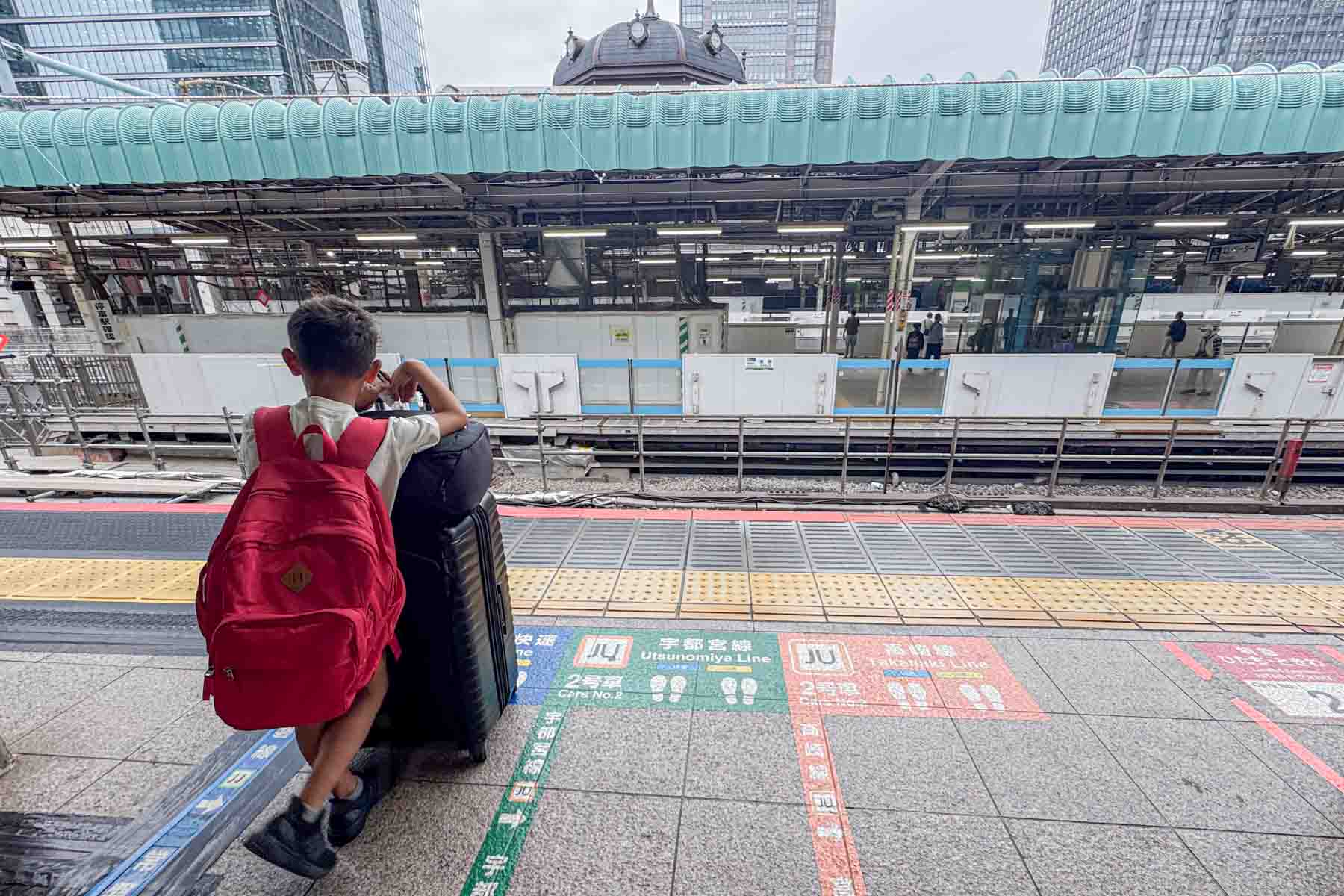
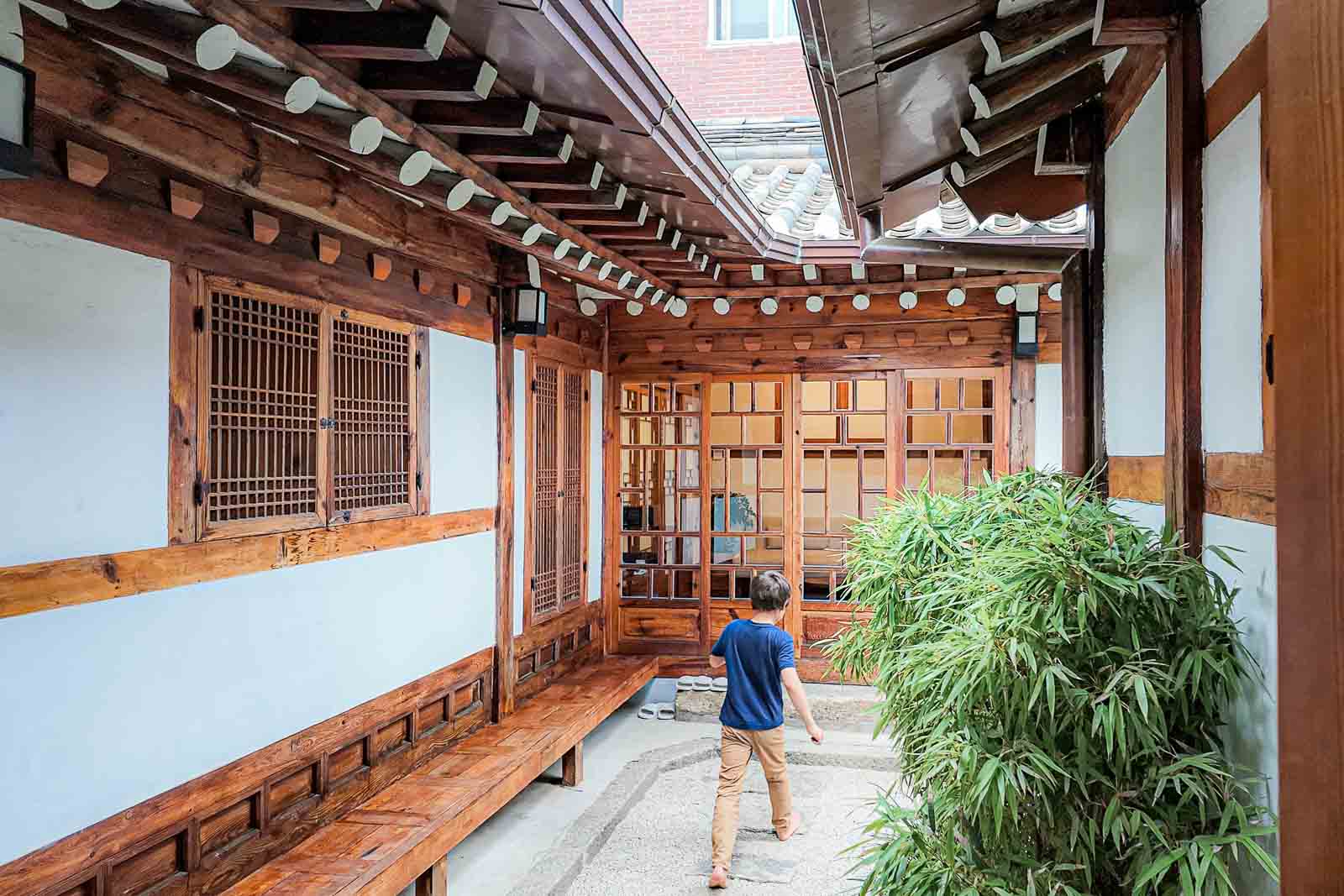
Getting Around Seoul with Kids: Subway, T-Money, Taxis and Strollers
Three kids, three suitcases, a steep hill in Bukchon, and a 45-minute wait for an Uber van in the summer heat. Not exactly our finest travel moment!
But after three trips to Seoul with my kids, ranging from 15 months to 10 years old, I’d happily explore the city without a rental car again. Getting around Seoul with kids is manageable with Naver Map, the extensive subway system, plenty of walking, and an occasional Uber.
Of course, navigating a city this enormous takes a little planning, especially with a stroller or a family of five. Here’s how we did it, what I’d recommend, and what I’d do differently next time.
Jump to: Apps to download, T-Money, Subway, Strollers, Buses, Taxis and Uber, Walking, Finding things, From the airport, KTX, Tips, FAQs
Affiliate Disclosure: Familee Travel contains affiliate links and is a member of the Amazon Associates Program, we may earn commissions from qualifying purchases at no additional cost to you.
In a rush? Pin this or email it to yourself to read later! (Psst! Use the buttons at the very top or bottom of this post for ease.)

Is Seoul Easy to Get Around with Kids?
Yes! Seoul’s public transportation is clean, extensive, relatively affordable, and easy enough to navigate without speaking Korean. For most visiting families, the subway is the best starting point, with walking and taxis also workable wherever needed.
The bigger challenge is Seoul’s size. A short train ride can still involve long station corridors, multiple transfers, a steep hill, or an unexpectedly long walk to the attraction.
| Transportation | Best for families | Keep in mind |
|---|---|---|
| Subway | Most sightseeing and longer journeys across Seoul | Transfers, deep stations, walking between platforms |
| Walking | Exploring individual neighborhoods | Hills, weather, uneven historic areas |
| Taxi or Uber | Awkward short routes, poor weather, tired kids, luggage | Traffic, vehicle capacity, car seats |
| City bus | A direct route closer to your destination | Crowding, road traffic, stroller logistics |
I wouldn’t rent a car for a typical Seoul city trip. We didn’t need one on any of our three visits.
If you’re still planning your trip beyond transportation, my Seoul with Kids guide covers the bigger picture, including things to do, where to stay, and practical tips for exploring the city as a family.

Transportation Apps to Download Before Visiting Seoul
Naver Map for navigating Seoul
If you download only one navigation app for South Korea, make it Naver Map.
I kept opening Google Maps out of habit, but Naver Map was more dependable for actual routes. It helped us compare subway and bus journeys, find walking directions, identify station exits, and check how far we’d still need to go after leaving the train.
You can use Naver Map in English, although some listings appear in Korean. If a place doesn’t come up, copy its Korean name or address into the search bar.
My biggest tip is to compare the whole journey, not only the train time. A route with fewer transfers or a shorter final walk may be easier with children even if the estimate is a few minutes longer.
Uber and other taxi apps
I also recommend setting up a taxi app before arriving. We used Uber, which let me enter our destination, check the estimated price, and pay through the app.
For a backup, consider Kakao T or k.ride, Kakao Mobility’s service for international visitors. I downloaded both and saw taxi drivers using them, though I didn’t personally end up trying them out. But having another option readily available can be helpful when one app isn’t offering you what you need.
I’ll cover when we chose a taxi and what worked for our family of five below.

Using T-Money Cards in Seoul with Kids
A T-money card is one of the first things I’d arrange if you’re planning to use Seoul’s subway or buses. It saves you from buying individual tickets for every journey, and registered children’s cards qualify for reduced fares.
How T-money works and where to buy it
T-money is a rechargeable transit card accepted on subways and buses across Seoul and much of South Korea, including Busan. It also works on many taxis and at participating businesses (e.g., convenience stores).
Each paying passenger needs their own card. Tap when entering and leaving the subway, and when boarding and exiting buses. Correct tapping also helps you receive eligible transfer discounts.
You can buy physical T-money cards at convenience stores such as CU, GS25, and 7-Eleven, plus select transportation card counters. Basic cards commonly cost ₩3,000–5,000 before you add travel credit. Recharge them at participating stores or subway machines. Keep cash on hand since foreign bank cards don’t work for every physical-card top-up method.
On our first June 2026 Seoul stay, we hadn’t bought T-money cards yet, so we had to purchase individual subway tickets. Unfortunately, one of the station’s two ticket machines was broken, leaving a long line at the other.
Here’s something to know about single-journey tickets: each ticket requires a refundable ₩500 deposit on top of the subway fare. After reaching your destination, tap your ticket to exit the fare gates, then find a separate machine labeled “Deposit Refund Device.” Insert your used ticket, and the machine returns your ₩500 deposit.
It’s straightforward enough, but purchasing tickets and returning them for a refund after every ride adds an unnecessary step, especially with kids. I’d recommend getting T-money cards early to skip the hassle.
I wouldn’t repeat that if I could avoid it. Get the cards early, ideally before your first subway ride.

Do children need their own T-money cards?
Children younger than 6 can ride Seoul’s regular subway free with a paying guardian, generally up to three young children per adult. Children ages 6–12 and teens ages 13–18 qualify for reduced fares.
Here are the standard subway base fares using registered transportation cards:
| Age | Base fare |
|---|---|
| Under 6 | Free with a paying guardian |
| 6–12 | ₩550 |
| 13–18 | ₩900 |
| 19 and older | ₩1,550 |
These are base fares, so longer routes and certain services can cost more. Bus fares vary by type.
For a child’s discounted fare, ask the convenience-store employee to register the card with the correct date of birth. Bring your child’s passport for age verification. We purchased and registered cards for our 8- and 10-year-olds in Busan, and those same cards could be used in Seoul.

Using MobileTmoney on an iPhone
Compatible phones can work as transit cards, too. On an iPhone, you can add T-money to Apple Wallet and use Express Mode to tap at subway gates without unlocking your phone. The MobileTmoney app supports eligible international card top-ups; payment options vary, and an ordinary foreign credit card generally cannot be tapped directly at a subway gate as a substitute for T-money.
I used MobileTmoney on my iPhone when we returned to Seoul after Busan. It was convenient not having another card to manage. Unfortunately, I forgot one child’s physical card in my other pants pocket, which is one reason we ended up using Uber more on that short stay.

T-money vs. Climate Card for families
Seoul also offers short-term Climate Card passes with unlimited rides on participating subway and bus services. Published visitor-pass prices are ₩5,000 for one day, ₩8,000 for two days, ₩10,000 for three days, ₩15,000 for five days, or ₩20,000 for seven days, plus ₩3,000 if you need to buy the physical card.
The catch is that coverage is restricted. The AREX Express, airport buses, and various routes outside the eligible network aren’t included. There have also been changes to Seoul’s longer-term Climate Card products in 2026, so check the official Climate Card information before buying.
For most short family vacations, I lean toward regular T-money for its flexibility, especially when traveling beyond Seoul or using discounted children’s fares. If you’re planning several eligible rides a day, compare the total cost with a Climate Card.

Taking the Seoul Subway with Kids
The subway was our primary way of getting around Seoul with kids. We used it across all three visits, starting when our youngest was 15 months old, and I found it refreshingly straightforward once I got used to the network.
How to navigate the subway
Seoul subway lines have colors and numbers, and stations display names and useful signs in Korean and English. Announcements are also available in English, and often in Mandarin Chinese and Japanese too.
My usual approach is simple:
- Search for the destination in Naver Map and select public transportation.
- Check the line, direction of travel, transfer stations, and suggested exit.
- Follow the station signs to the correct platform, then watch the displays and listen for your stop.
Pay attention to the direction and any express or branching service. Getting on the right-colored line isn’t enough if the train is heading the opposite way.
There is good signage in the stations. If you slow down and double-check your intended station, you should be able to easily identify which direction and platform you need.


Boarding and riding with children
Seoul’s subway platforms generally have screen doors. Let other passengers exit first, then board together, keeping younger kids within reach. We could always roll our YOYO stroller straight onto the train without folding it.
Leave designated priority seats available for people who need them. If the car is busy, I prefer to stand or sit where I can keep track of all three children and avoid blocking the doors with the stroller.

Transfers, station exits, and rush hour
Some subway stations are enormous, with deep platforms, long corridors, and exits scattered across several blocks. The time inside the station can be as important as the time on the train. Naver Map’s recommended exit can save a surprising amount of extra walking.
Weekday commuting periods, especially roughly 7–9 a.m. and 6–8 p.m., can be crowded. When possible, I’d avoid the busiest trains with small children, a stroller, or several suitcases. It’s still doable if you need to travel at these times; just allow more room in your schedule and don’t assume everyone will get a seat.


Bathrooms in Seoul subway stations
One of the most helpful things about taking the Seoul subway with kids is knowing that subway stations have public restrooms. We frequently used them for bathroom breaks before or after train rides, and it was reassuring to have a reliable place to stop while exploring the city.
In fact, one time when we asked about a bathroom at a small drink shop, the employee directed us to the nearest subway station instead!
Restrooms are generally well-marked, although their locations vary. Some are inside the paid fare gates, while others are outside, so check before exiting if you need a bathroom break during your journey. Look for restroom signs or the Korean word 화장실 (hwajangsil).
When you’re sightseeing with kids, knowing there’s a bathroom at the next subway station is really helpful, especially when you’re somewhere unfamiliar.

Is the Seoul Subway Stroller-Friendly?
Yes, generally. We brought our compact YOYO stroller on all three Seoul trips and never had to fold it to board a subway train. Sometimes it was tight, but never impossible. I never felt forced to fold it like some train rides in Tokyo.
The bigger challenge was navigating certain stations, not riding the trains themselves.


Elevators, stairs, and accessible gates
Look for the wider accessible fare gates and elevator signs. Many stations have elevators, but the most convenient exit isn’t necessarily the one with step-free access. You may need to walk farther or change your route.
Because our stroller was light and compact, we could manage occasional stairs after taking our daughter out. Still, use an elevator whenever possible, and don’t ride an escalator with a child seated in a stroller. Families who require step-free access should check the official subway accessibility information for their exact stations and exits.


Stroller or baby carrier?
On our 2023 trip with a 15-month-old, I brought both the YOYO and an Ergobaby carrier. I liked having the stroller for long sightseeing days and naps, plus a carrier for stairs or places where rolling wheels wasn’t practical.
I wouldn’t hesitate to bring a compact stroller to Seoul with a baby or toddler, but don’t expect to roll it effortlessly everywhere. Bukchon’s slopes and the uneven paths around some palaces were more challenging than the subway itself.
Taking Buses Around Seoul with Kids
Seoul’s buses fill gaps in the subway network, but we didn’t take a city bus during any of our Seoul visits, much to my children’s dismay. We used buses in Busan; in Seoul, the subway or a short Uber ride always seemed more practical for our routes.
Blue buses generally connect major areas, green buses serve shorter and connecting routes, yellow buses circulate in central areas, and red buses connect Seoul with surrounding cities. Smaller local buses operate in some neighborhoods.
Use Naver Map to find the right stop and route. Generally, you board at the front, tap your T-money card, press the stop button before your stop, tap out, and exit at the rear. Low-floor buses can make stroller boarding easier, although space may still be tight when crowded.
One day the kids actually wanted to take a bus just for fun. We stopped at a subway station for a bathroom break, though, and ended up taking the train because we were already there.
My advice is to compare the two routes rather than dismiss buses. A direct bus could spare you a subway transfer or a longer walk.
Taking Taxis and Uber in Seoul with Kids
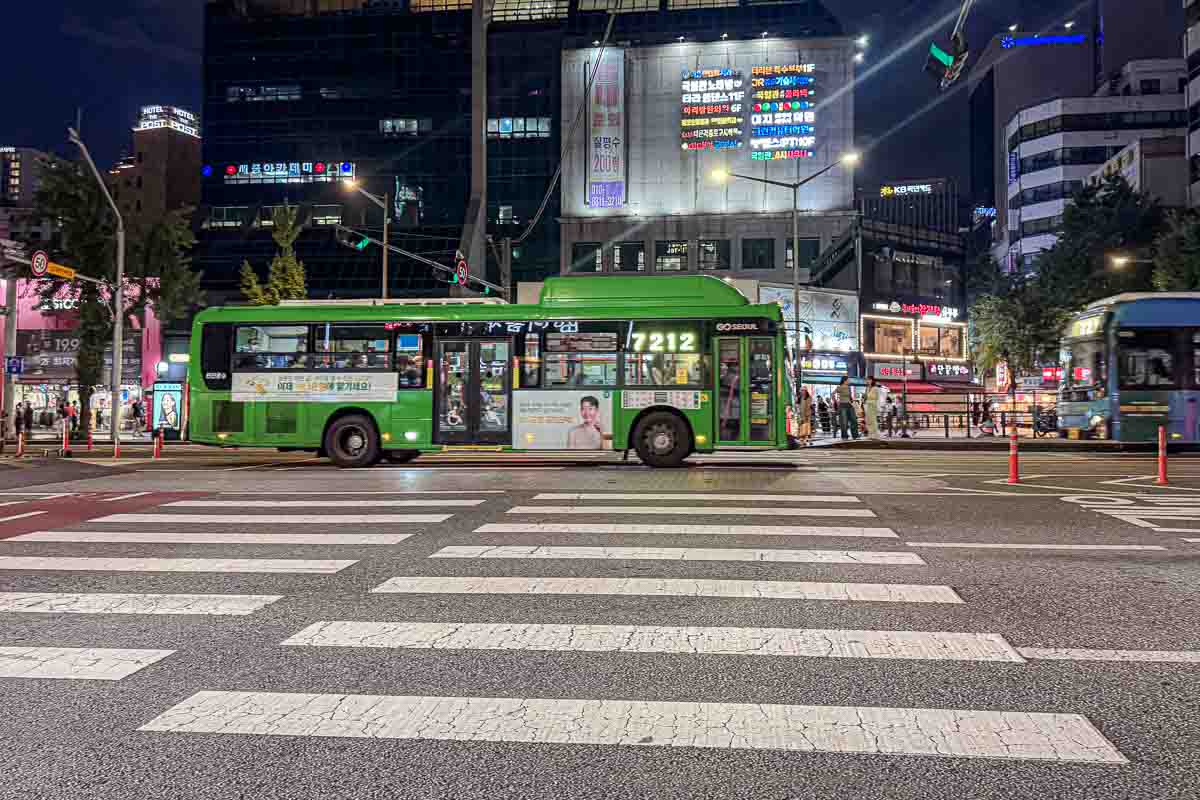
I found taxis useful when the subway route was awkward, the weather was uncomfortably hot, or we had luggage. Compared with many large U.S. cities, the occasional ride was affordable enough that I was comfortable using it strategically.
Booking a taxi and choosing a vehicle
You can hail taxis on the street or use a booking app. I preferred Uber because I could confirm the destination and estimated fare without needing to explain our route in Korean.
A standard taxi generally has room for four passengers, so a family of five needs to look more carefully at capacity. Uber advertises UberXL for groups of up to six, and Premier Van for roomier group travel, but the specific vehicle and luggage space vary.
For our family, Premier Van consistently offered plenty of room for all five of us and our bags. Some UberXL vehicles felt cramped and couldn’t fit our luggage. I would never assume that a vehicle has enough usable seating just because the group looks as though it might squeeze in. Every passenger needs their own seat and seat belt.

Car seats in Seoul taxis
South Korean law requires children under 6 to use an appropriate car seat when traveling in a vehicle, including taxis. However, enforcement of the car-seat requirement in taxis was deferred in 2018 due to limited availability, and standard taxis generally don’t provide child restraints.
Fortunately, there are some options for booking taxis with car seats in Seoul.
- TADA: Offers child-seat-equipped vehicles, including options to request a car seat through its app.
- PAPA Mobility: Offers car-seat-equipped rides through its app, with seats available for newborns through children weighing up to 25 kg (55 pounds).
- Private transfer services: Companies such as KPLANZ and Seoul Car Service can arrange child car seats for prebooked airport transfers and other eligible journeys.
These services are more specialized than standard Uber rides, and availability, booking requirements, and foreign visitor accessibility vary. Check directly with the provider before relying on a car-seat-equipped vehicle.
We didn’t bring or use car seats during our Seoul visits, but for families traveling with babies or younger children, I’d recommend arranging an appropriately equipped vehicle in advance or bringing a suitable travel car seat if you expect to use cars and taxis regularly.
When taking an Uber made sense for us
I chose Uber mainly for the final stretch between Seoul Station and our accommodations, short trips involving inconvenient subway transfers, and extremely hot days when the kids were tired. Forgetting one child’s T-money card also nudged us toward a taxi on our last stay.
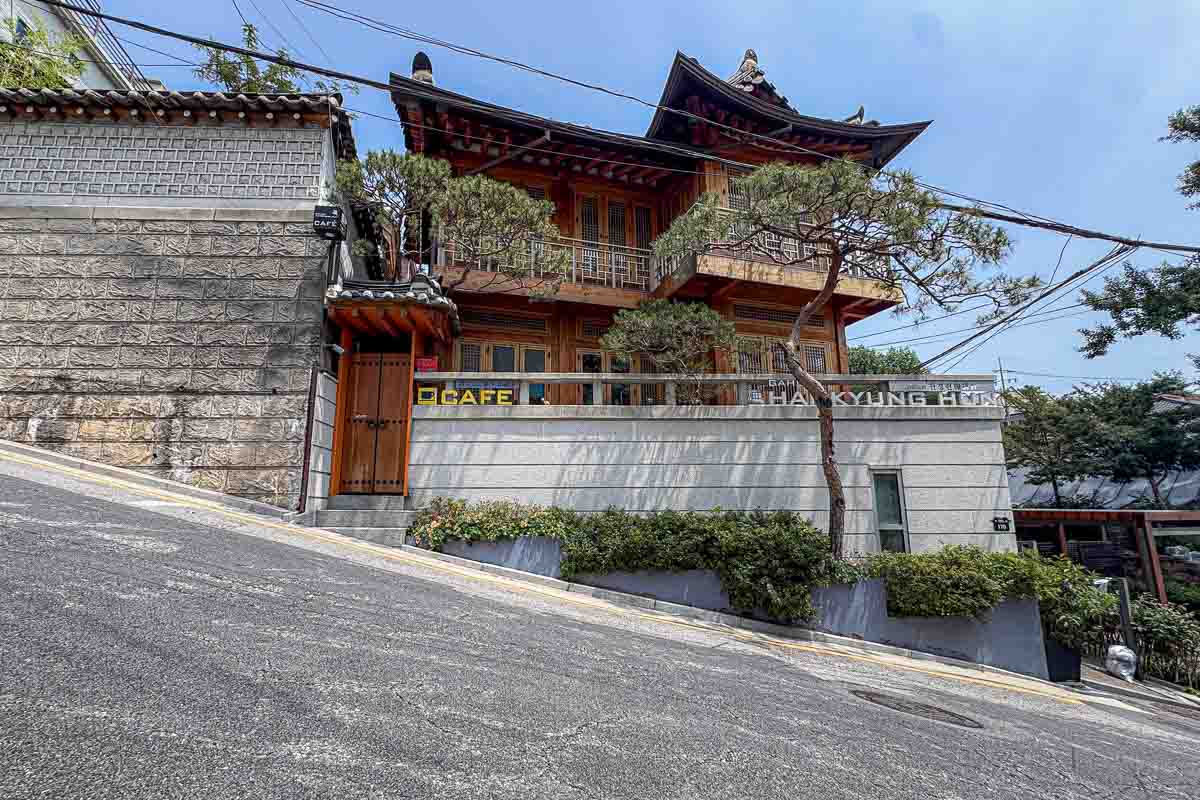
My biggest lesson came when we checked out of our Bukchon hanok and needed a Premier Van to reach Seoul Station for the AREX. Larger vehicles had been easy to request earlier in the trip, so I assumed one would arrive quickly.
Instead, we waited about 45 minutes on a steep hill in the heat, juggling the kids and suitcases. If you need a large vehicle to catch a train or flight, reserve ahead when possible and leave a buffer even with a reservation.
Walking Around Seoul with Kids and Strollers
Walking is a big part of exploring Seoul, even if you use the subway constantly. I found many neighborhoods pleasant and pedestrian-friendly, with wide sidewalks, crosswalks, and interesting shops or cafes to stop at along the way.
Myeongdong and Insadong were especially enjoyable to explore on foot. Still, distances between attractions can be deceptive, and not all of Seoul is flat.
Bukchon, palace grounds and uneven streets
We stayed in a private hanok in Bukchon on our final trip. I expected a punishing uphill walk every day, but much of the route was a manageable gradual incline. The final stretch to the house was very steep, though, and other lanes around the village were harder to push a stroller through.
Some historic palace areas also have gravel and large stone slabs with gaps between them. We occasionally parked the stroller to the side to explore a tricky section on foot.
A carrier can help if you’re visiting with a smaller child. Otherwise, just plan extra time and be selective about which routes you take.

Plan around the places you want to visit
Seoul is large enough that crisscrossing it repeatedly can eat up your day. I recommend clustering attractions by neighborhood and checking the final walking route, not just the nearest subway station.
Where you stay also affects how much walking and commuting you’ll do. If you’re still deciding on a base, my Where to Stay in Seoul with Kids article compares the neighborhoods and the practical tradeoffs for families.
Finding Restaurants, Shops, and Attractions in Seoul
One thing that can make navigating Seoul a little tricky is finding the actual entrance to your destination. Just because Naver Map gets you to the right building doesn’t mean you’ve found the right door.
Seoul makes extensive use of vertical space. Restaurants, cafes, shops, and attractions are often tucked away on upper floors or in basements rather than at street level. Sometimes the entrance is inside a shopping mall, down an exterior staircase, or somewhere you wouldn’t necessarily think to look.
We ran into this several times.
On one occasion, we successfully navigated the subway and walked to a shopping mall where we planned to visit a children’s cafe. But once inside, actually finding the cafe was surprisingly difficult. We went up and down different levels, through a parking garage, and back up again before finally finding it. It was worth the effort, but definitely tested our patience!
Another time, we were searching for a Korean barbecue restaurant in Insadong. The map pin wasn’t quite accurate, and the restaurant was actually upstairs. It took some wandering around to find the correct exterior staircase. We also visited a restaurant tucked below street level that required going down to the basement. These were some of my favorite meals though – definitely worth the effort.

Tips for finding your destination in Seoul
A few things can help when you’re having trouble finding an establishment:
- Check the floor number. Look for B1 or B2 for basement levels and 2F, 3F, etc., for floors above ground.
- Look up and down. Don’t assume an establishment is on the ground floor. Look for signs on upper floors, basement entrances, and exterior staircases.
- Check building directories. Large malls and commercial buildings often have directories listing shops and restaurants by floor.
- Use Naver Map’s indoor maps. Some major malls and transportation hubs have floor-by-floor maps, although not every building supports this feature.
- Match the Korean name. Some signage is only in Korean, making it difficult to match the business on your phone with what you see. Keep the Korean name handy and use a camera translation app if needed.
- Ask for help. If you’re stuck, show an employee or nearby shopkeeper the business name in Korean on your phone.
Don’t be surprised if the last few steps to your destination require some extra detective work. Many places are perfectly straightforward to find, but occasionally you need a little more patience, especially when navigating with kids.
I recommend allowing some extra time when visiting an unfamiliar restaurant, children’s cafe, or attraction inside a large building, particularly if you have a reservation or timed entry.
Planning your own trip with kids?
I share one email a month with real-world family travel strategies, packing tips, and destination breakdowns that make planning easier.
Join below.
Getting From Incheon Airport to Seoul with Kids
For our family, the AREX Express was a reliable way to travel between Incheon International Airport (ICN) and Seoul Station. We used the Express for our airport rail journeys and handled our own luggage, including when our youngest was still a toddler.
But the best airport transportation depends on where you’re staying and whether you want to navigate another transfer after the train.

AREX Express vs. all-stop train
The AREX Express runs nonstop to Seoul Station, with assigned seats and space for luggage. The journey takes about 43 minutes from Terminal 1 and 51 minutes from Terminal 2. Current regular fares are ₩13,000 for adults and ₩9,500 for children ages 6–12. Younger children may ride free without a separate seat, subject to AREX’s infant rules.
The Express requires its own ticket. You can’t simply tap a regular T-money card to board.
The AREX all-stop train is less expensive, accepts regular transit payment, and stops at places including Hongik University and Gongdeok. If your hotel is near one of those stops, the all-stop train may be more convenient than taking the Express to Seoul Station and doubling back.
I liked having assigned seats and a direct journey on the Express, especially with three kids and suitcases.


From Seoul Station to your accommodation
On our first trip in 2023, we took the Express, transferred to the subway, and walked to our Dongdaemun hotel with the kids, stroller, and luggage. It worked, but it was a long arrival sequence.
In early June 2026, we used the Express again and took an Uber from Seoul Station to our apartment in Myeongdong. Avoiding another subway transfer made that last stretch easier.
Compare the full door-to-door journey. The train may be fast, but a complicated final connection can cancel out some of the convenience.
Airport limousine bus or private transfer
Airport limousine buses connect Incheon with many Seoul neighborhoods and offer designated seating and luggage compartments. We haven’t tried them, but a bus that stops close to your hotel may save you a subway transfer or taxi ride. Check the Incheon Airport ground transportation information for your route and schedule.
A prearranged private transfer is another option, particularly for an early departure, several checked bags, or children who require car seats. Confirm passenger capacity, luggage space, and child seats before booking.

Can you have your luggage delivered instead?
Yes, and I wish I’d realized this sooner! Just before leaving Korea, I spotted a Zimcarry counter at Seoul Station advertising luggage storage and delivery with the slogan “Don’t carry! We carry!”
I hadn’t used it, but I looked into it afterward. Zimcarry offers delivery on eligible routes between stations, airports, and accommodations, including services in Seoul and Busan. Goodlugg also offers selected airport-to-hotel and hotel-to-hotel routes, including Seoul-to-Busan luggage forwarding. Luggagent provides another luggage service option between the airport and downtown areas.
Seoul Metro has a separate T-Luggage service for storage and delivery through participating stations.
This is worth comparing if you’re traveling with children and several suitcases, especially when changing cities by train. Coverage, delivery times, accommodation eligibility, and cost vary, so check the exact route in advance. Keep passports, medication, and anything needed that day with you.
We loved using Japan’s Black Cat luggage-delivery service on our family trips, and I’m excited that similar options are becoming available in Korea.

What about Gimpo Airport?
Gimpo International Airport (GMP) is closer to central Seoul and is connected to the subway, Line 9, Line 5, and the AREX all-stop train. Enter your accommodation in Naver Map to compare the easiest route. You don’t need the AREX Express for Gimpo.
Taking the KTX From Seoul with Kids
If you’re combining Seoul with another Korean city, the KTX high-speed train is an easy option to consider. Our Seoul-to-Busan trip in June 2026 took roughly 2.5–3 hours, and we brought three suitcases plus everyone’s backpacks.
Seoul Station was straightforward to navigate with English signs, elevators, and escalators. I’d still arrive early enough to find the platform and board without rushing, particularly when traveling with children and bags.
Reserve tickets ahead if you need a specific departure or seats together. KTX uses separate train tickets, not T-money. You can check schedules and tickets through KORAIL.
For what happens after you arrive, my Getting Around Busan with Kids article covers the metro, buses, T-money, taxis, and practical family logistics in more detail.


Practical Tips for Getting Around Seoul with Kids
These are the things I’d prioritize before and during a family trip:
- Set up Naver Map and your transit cards early. You’ll use them repeatedly, and you don’t want to learn the system while standing in a ticket line with tired kids.
- Check transfers, exits, and the final walk. The fastest train isn’t always the easiest door-to-door journey.
- Choose a stroller you can manage on stairs if needed. A lightweight travel stroller gave us flexibility, although elevators should remain the first choice.
- Group sightseeing geographically. Less time crossing Seoul means more time enjoying the places you came to see.
- Keep a taxi option available, especially for luggage or bad weather. Confirm seats and child restraints before riding.
- Prebook an appropriately sized vehicle for time-sensitive transfers. My Bukchon departure was enough to convince me not to leave that to chance again.
You don’t need to use every type of transportation. Start with the subway, look at what works for that day’s plans, and adapt as you go.
FAQs About Getting Around Seoul with Kids
Do kids ride the Seoul subway for free?
Children under 6 generally ride free with a paying guardian, subject to the accompanying-child limit. Kids ages 6–12 pay a reduced ₩550 standard base fare with an appropriately registered transit card.
Do children need their own T-money cards?
Children qualifying for free travel don’t. Everyone paying a fare should have their own T-money card or single-journey ticket. Register child and youth cards for the right discounts.
Can you take a stroller on the Seoul subway?
Yes. We pushed our compact YOYO onto trains without folding it. Elevators and accessible gates are available at many stations, but some routes require extra walking to find step-free access.
Can a family of five take one taxi in Seoul?
Yes, if the vehicle has at least five passenger seats and suitable restraints. Standard taxis are generally designed for up to four passengers, so check larger categories such as UberXL or Premier Van. Verify luggage space before booking, too.
Do you need a rental car in Seoul with kids?
No. We experienced three family visits without one. The subway, walking, and occasional taxis covered our sightseeing and transfers.

Ready to Explore Seoul with Kids?
With the right apps, a little flexibility and patience, and realistic expectations about distances, it’s entirely possible to explore Seoul with young children without renting a car. I’d do it again, and next time I’d investigate luggage delivery before hauling our bags to the station!
Still putting your trip together? Start with my complete Seoul with Kids guide, explore things to do in Seoul with kids, and use my Where to Stay in Seoul with Kids article to choose a convenient base.